


Arsenal lead the title race, while London City and Chelsea are almost inseparable in the race for a top-three finish.
Arsenal enter the 2026–27 season as the clear favourites in our model, winning the league in 74.7% of 10,000 simulated seasons. Manchester City are the only serious title challenger at 19.6%, with every other club below 3%.
The race for the top three is much closer. London City Lionesses have a 45.5% chance of finishing there, only 0.6 percentage points ahead of Chelsea at 44.9%. At the other end of the table, Birmingham City face the greatest danger, with a 39.3% chance of automatic relegation and a 63.9% chance of finishing in the bottom two.
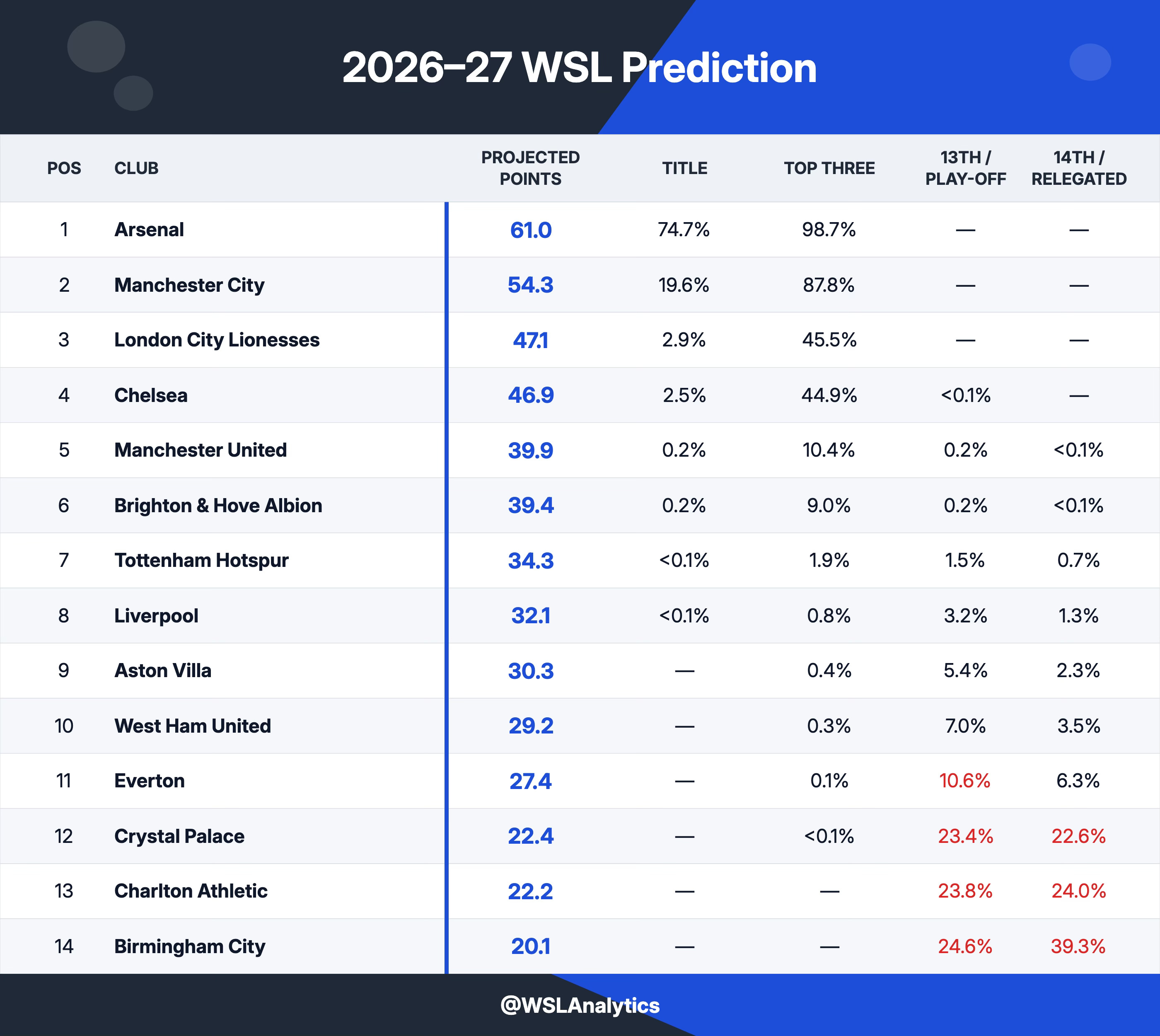
Arsenal and Manchester City form the leading pair, while London City and Chelsea are separated by just 0.2 projected points. The relegation picture remains far less settled.
The title race
Arsenal have finished second in each of the past two seasons, but the gap to the champions has been narrowing. They ended the 2024–25 campaign 12 points behind an unbeaten Chelsea side; last season, they finished only four points behind Manchester City. That progress gives Arsenal a strong base from which to challenge again.
They have also strengthened that base during the summer. Georgia Stanway, Ona Batlle, Selina Cerci and Géraldine Reuteler bring quality in several areas of the pitch, adding greater control, creativity and depth to an already balanced squad. Our model consequently makes Arsenal the clear favourites, giving them a 74.7% chance of winning the title.
Manchester City cannot be discounted. They are the defending champions and retain one of the strongest squads in the league. Their summer business, however, has not improved their position as decisively as Arsenal’s. The loss of Kerolin Nicoli—who contributed nine goals and five assists in the league last season—is particularly significant. City remain the only serious challenger at 19.6%, but the model believes Arsenal begin the season in the stronger position.
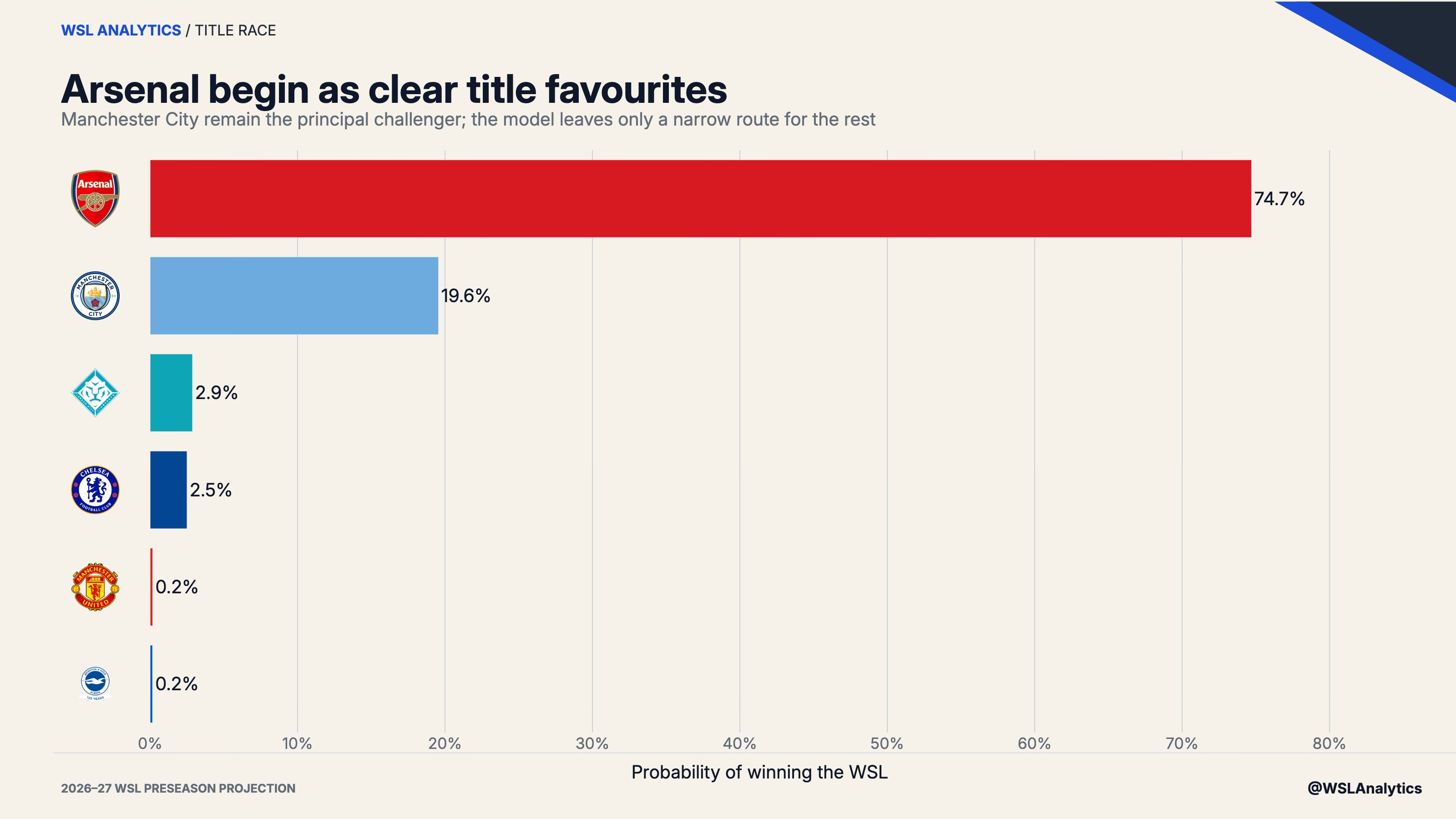
The race for the top three
Arsenal and Manchester City are likely to take two of the top-three places, leaving London City and Chelsea in a remarkably close contest for the likely remaining spot. London City finish in the top three in 45.5% of our simulations, only narrowly ahead of Chelsea at 44.9%.
London City have transformed their squad this summer. Alexia Putellas and Kadidiatou Diani give them greater quality in attack, while María León and Mary Earps strengthen the team defensively. Nicole Anyomi and Rosa Kafaji add further first-team options.
Chelsea still have plenty of quality, and Giulia Dragoni is an exciting addition. But the departures of Millie Bright, Guro Reiten, Sam Kerr, Johanna Rytting Kaneryd and Niamh Charles leave significant gaps in experience and leadership. That uncertainty is why the model finds so little between Chelsea and London City.
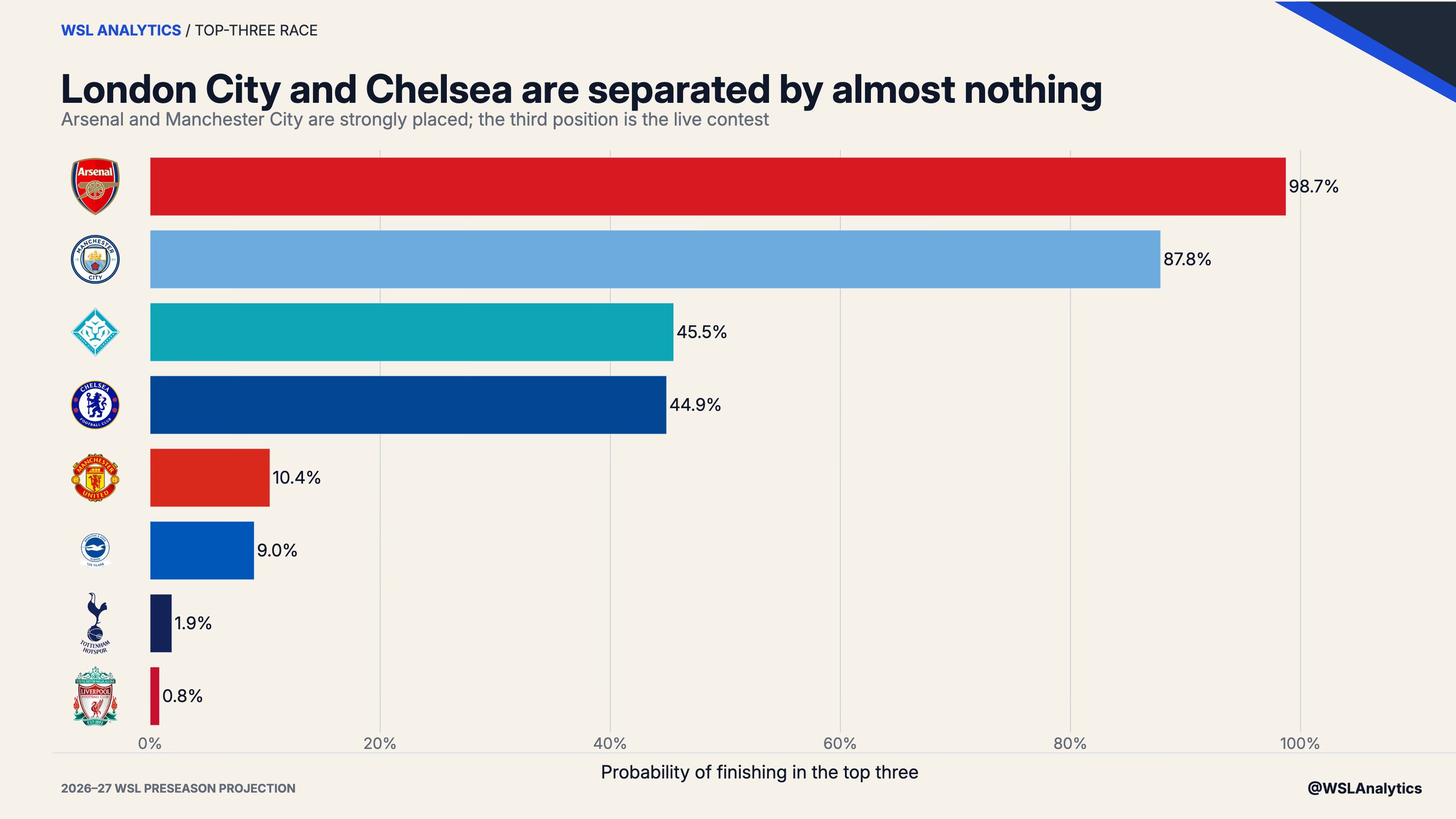
Arsenal and City are strongly placed. London City and Chelsea are separated by only 0.6 percentage points, while United and Brighton lead the outside chase.
Looking beyond the headline probabilities shows two distinct groups among the leading four. Arsenal and Manchester City dominate the first two positions, although Arsenal are much more likely to finish first. Behind them, London City and Chelsea have almost identical finishing profiles, with both most commonly finishing third or fourth.
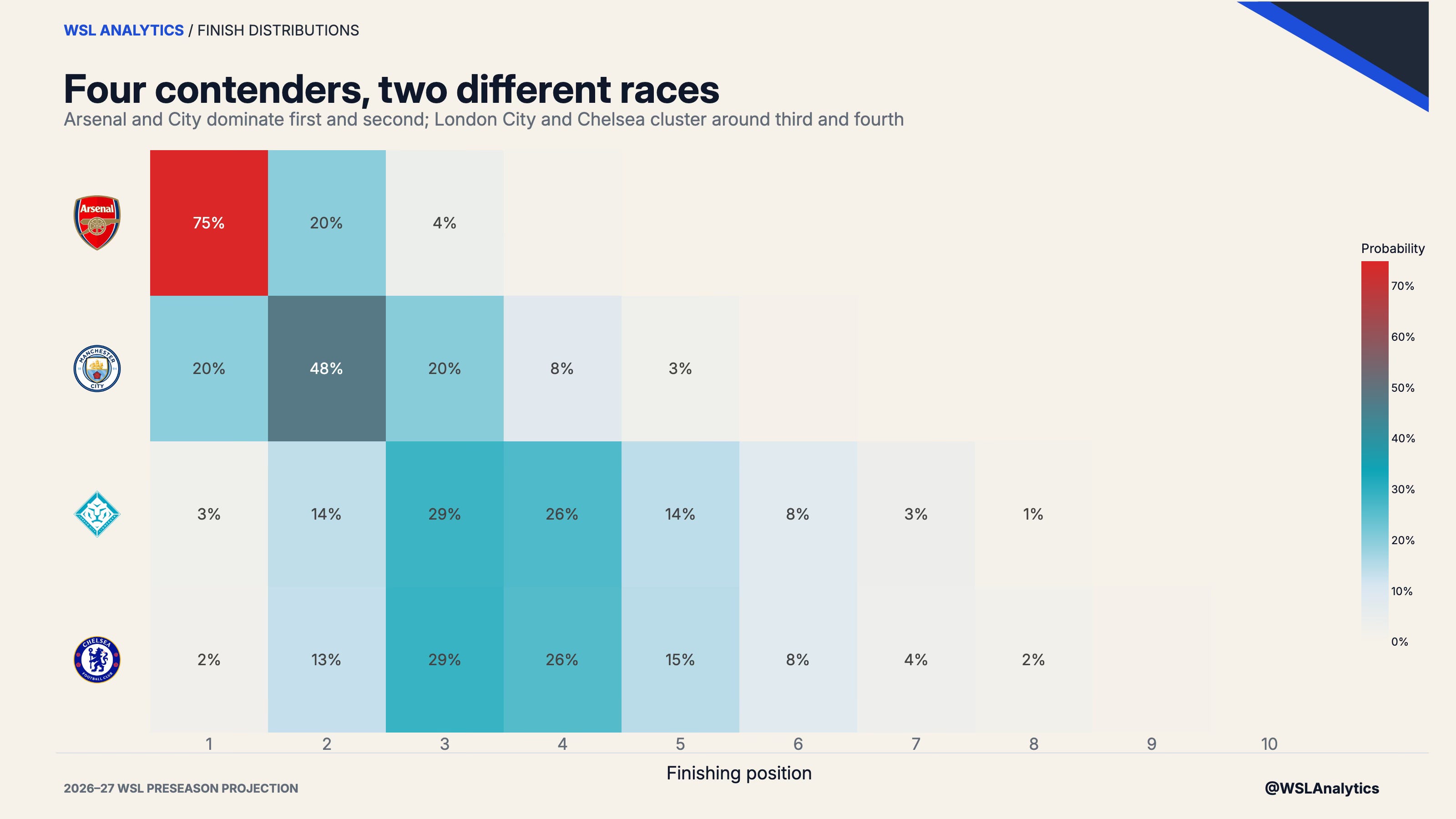
Arsenal and Manchester City are concentrated around first and second. London City and Chelsea share almost identical distributions centred on third and fourth.
The fight to stay up
The three promoted clubs begin the season at the centre of the relegation fight, with Birmingham facing the greatest danger. They finish bottom in 39.3% of our simulations and occupy the play-off place in a further 24.6%. That gives them a 63.9% chance of ending the season in the bottom two.
Charlton and Crystal Palace are much harder to separate. Charlton have a 24.0% chance of automatic relegation, compared with 22.6% for Palace, and their chances of entering the play-off are almost identical. Everton are the next most exposed club, but the model places a considerable gap between them and the three promoted sides.
None of those teams are doomed before a ball is kicked. Birmingham have added players with top-flight experience, while Charlton and Palace have also strengthened during the summer. The challenge for all three will be adapting quickly enough to the higher level.
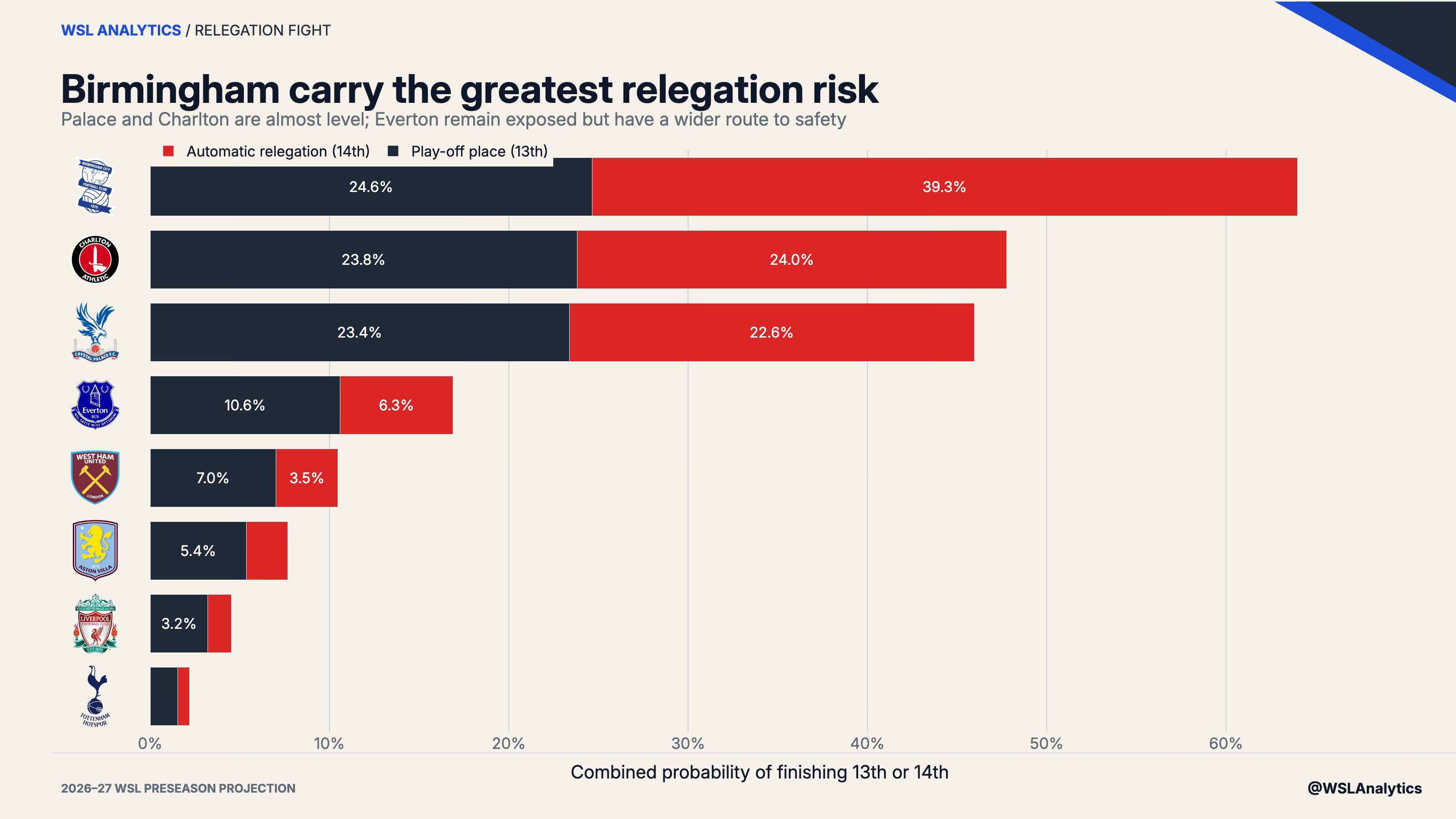
Birmingham face the greatest danger, while Charlton and Crystal Palace are almost inseparable. Everton are the most exposed of the established WSL clubs.
How does the model work?
Our projections begin with each club’s attacking and defensive strength from the prior season. Promoted clubs are treated separately because performances in the WSL2 cannot be compared directly with performances against WSL opposition.
We then adjusted each team’s starting strength to account for material summer arrivals and departures.
For every fixture, the model estimates the goals each team might score, while accounting for home advantage. It then generates a possible result and repeats the complete 182-match season 10,000 times.
The percentages in this article represent how frequently each league outcome occurred across those simulated seasons.
All prediction data is based on WSLAnalytics simulations run on 25 August 2026. Transfers and other material model inputs were checked through the same cutoff.