

The Women’s Super League is bigger this season.
Fourteen clubs are competing in the division for the first time. Every match is available to watch live, and more teams are taking games into their clubs’ main stadiums.
But the opening attendance figures point to a more complicated picture.
Across all 14 clubs’ first home league matches, 64,341 people came through the gates—an average of 4,596 and a median of 2,686.
The WSL may have a wider footprint this season, but the typical opening-home crowd was smaller than in any of the previous four campaigns.
First, what are we measuring?
This is not simply a total of the fixtures played in Matchweek 1.
Some clubs began the season away from home, so comparing only the first round would include some clubs and exclude others. Instead, we take each club’s first played home league match and give every team one observation.
For most clubs, that match came in Matchweek 1 or 2.
The same method has been applied to the previous four seasons: for every club, we use the attendance from their first home league match, regardless of the matchweek in which it was played.
The five-season picture
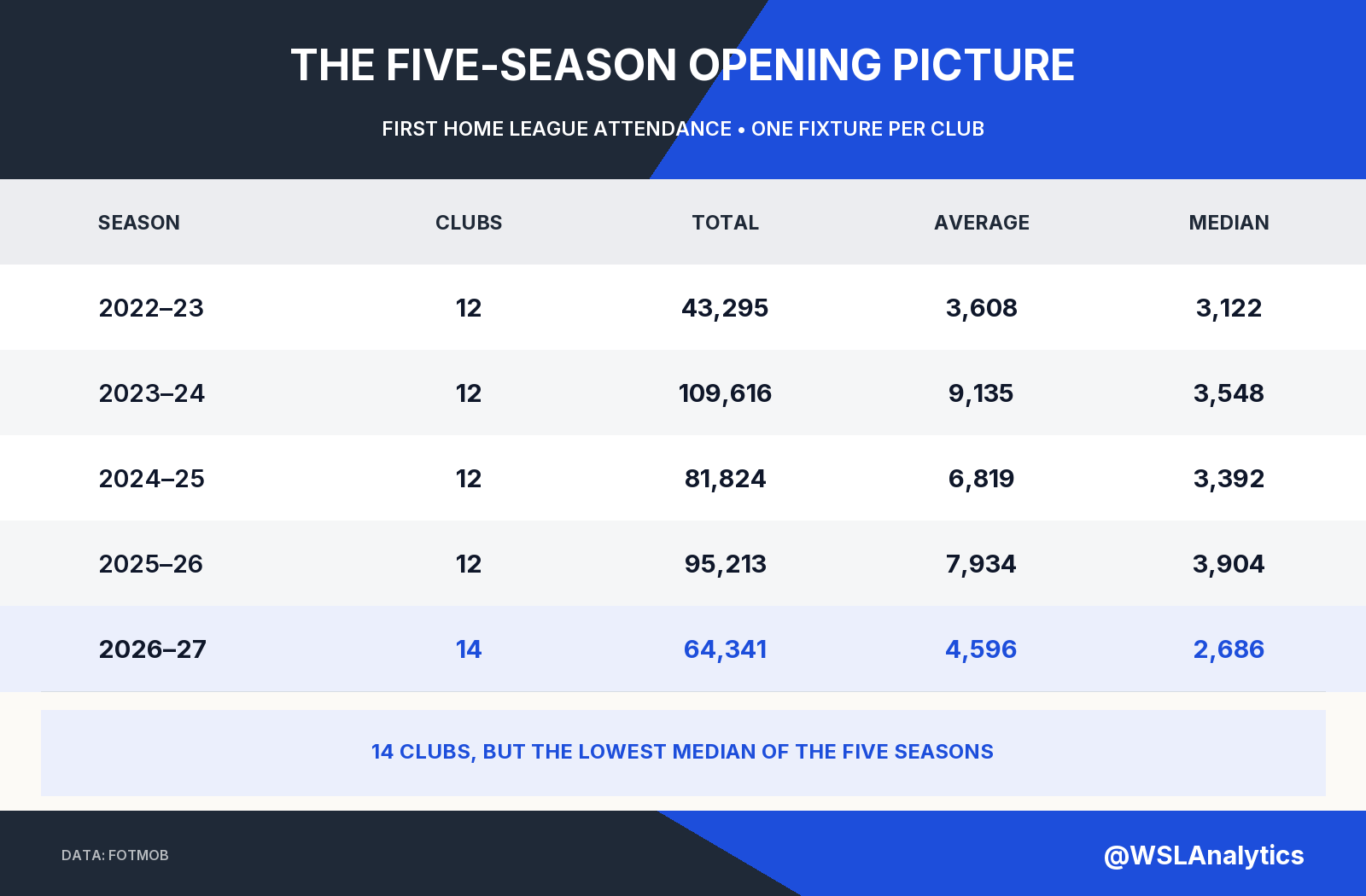
Despite the league expanding from 12 to 14 clubs, this season’s total remains below 2023–24, 2024–25 and 2025–26. Compared with last season, the total fell by 32.4% and the average by 42.1%. The average is the second-lowest of the five seasons studied, above only the disrupted 2022–23 opening-home cycle.
The median delivers an even clearer finding. At 2,686, it is the lowest in the five-season comparison and 31.2% below last season’s 3,904.
The typical club’s opening attendance has fallen.
Why the median matters more than the average
The average is useful, but WSL attendance is increasingly shaped by a small number of very large crowds.
Arsenal’s 23,900 against Crystal Palace accounts for 37.1% of the opening-home total.
Arsenal, Chelsea and London City Lionesses—the three highest crowds—account for 57.8% between them.
Without Arsenal’s Emirates crowd, the other 13 clubs averaged only 3,111.
This concentration is not new.
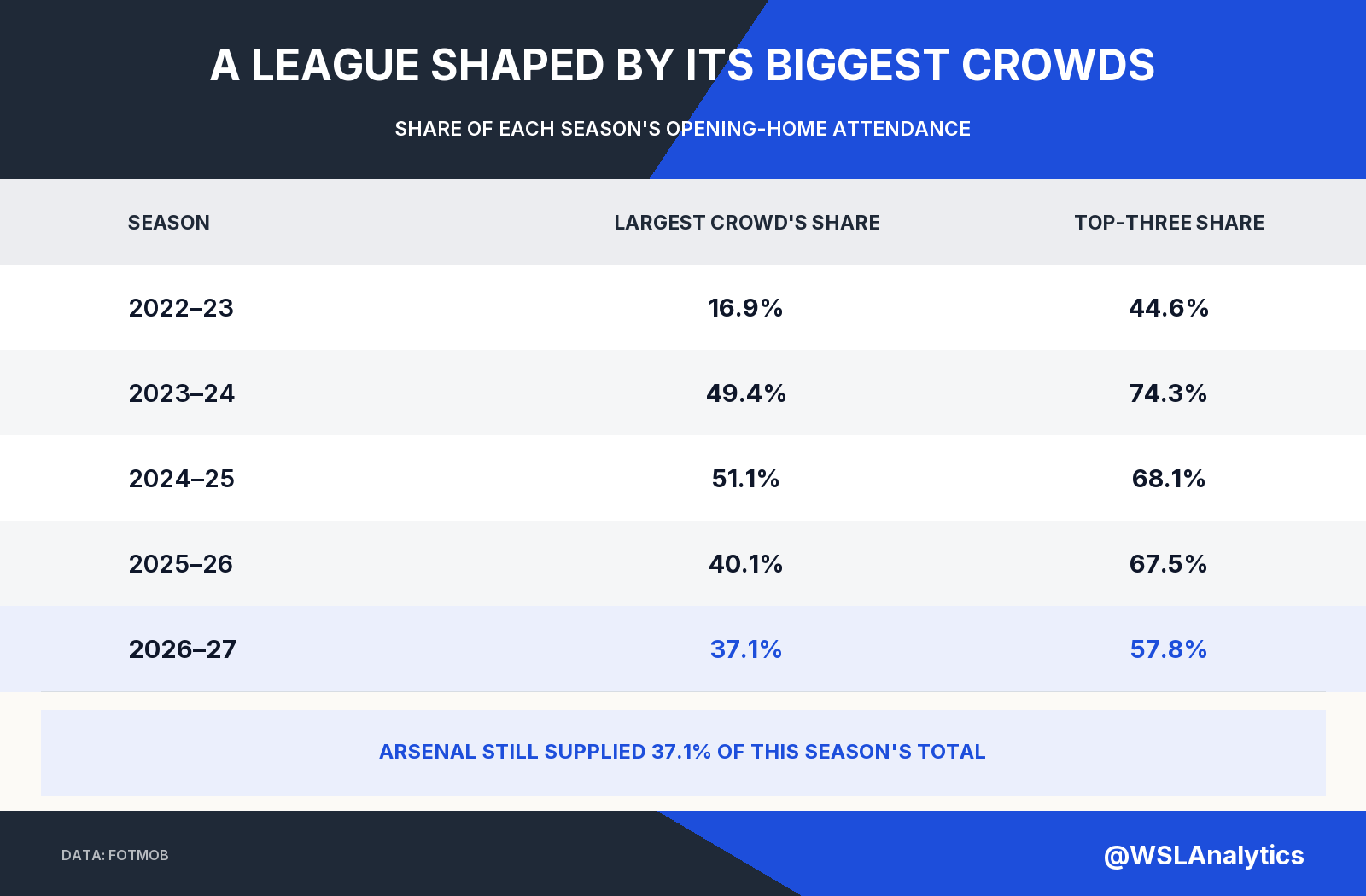
In 2023–24, Arsenal’s record 54,115 crowd against Liverpool represented almost half of the entire opening-home total by itself.
That is why the average climbed to 9,135 while the median was only 3,548.
The mean tells us about the league’s total reach. The median tells us what the experience looked like for the typical club.
This season, those two pictures are again very different.
The decline is real—but it is not evenly distributed
Eleven returning clubs have opening-home figures in both 2025–26 and 2026–27.
Their combined attendance fell from 93,393 to 59,511, a decline of 36.3%.
At first glance, that looks like a broad league-wide contraction. A closer look reveals something more specific.
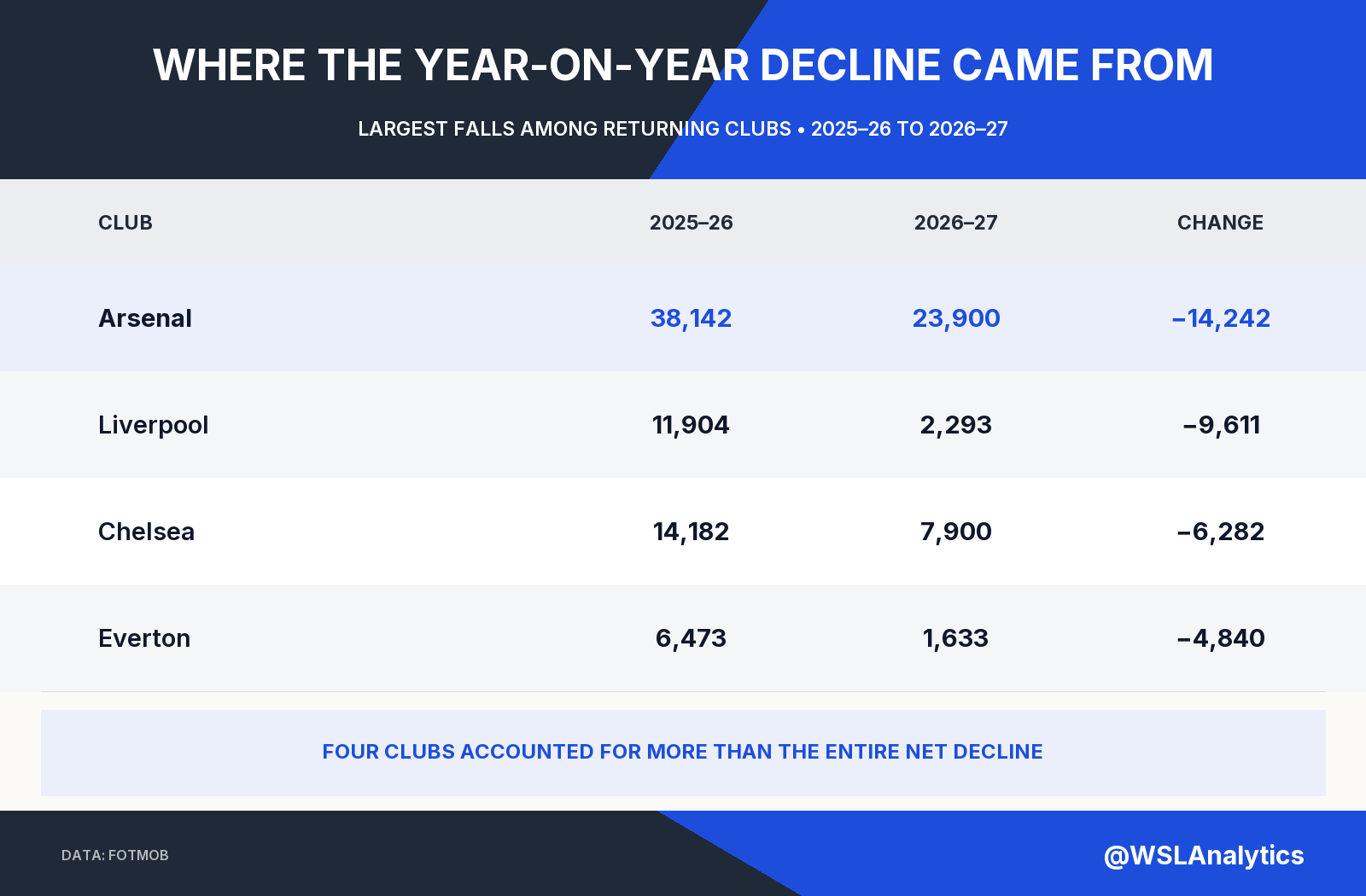
The combined attendance of Arsenal, Liverpool, Chelsea and Everton fell by 34,975.
The total decline across all 11 comparable clubs was 33,882.
In other words, Arsenal, Liverpool, Chelsea and Everton account for more than the entire net decline. The other seven clubs increased their combined attendance by 1,093, or 4.8%.
So the opening figures do not show every WSL club moving backwards at once.
They show a sharp decline concentrated in a small number of fixtures that carried last season’s headline total.
The fixtures changed—and so did the venues
The largest year-on-year falls require context.
Liverpool opened last season with a Merseyside derby against Everton at Anfield and drew 11,904. This season, their first home match was against Tottenham at St Helens Stadium and attracted 2,293.
That is not simply a like-for-like attendance collapse. It is a different opponent in a different venue, with a very different ceiling.
Chelsea remained at Stamford Bridge, but Manchester City were replaced by Aston Villa as the opening visitors. Attendance fell from 14,182 to 7,900.
Arsenal also remained in the same venue, but their opening opponent changed from newly promoted London City Lionesses to Crystal Palace. Their crowd fell from 38,142 to 23,900.
Everton stayed at Goodison Park, but Tottenham were replaced by Charlton. Attendance fell from 6,473 to 1,633.
The WSL therefore began this season without some of the combinations that lifted last year’s opening figures: no Merseyside derby at Anfield, no Chelsea–Manchester City game at Stamford Bridge and a less commercially powerful fixture at the Emirates.
That explains part of the decline.
It does not explain everything.
A capacity problem as well as an attendance problem
Absolute attendance tells us how many people were reached. Occupancy tells us how effectively the selected venue was filled.
Across all 14 opening-home fixtures:
total attendance was 64,341;
combined nominal capacity was 302,909;
capacity-weighted occupancy was 21.2%;
the median club occupancy was 22.5%;
seven clubs filled less than 20% of their venue;
four clubs filled less than 10%.
Those four were:
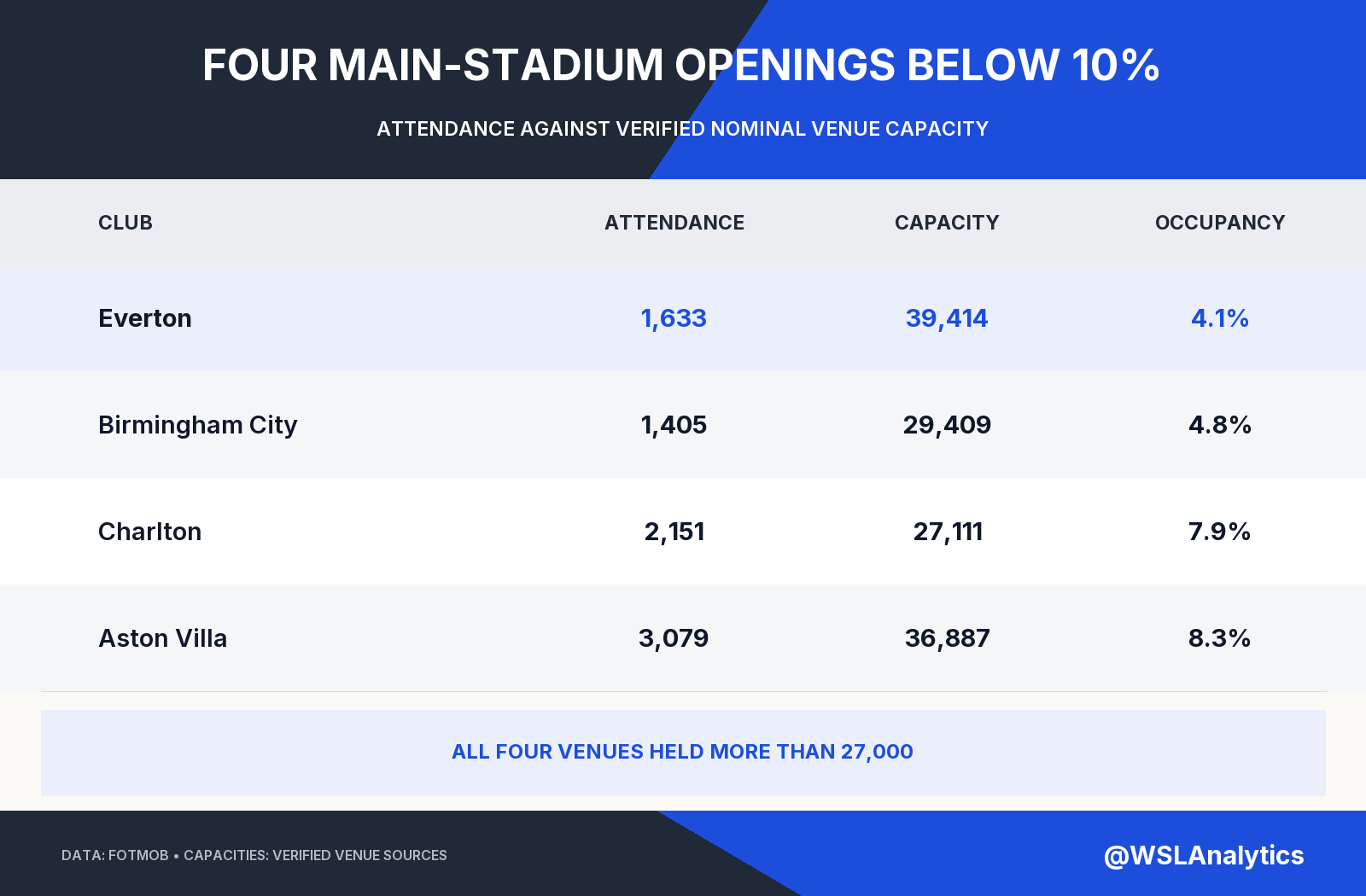
All four played in venues with capacities above 27,000.
That creates a strategic tension.
Using a larger stadium can increase visibility, improve accessibility and give a club room to grow. But when fewer than one seat in ten is occupied, the result can also be a visibly sparse stadium and a weaker matchday atmosphere.
The answer is not necessarily to retreat permanently into smaller grounds. It is to build sufficient demand around the main-stadium fixtures to justify the move.
Club by club
London City provide the clearest success story
London City’s opening crowd is the strongest positive signal because it offers a rare genuine like-for-like comparison.
They hosted Manchester United at the Copperjax Community Stadium in both seasons.
2025–26: 2,800
2026–27: 5,402
Increase: 2,602
Growth: 92.9%
The club described this season’s fixture as sold out and its biggest-ever home match at the venue.
The nominal-capacity calculation produces an occupancy of 88.6%, illustrating an important limitation of stadium-capacity data: segregation, broadcast positions and unavailable sections can reduce the number of tickets that can actually be sold.
But whichever denominator is used, the direction is unmistakable.
Same opponent. Same venue. Nearly twice the crowd.
That is the clearest evidence of genuine audience growth in this year’s opening figures.
Brighton are also moving in the right direction
Brighton’s first-home crowd at Broadfield Stadium has increased for three consecutive seasons:
2023–24: 1,126
2024–25: 2,125
2025–26: 2,219
2026–27: 4,104
Having Arsenal as the visiting team clearly increased the fixture’s drawing power. It should not be treated as pure organic growth.
Even with that qualification, a 66.9% nominal occupancy rate and the continuation of the upward sequence make Brighton one of the more encouraging opening stories.
Tottenham are stable—but not growing
Tottenham offer another useful comparison because they opened at home to West Ham at the same venue in consecutive seasons.
2025–26: 1,735
2026–27: 1,675
Change: −60
Their last four opening-home crowds have been 1,605, 1,778, 1,735 and 1,675.
That consistency shows Tottenham have a dependable base. It also shows that the base has barely expanded.
For a team now producing some of the league’s most exciting attacking football, converting on-field interest into attendance growth is an obvious opportunity.
Arsenal still lead—but their opening draw is shrinking
Arsenal remain comfortably ahead of every other club. Their 23,900 crowd was more than three times Chelsea’s second-highest figure.
But their last four Emirates openers have moved in one direction:
2023–24: 54,115 against Liverpool
2024–25: 41,818 against Manchester City
2025–26: 38,142 against London City Lionesses
2026–27: 23,900 against Crystal Palace
That is a fall of 55.8% from the 2023–24 record opener.
The opponent changed each year, and the 54,115 crowd arrived when a major WSL fixture at the Emirates still carried more novelty. Arsenal have since made the stadium their permanent league home, giving supporters many more matches from which to choose.
That context matters. So does the trend.
Arsenal are still operating on a completely different scale from the rest of the league, but even the league’s strongest attendance engine cannot be treated as automatic.
A difficult start for the promoted clubs
The three promoted clubs drew a combined 4,830 to their first home fixtures:
Charlton: 2,151
Birmingham City: 1,405
Crystal Palace: 1,274
That is an average of 1,610.
Their venue stories were different.
Crystal Palace’s 1,274 filled 25.4% of the smaller VBS Community Stadium. Charlton’s crowd represented only 7.9% of The Valley, while Birmingham filled 4.8% of St Andrew’s.
These clubs are not only trying to establish themselves competitively. They are trying to build top-flight audiences while playing in venues whose scale can make modest crowds look even smaller.
How those numbers develop across their first five home matches will tell us far more than one opener—but the starting point is low.
Manchester City recorded one of the strongest occupancy rates
Manchester City’s 3,560 against Birmingham City was the sixth-largest opening crowd in the league. In the context of the Joie Stadium, however, it was one of the stronger attendance performances.
The crowd filled 55.2% of the stadium’s verified nominal capacity—the third-highest occupancy rate among the 14 clubs.
It was also 424 higher than City’s 3,136 opener at the same venue last season, an increase of 13.5%, although the opponent changed from Brighton to Birmingham City.
City were some distance from the league’s largest opening crowds in absolute terms, but they filled their selected venue far more effectively than most clubs. It is another example of why attendance and occupancy need to be considered together.
The real opening picture
There are two stories in these numbers.
The first is reach. The WSL now has 14 clubs, more matches and more opportunities to bring elite women’s football to supporters around the country.
The second is depth. Outside a small number of major fixtures, too many clubs are still drawing modest crowds—sometimes into very large stadiums.
London City demonstrate what genuine growth can look like. Brighton’s trajectory is encouraging. Manchester United and Tottenham have retained a stable base.
But the league-wide median has fallen, four main-stadium fixtures recorded occupancy rates below 10% and the aggregate remains dependent on Arsenal.
Should the league be worried? Probably not yet—this is only one home match per club, and the fixture, opponent and venue context matters. But the early warning signs are difficult to ignore.
Expansion has made the WSL wider. The next challenge is to make its audience deeper.