


Arsenal did not need another headline name. They needed a midfielder who raises the level of the team, carries responsibility across a full season and gives Renée Slegers better options when the schedule tightens. Georgia Stanway does all three.
A signing built for a title race
On 3 July 2026, Arsenal announced the signing of 27-year-old Georgia Stanway on a free transfer following the expiry of her Bayern Munich contract. She will wear number 4 and returns to the Women’s Super League four years after leaving Manchester City, not as the same utility midfielder, but as a four-time Bundesliga champion shaped by central responsibility at Bayern.
This is not your typical speculative signing or a bet on potential. Arsenal have recruited a player in her prime with extensive WSL experience, 128 Bayern appearances, four consecutive Bundesliga titles and two European Championships with England. She has played in title races, major knockout matches and demanding international tournaments. She knows the league and arrives with a broader midfield education from Germany.
The timing is also key. Arsenal finished four points behind Manchester City last season. They had an elite squad that was good enough to challenge for the title, but they spent too much of the season recovering from an uneven start and too much of the run-in carrying a heavier schedule than their main rival.
Stanway does not solve every problem behind that four-point gap. She does, however, address one of the biggest: Arsenal needed more high-level midfield capacity without sacrificing intensity, experience or attacking contribution. They did not have it last season. When either Mariona Caldentey or Kim Little was removed from central midfield, Arsenal’s alternatives could not reproduce the same control. That drop-off was not title-winning depth.
Arsenal lost ground before the run-in
Arsenal finished second on 51 points with a +39 goal difference. Manchester City won the title with 55. The final table made the race look close, but in reality Arsenal spent much of the season chasing.
They won their opening two league matches and then took only two points from the next three. By Christmas, after 11 games, they were eight points behind. Arsenal recovered strongly, but a title-winning side cannot allow that deficit to develop in the first place, or spend half a season repairing avoidable damage.
The schedule made that task even harder. Arsenal competed across five competitions. Before their final league match, their players had averaged 481 more minutes than Manchester City’s, and Arsenal had played ten more games. During the final stretch, Arsenal played six times in 18 days while City played twice.
That workload exposed the difference between having talented midfielders and having enough midfield power for an entire campaign. Arsenal needed to rotate without losing control. They needed experienced players ready to enter major matches without the structure changing around them. They needed more than one route through midfield.
Stanway gives them that.
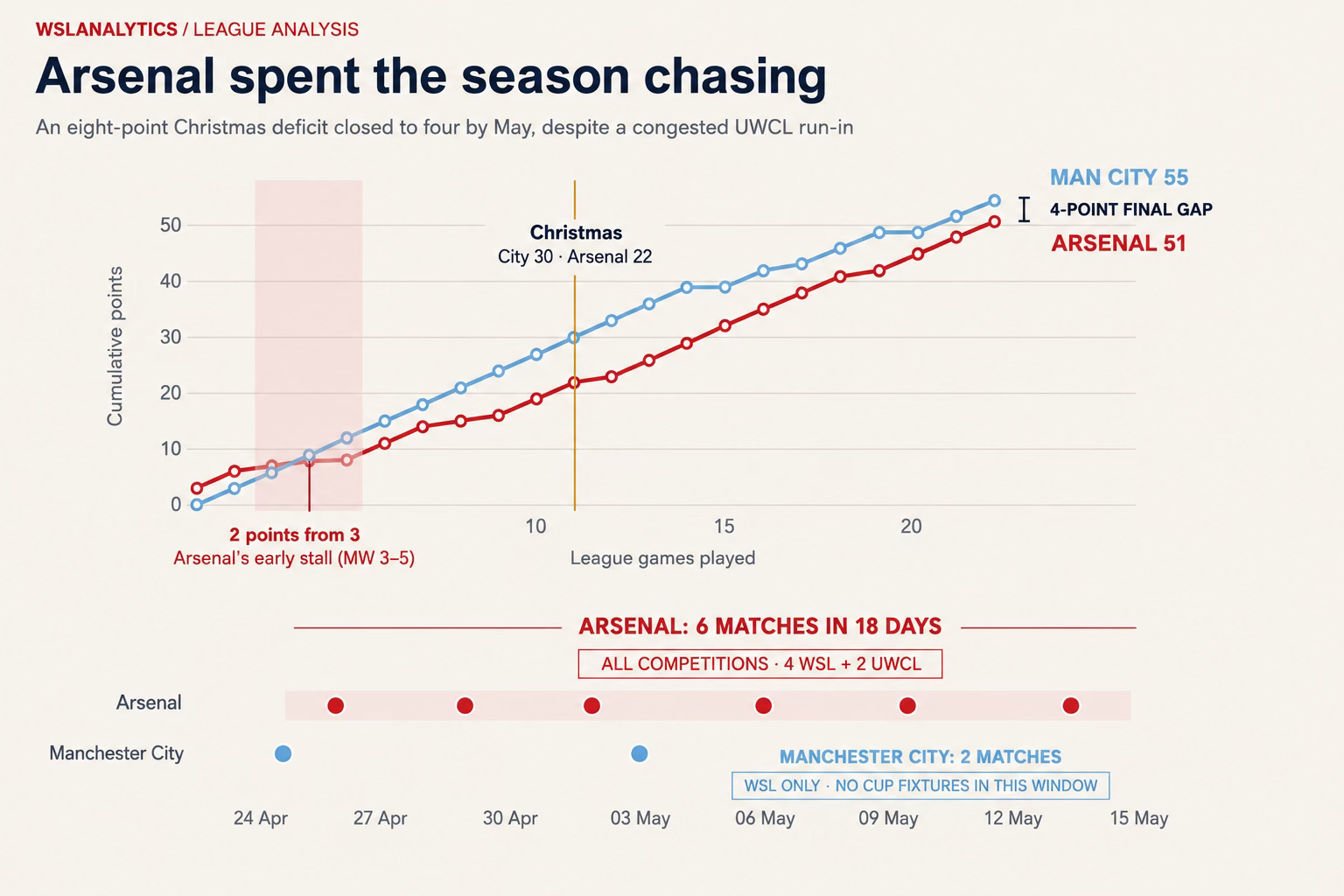
Arsenal recovered from an eight-point Christmas deficit to finish four points behind Manchester City, while carrying six matches across all competitions in 18 days during the run-in.
Stanway returns at the peak of her career
Stanway left Manchester City in 2022 after seven seasons, 186 appearances and 67 goals. She moved to Bayern, won the Bundesliga in each of her four seasons and added two German Cups and two German Super Cups. Her Bayern spell produced 128 appearances and 32 goals.
The medals matter, but the development behind them matters more. At Manchester City, Stanway’s versatility sometimes pulled her between central, advanced and wider roles. Bayern made her a central figure. She became responsible for progressing possession, competing through midfield, arriving around the penalty area and setting the tempo of the team.
The passing data makes that development explicit. Since the start of 2022–23, Stanway completed 2,919 passes in the opposition half in the Bundesliga, 754 more than any other player, and 1,495 passes that ended in the final third, 418 clear of the next player. In the Champions League over the same period, she ranked fifth for completed passes in the opposition half and sixth for passes into the final third.
Those are not the numbers of a midfielder who only arrives to finish attacks. They show a player who can start from the base, take responsibility for circulation and move Arsenal into advanced territory.
Her 2025–26 season shows the level at which she returns. Stanway played 1,841 Bundesliga minutes across 25 appearances, her second-highest league total at Bayern and just 22 minutes below her 2023–24 peak. Across the Bundesliga, Champions League, German Cup and Supercup, she played 2,997 minutes.
Stanway also delivered in the final third. She scored seven Bundesliga goals and registered 11 assists in 2025–26, the second-highest assist total in the league according to the DFB. That gave her 18 direct goal contributions. That is an elite attacking production from central midfield.
This is the player Arsenal have signed, not simply the familiar England international who used to play for Manchester City, but a midfielder returning from four years of increased responsibility.
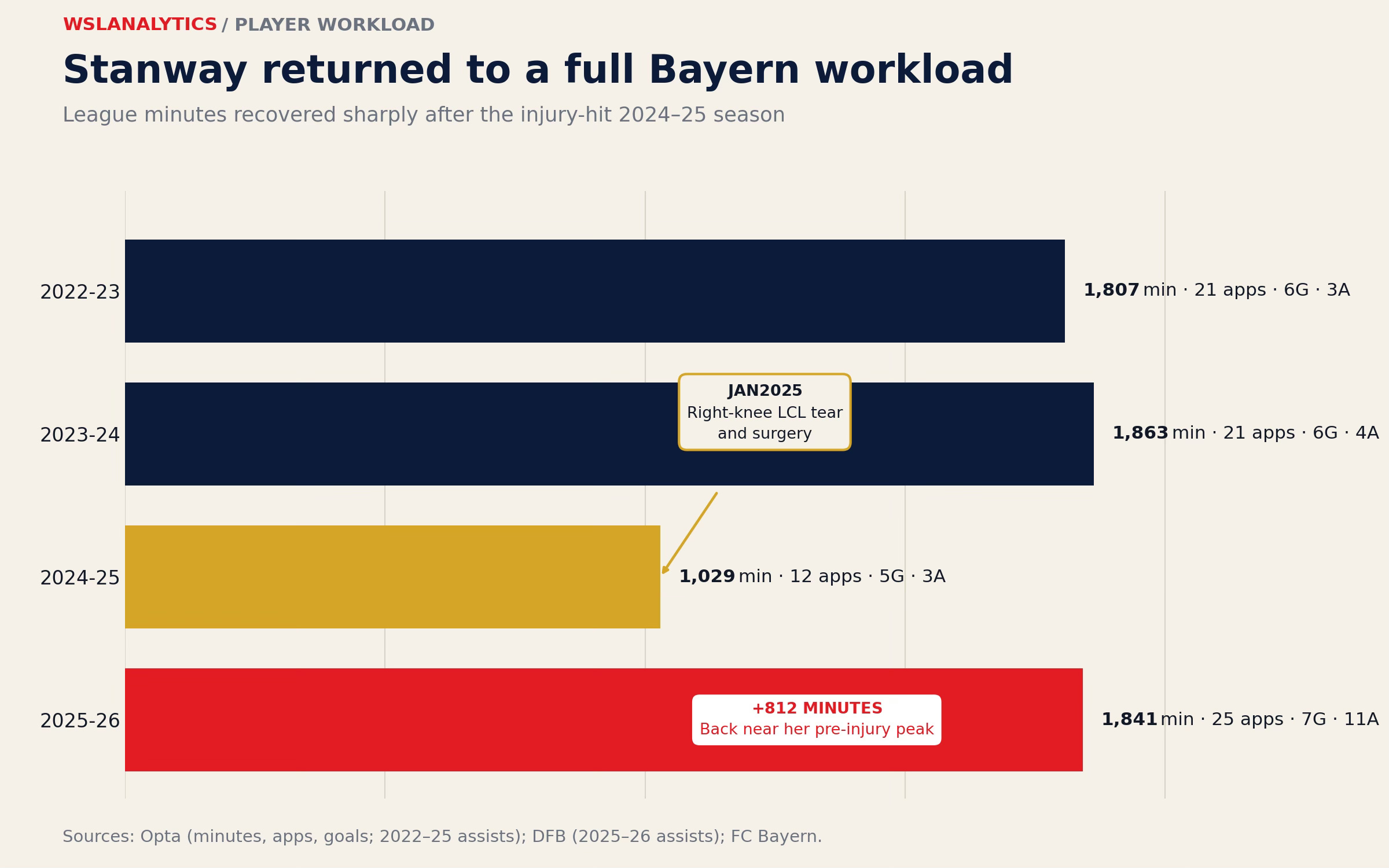
Stanway returned from the 2024–25 knee injury to play 1,841 Bundesliga minutes, just 22 short of her Bayern high.
Stanway can control Arsenal’s midfield from the base or as an eight
Stanway is not a passive holding midfielder. Bayern used her from the base, but her value there was progressive: she received early, played through pressure and repeatedly moved possession into the opposition half and final third.
This gives Arsenal two credible starting points. She can operate as the deeper controller in a midfield with enough mobility and defensive discipline around her, or as the aggressive eight beside a more positionally fixed holder. In both roles, the purpose is the same: move the team forward without surrendering control when possession changes.
Her presence also changes the demands placed on Arsenal’s other midfielders, particularly Mariona Caldentey. Caldentey no longer has to solve every progression problem from central areas. Arsenal can push her higher without stripping the midfield of experience, or use her deeper without making that the team’s only route through pressure.
Géraldine Reuteler’s arrival widens those choices further. She has played at the base, as an eight, in advanced midfield and across the front line. Arsenal have added two players capable of changing both the shape and distribution of responsibility in the central third. Slegers can now select combinations to suit the opponent instead of allowing fatigue or injury to dictate them.
In a nutshell, there are three practical uses for Stanway:
1. Use her as a progressive base midfielder who takes responsibility for moving Arsenal up the pitch.
2. Start her as the two-way eight in a pairing with a more positionally conservative midfielder.
3. Rotate her across central roles during congested periods without lowering the level of the midfield.
Those are not three competing identities. They are the point of the signing. Arsenal have bought one player who strengthens the first-choice team and the rotation behind it.
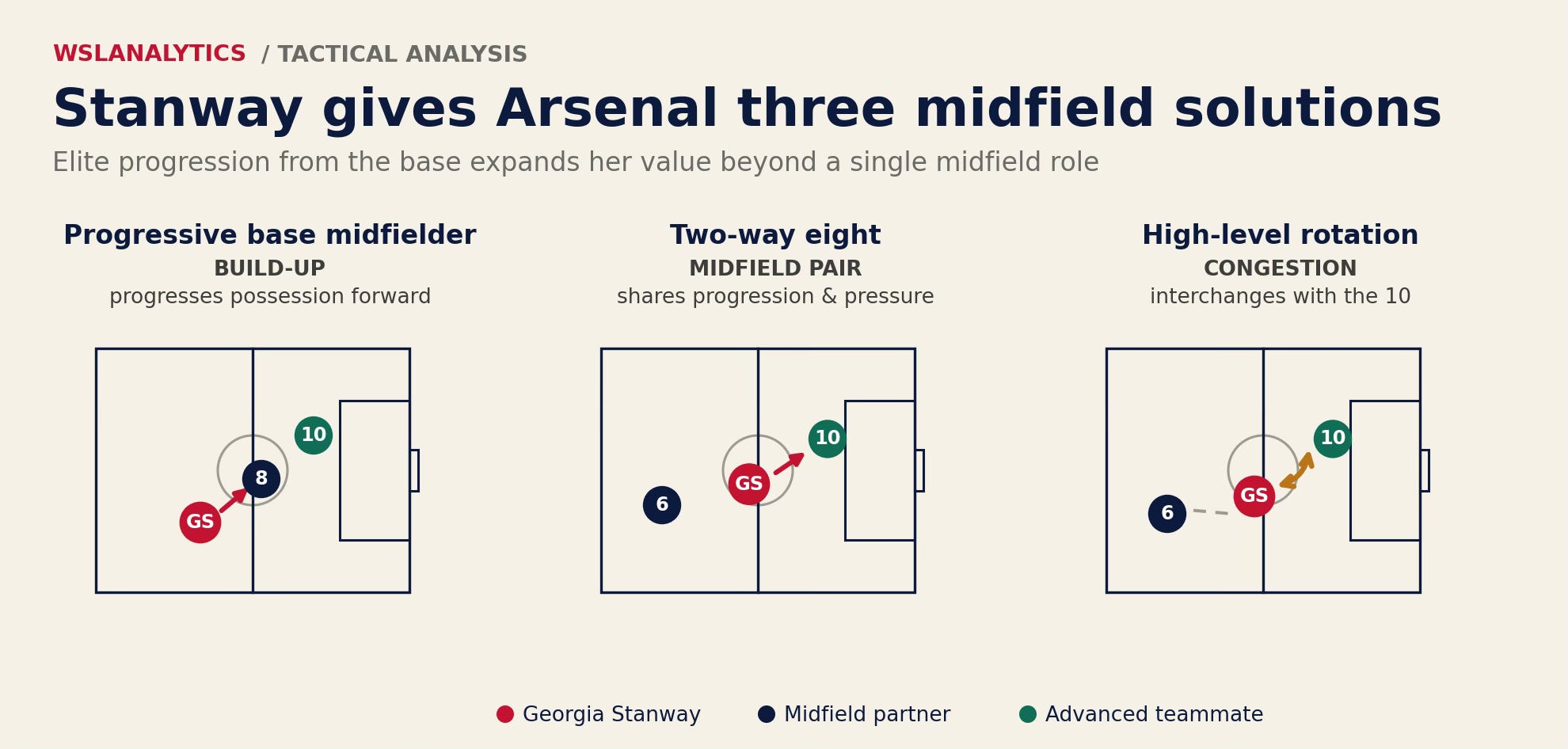
Stanway can progress Arsenal from the base, play as a two-way eight or preserve the midfield’s level through rotation. These are WSLAnalytics tactical pathways, not confirmed Arsenal formations.
Stanway gives Arsenal more control, not just more output
Seven goals and eleven assists make an easy headline, but Stanway’s larger value is structural.
Arsenal’s challenge is not simply to add more final actions. It is to maintain the same authority across different game states and different weeks of the season. A title-winning midfield has to control open matches, break down compact opponents, survive transitions and keep functioning when the calendar removes recovery time.
Stanway improves that structure because she can contribute without the team being built around one narrow skill. She can receive deeper, play through pressure, attack space and compete when the ball turns over. She gives Arsenal another midfielder who expects responsibility rather than protection.
That should make rotation more credible. Resting one senior midfielder no longer has to mean changing the personality of the team. Moving Mariona forward no longer has to remove proven progression from central areas. Chasing a goal no longer has to mean replacing midfield control with another attacker.
This is how a free transfer can alter a title race without being framed as a saviour. Stanway expands the number of strong decisions available to Slegers.
What can previous WSL transfers tell us?
Keira Walsh’s move from Barcelona to Chelsea is the obvious recent comparison: an established England midfielder returning from an elite continental club to join an immediate WSL contender. The roles are different though, Walsh is a distribution-led holding midfielder, while Stanway offers more running and final-third involvement, but both transfers reduce adaptation risk and add proven authority to the centre of the pitch.
Mariona’s move from Barcelona to Arsenal offers the more useful internal lesson. Arsenal did not preserve one fixed role for her; they used her intelligence in different areas according to the team’s needs. Stanway gives Slegers the same kind of flexibility from a different midfield profile.
The lesson is not that either player predicts Stanway’s numbers. It is that elite experience becomes most valuable when the manager uses it to solve several problems, not just to fill one position on a team sheet.
What Arsenal must get right
The transfer is excellent. The implementation still matters.
First, Arsenal must define the protection around Stanway. Playing from the base does not make her a one-player defensive platform, and using her as an eight creates space behind her advances. Pairing her with another aggressive midfielder without clear positional discipline would create the same transition problems the signing is supposed to reduce.
Second, Slegers must use the depth. Stanway’s arrival loses part of its value if Arsenal simply replace one overworked midfielder with another. Her minutes should allow the team to rotate earlier, not merely survive later.
Third, Arsenal must define the hierarchy without limiting the flexibility. Stanway is good enough to start major matches, but the midfield should not depend on one fixed partnership. The advantage lies in having several strong combinations for different opponents and different stages of the season.
Finally, the team must start faster. Yes, faster. Stanway strengthens the conditions around the title challenge, but Arsenal still have to turn early control into wins. Four points separated them from Manchester City; the decisive damage was the eight-point deficit they had already allowed to develop by Christmas.
Verdict
Georgia Stanway is exactly the type of midfielder Arsenal needed.
She arrives on a free transfer, in her prime, after returning to a near-career-high league workload at Bayern. She brings WSL knowledge, four years of title-winning experience in Germany, recent attacking output and the ability to take responsibility in several phases of the game.
Most importantly, she strengthens Arsenal twice: she improves the first-choice midfield and raises the standard of the rotation behind it.
The best version of this signing is not Stanway carrying Arsenal to the title by herself. It is Arsenal remaining a title-level team when the opponent changes, when the game opens up, when Mariona moves forward and when six matches arrive in 18 days.
Manchester City finished four points ahead because they produced the stronger league season. Arsenal’s response is to build a squad capable of sustaining its best football for longer. Stanway is a decisive part of that response.
Questions we’ll revisit in May 2027
1. Did Stanway establish herself at the base of Arsenal’s midfield, as a two-way eight or in both roles?
2. Did Arsenal distribute central-midfield minutes more effectively during congested periods?
3. Did the team avoid the early draws that damaged the 2025–26 title challenge?
4. Did Stanway’s influence extend beyond goals and assists into progression, pressing and midfield control?
5. Did her arrival allow Arsenal to use Mariona and the rest of the midfield more effectively?