

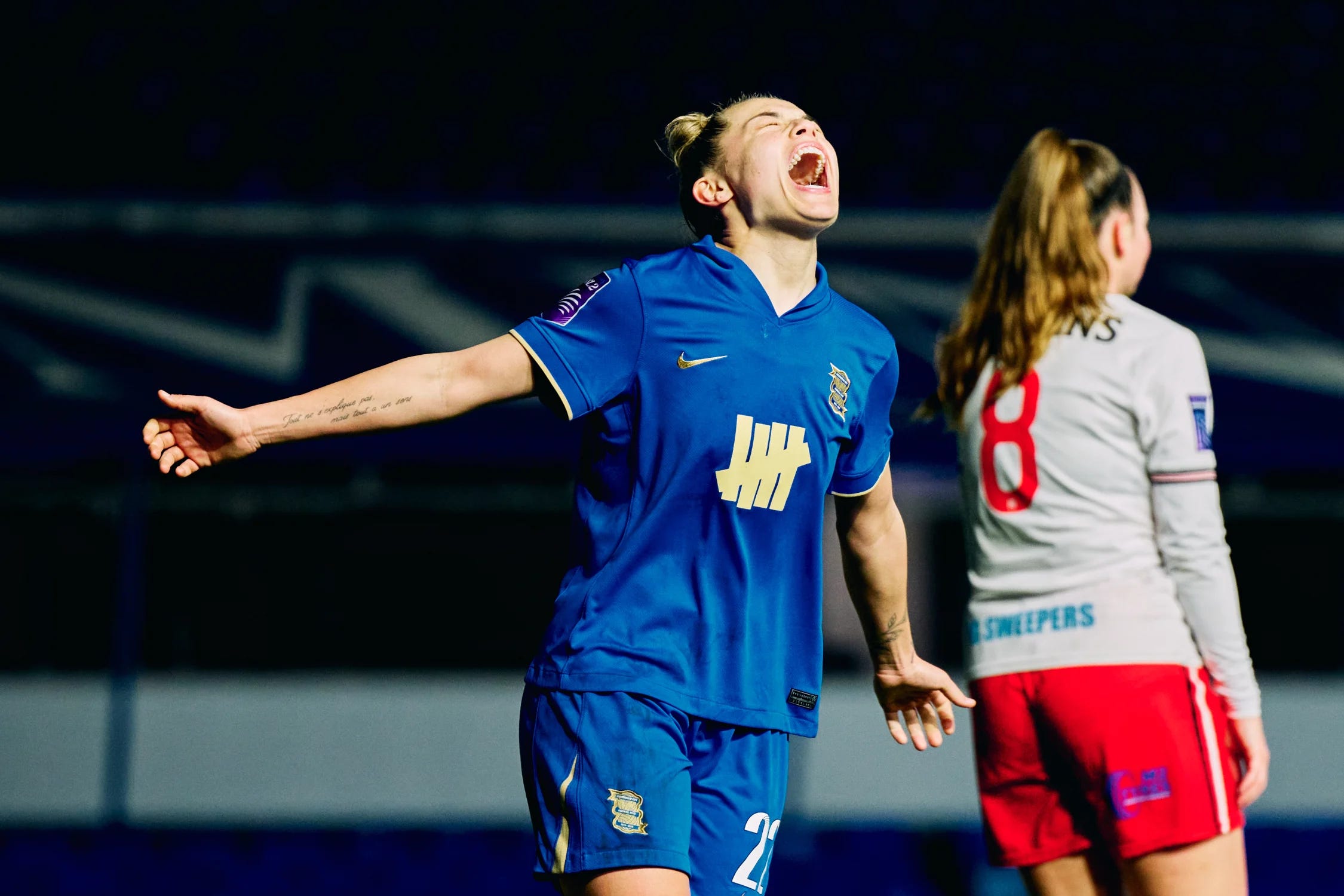
Birmingham City finally recorded their first WSL victory of the season on Sunday. Curiously, Océane Hurtré neither scored nor assisted the winning goal.
That sounds like an unusual place to begin an article about Birmingham’s most important attacker. But her performance in the 1–0 victory over Charlton may have revealed more about her season than another goal would have done.
Hurtré created eight chances, including two big chances. She accumulated 0.95 expected assists, attempted six shots and completed five dribbles.
No player has created more chances in a WSL match this season. Only Signe Gaupset, with eight for Tottenham against Aston Villa in Matchweek 4, has matched her.
For the first six rounds, Hurtré’s season had largely been told through her goals. Against Charlton, she showed that Birmingham’s reliance on her extends far beyond the final touch.
Hurtré is not simply finishing Birmingham’s attacks. Increasingly, she is building them too.
Birmingham’s scorer and creator
Through seven matchweeks, Hurtré has scored six goals. Only Manchester City’s Khadija Shaw has scored more.
She is also joint-top of the WSL for chances created:
22 chances created — joint-first
2.53 expected assists — fourth
24 shots — joint-second
11 shots on target — joint-second
Five big chances created
15 successful dribbles — fourth
These are not the numbers of a player performing one specialised attacking role. Hurtré is producing the shot volume of a leading scorer and the creative volume of a primary playmaker.
That combination matters enormously for Birmingham because so much of their attack is concentrated around her.
The team have scored nine league goals. Hurtré has scored six and assisted another, meaning she has been directly involved in seven of Birmingham’s nine goals—77.8%.
That is the highest share of any WSL player for her club this season.
She has also created 22 of Birmingham’s 64 chances, a 34.4% share, and generated 2.53 of their combined 6.08 xA. That gives her a 41.6% share of Birmingham’s expected assists.
From useful contributor to attacking reference point
This is a substantial change from Hurtré’s first season in England.
After joining Birmingham from Paris Saint-Germain in August 2025, she made 21 WSL2 appearances but started only 10. Across 937 minutes, she recorded three goals and three assists as Birmingham won promotion. She nevertheless created 31 chances and a team-leading six big chances—early evidence of the creative range now becoming visible in the WSL.
Seven top-flight matches have transformed both her role and her output.
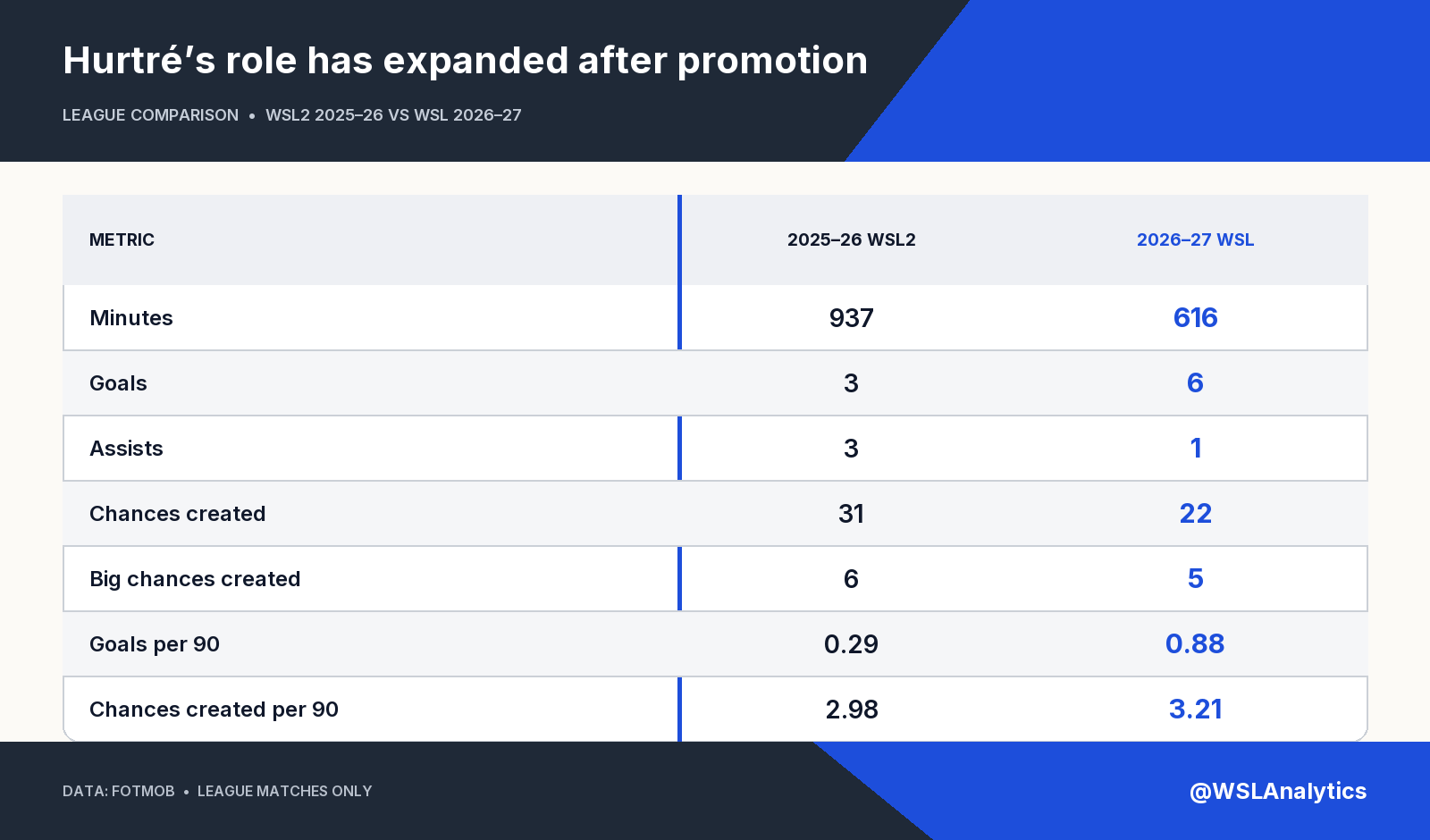
Hurtré’s league output before and after Birmingham’s promotion.
Her scoring rate has more than tripled. Just as importantly, her chance creation has increased slightly despite Birmingham now spending far less time in control of matches than they did in WSL2.
The match-by-match progression shows how she has adapted.
She scored against Manchester City on the opening weekend, then produced a goal and an assist against Brighton. Chelsea kept her quiet in Matchweek 3, but she responded with two goals and five chances against Crystal Palace. She then scored against Everton and Arsenal before producing her eight-chance performance against Charlton.
There has been only one match in which she neither scored, assisted nor created at least two chances: the defeat at Chelsea.
The finishing has been exceptional—perhaps too exceptional
There is, however, an important qualification.
Hurtré’s six goals have come from 2.89 xG, an overperformance of 3.11 goals. She has converted 25% of her 24 attempts and scored with six of her 11 shots on target.
Finishing at that level indefinitely would be an unreasonable expectation. Even elite finishers rarely continue scoring at more than twice their expected rate across an entire season.
The comparison with her teammates makes the effect even clearer:
Hurtré: six goals from 2.89 xG
All other Birmingham players combined: three goals from 5.6 xG
Birmingham as a team have scored nine goals from 8.53 xG, almost exactly in line with expectation. But that apparently ordinary team-level return hides two very different stories: Hurtré’s outstanding execution and substantial underperformance from everyone else.
She has not merely added goals. Her finishing has kept Birmingham’s entire attack close to expectation.
Why the creative numbers are so important
If Hurtré’s goals were the whole story, Birmingham would have reason to worry about what happens when the finishing cools.
The creative numbers changes that assessment.
Her 22 chances and 2.53 xA have produced only one assist. Just as her scoring has run ahead of the underlying numbers, the return from the opportunities she has supplied to teammates has lagged behind their quality.
Those two effects may not continue in the same direction. Hurtré is unlikely to keep converting chances at her present rate, but she should also receive more assists if Birmingham begin finishing a greater share of what she creates.
That is what made the Charlton performance significant. Birmingham won without another Hurtré goal, yet she remained the dominant attacking figure. Her influence moved from the end of the sequence to its beginning.
It also offered a healthier version of Birmingham’s dependence. Wilma Leidhammar supplied the finish, but Hurtré continued to generate the volume and quality around it.
A strength—and a warning
There are two ways to read a 77.8% involvement in a team’s goals.
The first is to recognise an exceptional individual beginning. A 22-year-old who started fewer than half of her league appearances last season has become one of the WSL’s leading scorers and most productive creators almost immediately after promotion.
The second is to recognise the risk for Birmingham. No team wants such a high proportion of its attack resting on one player. An injury, loss of form or simply ordinary finishing variance could remove much of their current threat.
Their first victory offered a small but meaningful sign of progress. Someone else scored the decisive goal. Birmingham produced their highest xG of the season, attempted 20 shots and created three big chances. Hurtré remained central without having to appear on the scoresheet.
For Birmingham, the next step is not to reduce her influence. It is to ensure that more players begin turning that influence into goals.
More than a revelation
Hurtré’s six goals have made her one of the stories of the opening seven matchweeks. But goals alone do not fully explain what has happened.
She has become Birmingham’s leading scorer, most productive creator, most frequent shooter and most reliable one-v-one outlet at the same time. Even the match in which she did not score or assist ended with her matching the season’s highest chance-creation total.
The finishing may regress. The responsibilities are unlikely to disappear.
Birmingham have found their first WSL victory. In Océane Hurtré, they may also have found the player around whom their entire top-flight attack can be built.
Data: FotMob via the WSL Analytics Match Centre, through Matchweek 7 of the WSL 2026-27 season.