

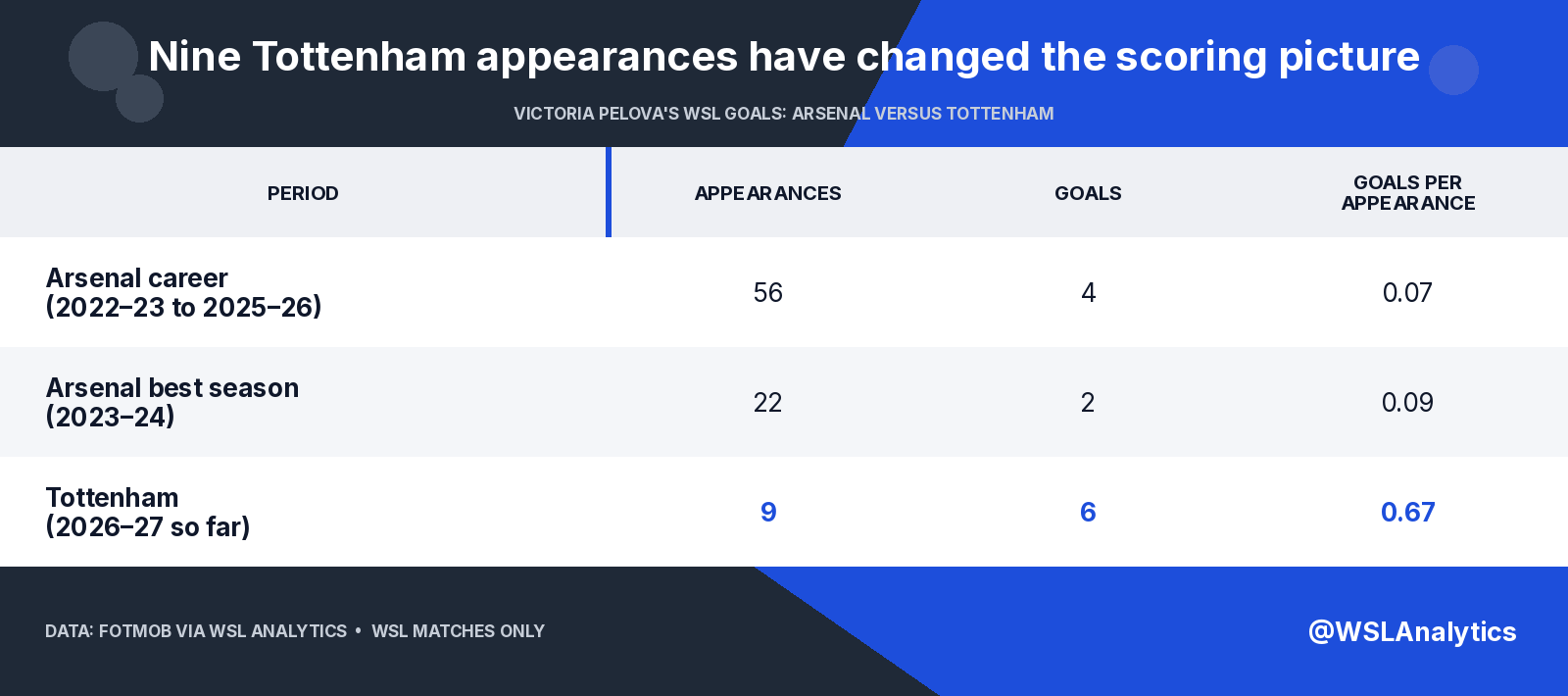
Victoria Pelova scored four WSL goals across three-and-a-half seasons and 56 league appearances at Arsenal.
Nine appearances into her Tottenham career, she already has six.
That contrast is striking enough on its own. But it does not automatically mean Pelova has become a completely different player overnight. Her six goals have come from 1.86 xG, an overperformance that may be difficult to sustain over a full season.
The more interesting question is why she is now getting the opportunities to score so often—and why her influence at Tottenham looks broader than a short finishing streak.
The answer begins with the path that brought her there.
A trajectory interrupted
Pelova joined Arsenal from Ajax in January 2023, quickly becoming a regular. She made 21 appearances in all competitions during her first half-season, then appeared 33 times in 2023–24.
That 2023–24 campaign was her most settled at Arsenal. In the WSL, she played 1,560 minutes across 22 appearances, starting 20 times. She scored twice, assisted five goals and was a consistent part of Arsenal’s midfield and attacking rotations.
Then came the ACL injury ahead of 2024–25.
Pelova missed most of that season and returned to Arsenal’s first team in March 2025 after 308 days out. She made five league appearances after returning, but the season was already nearing its end.
Her return came into a changed Arsenal context, and she did not regain the same certainty in the side before her contract expired.
In 2025–26, Pelova made 17 league appearances but started only seven. She played 719 minutes, did not score and registered three assists.
That does not make her Arsenal spell a failure. She won trophies, played regularly before injury and contributed in a variety of roles. But the injury interrupted the period in which she was becoming an established WSL player, and the route back was not straightforward.
Tottenham have given her a new one.
Six goals in nine appearances
Pelova began the season with two substitute appearances, totalling 38 minutes.
Her first start came in Matchweek 3, away to Crystal Palace. She scored twice, assisted another and recorded 16 touches in the opposition box. A week later, she scored twice again against Aston Villa.
By her fifth Tottenham league appearance, Pelova had five goals—already more than she managed in 56 WSL appearances for Arsenal.
That is the headline. But it is not the whole argument.
Pelova’s six goals have come from 1.86 xG. The finishing has been outstanding, but it is also running well above expectation. If we judge her Tottenham start only by the goals, we risk mistaking an unsustainably hot scoring run for the complete story.
The more durable evidence lies in how often she is now involved in Tottenham’s attacking moves.
More than a scoring run
Pelova has not just scored more at Tottenham. She is shooting more, creating more, dribbling more and entering the penalty area more frequently than she did across any full Arsenal league season.
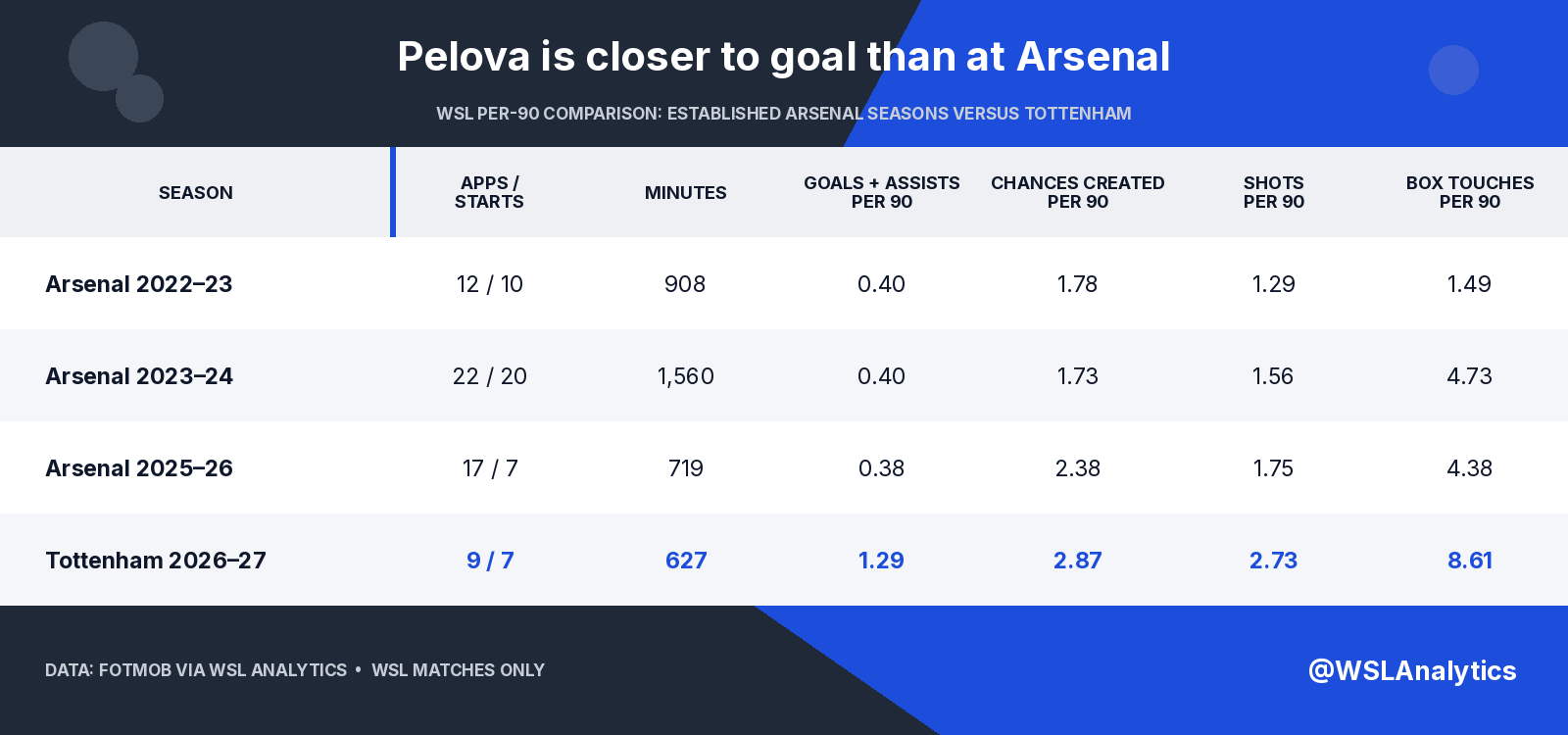
The 2024–25 return sample is excluded from the comparison because it covers only 134 league minutes after her ACL injury.
The clearest shift is in the penalty area.
Pelova’s 8.61 opposition-box touches per 90 are almost double her previous full-season high of 4.73, recorded during her 2023–24 Arsenal campaign. Her shot volume is also substantially higher: 2.73 per 90, compared with 1.56 in 2023–24 and 1.75 last season.
This is important because it helps explain why she is scoring more: she is repeatedly getting into areas where goal-scoring opportunities are created.
Her six goals may fall back towards expectation over time. But Tottenham are giving her more opportunities to influence games in the areas where goals are made.
The finishing may cool. The increased involvement is the more important finding.
From occasional influence to a regular attacking reference point
Since Pelova’s first Tottenham start, she has played 599 league minutes. In that period, she has six goals, three assists, 17 chances created and 52 touches in the opposition box.
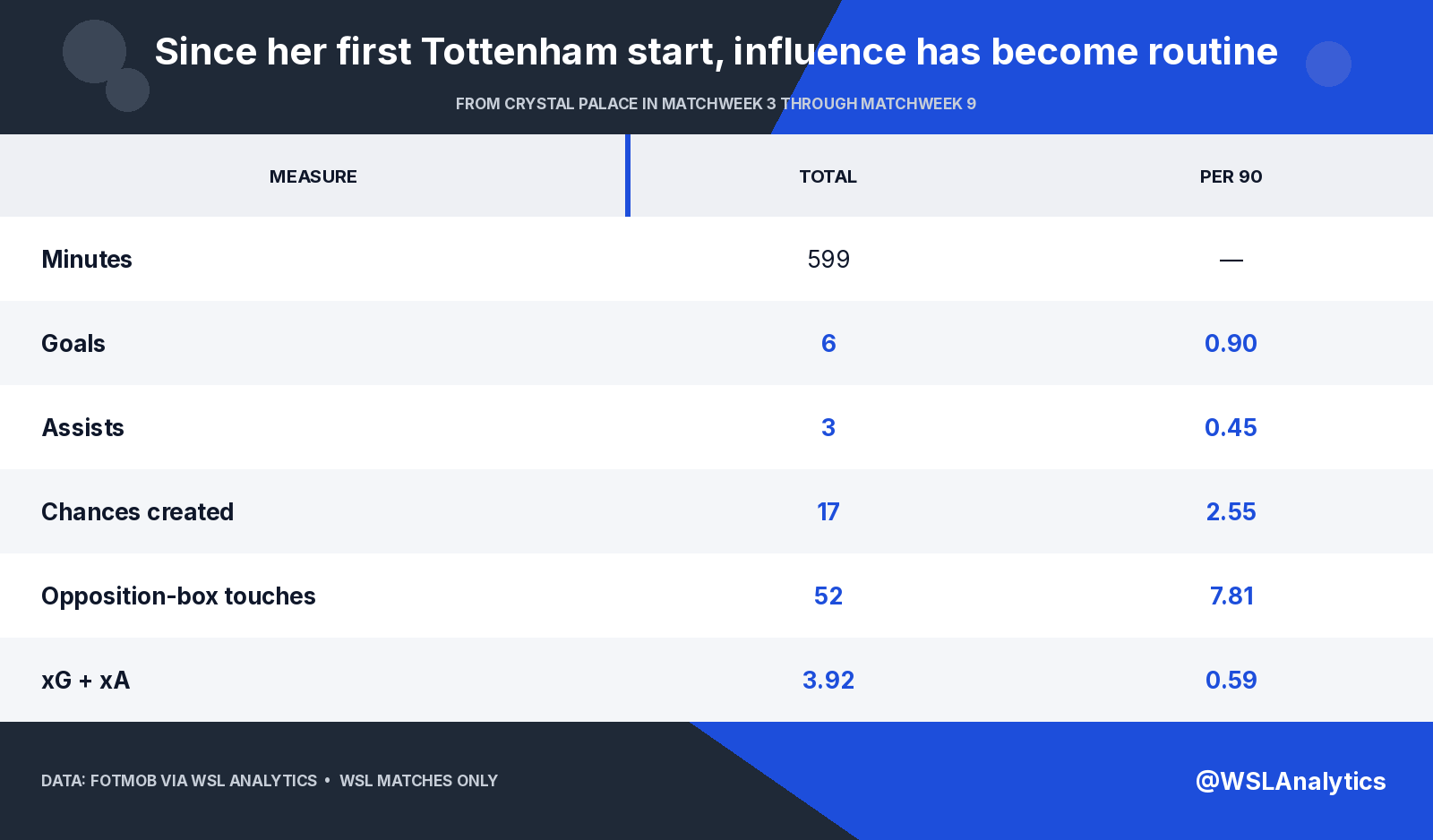
She has been directly involved in nine of Tottenham’s 25 league goals this season: 36.0%.
That should not be read as a claim that Tottenham depend on one player alone. Olivia Holdt, Signe Gaupset, Kirsty Hanson and others have all made important contributions.
Across all nine league appearances, Pelova has become a recurring connection point in the attack. She can receive deeper and carry the ball forward, create a chance for a team-mate, or arrive in the box herself. Her six goals, three assists, 20 chances created and 60 opposition-box touches reflect different types of influence rather than one narrow route to output.
That is particularly significant given her final Arsenal season. In 2025–26, she produced three assists in 719 league minutes. At Tottenham, she has already matched that assist total in 92 fewer minutes—and added six goals.
What Tottenham have changed
The difference is not simply that Pelova has moved from one north London club to another.
At Arsenal, her versatility was valuable. She could play centrally, wide, deeper in midfield or in defensive areas when needed. But versatility can also mean moving between jobs rather than owning one.
At Tottenham, the early evidence suggests a more attacking interpretation of her game. She is not being judged only on control in midfield or on whether she can fill a tactical gap. She is regularly arriving where the decisive actions happen.
That freedom has shown up in the numbers:
20 chances created, joint-sixth in the WSL;
60 opposition-box touches, fourth in the division;
14 successful dribbles, sixth;
11 shots on target, joint-seventh;
six goals and three assists in 627 minutes.
The numbers do not prove that Tottenham have solved everything for Pelova. Nine matches cannot do that. They do show that her current role is asking more of the parts of her game that had become less visible during her final Arsenal season.
A new chapter, not a finished story
There is a temptation to turn every player who moves across a rivalry into a verdict on the club they left. This is not that story.
Arsenal gave Pelova her route into the WSL and a platform in which she became an established international player. Her ACL injury then interrupted a promising period, while Arsenal’s squad and context changed around her.
Tottenham have offered a fresh environment. So far, Pelova has taken it.
The goal return might soften. Six goals from 1.86 xG is not a rate that should be projected across an entire season. But the deeper indicators give the start real substance: more shots, more chance creation, more dribbles and, most notably, far more involvement inside the opposition box.
Pelova is not simply scoring more at Tottenham.
She is finding more ways to matter.