

One season after the 2025 summer transfer window closed, it is time to revisit the judgments we made.
In August last year, we published a club-by-club assessment of every Women’s Super League transfer window. The aim was never to rank signings or hand out grades in isolation. We assessed whether each club had genuinely strengthened, weakened or entered the new season facing greater uncertainty.
The verdicts generated agreement, criticism and considerable debate, as they should have. What we did commit to was that once the season was over, we would return and test those conclusions against what actually happened. And that is what we are doing in this series.
OUR ORIGINAL FRAMEWORK
The original analysis was produced within clear data constraints. At the time, our framework relied on a relatively limited set of indicators: minutes played, squad value where available, goals and assists. The balance between the arrivals and departures then informed whether we judged a team to have strengthened or weakened.
We also counted only WSL minutes, which created an obvious limitation for players arriving from overseas. A high-quality international signing could therefore receive little or no numerical credit simply because she had not previously played in the league. Where we had sufficient knowledge of the competition, particularly leagues such as Liga F, we introduced qualitative adjustments, but those judgments could not be applied consistently across every market.
The assessments were analytical judgments made from the best evidence available to us at the time. The criticism helped expose where the first version of the framework was too narrow, where it undervalued performance outside the WSL and where simple production metrics could not fully capture a player’s quality, role or likely fit.
WHAT TO EXPECT IN THIS SERIES
This review is not an exercise in proving ourselves right or wrong. Forecasting is valuable only if it is tested against reality.
Some verdicts may have been right for the wrong reasons. Some individual signings may have exceeded expectations even if the overall window of the team disappointed. Injuries, tactical changes and squad development can all reshape a season in ways that no pre-season analysis can fully anticipate.
The objective is therefore twofold:
Was our original club-level verdict right?
What did the outcome teach us about improving the evaluation framework?
Reviewing every club in sufficient depth would make for an article that is difficult to read and even harder to do justice. As a result, we divided the retrospective into three parts, allowing each club's transfer window to be examined in the detail it deserves.
Part 1 will cover:
Arsenal
Brighton
Aston Villa
Leicester City
Part 2:
Chelsea
Manchester United
Tottenham Hotspur
West Ham United
Part 3:
Manchester City
Liverpool
Everton
London City Lionesses
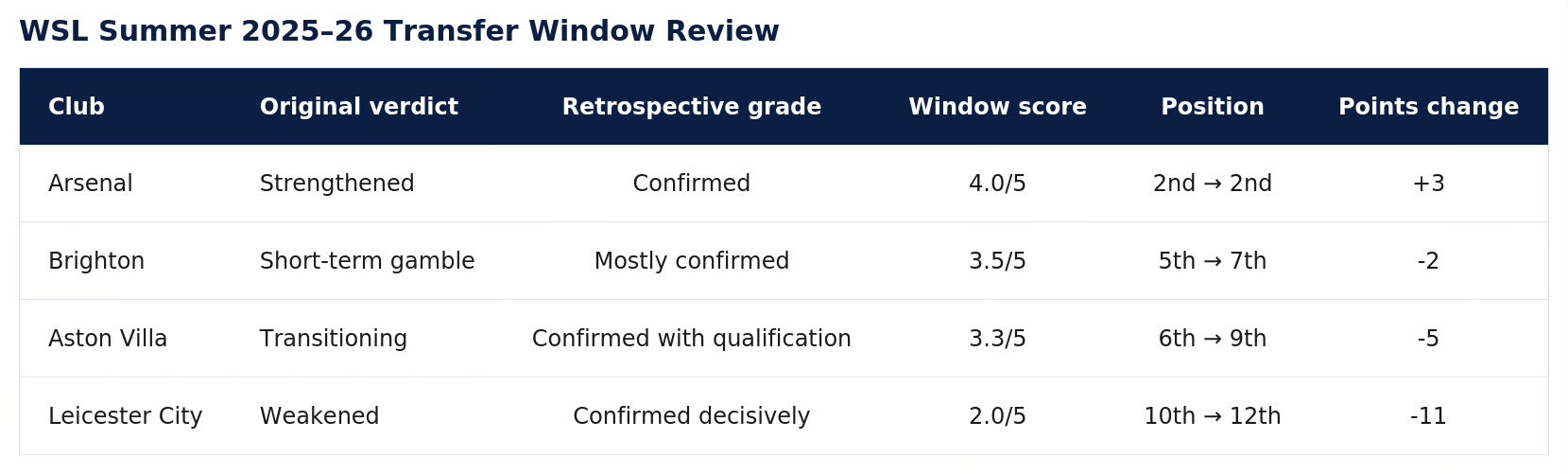
PART 1: ARSENAL, BRIGHTON, ASTON VILLA & LEICESTER CITY
We begin with four clubs whose transfer windows illustrate very different outcomes: one title challenger that strengthened as expected, one ambitious project that accepted significant short-term risk, one club navigating a transitional summer, and one whose squad regression proved even more damaging than anticipated.
Part 1 at a glance
Arsenal — strengthened, but still came second
Our original verdict: Strengthened
Retrospective grade: Confirmed
Window score: 4.0/5
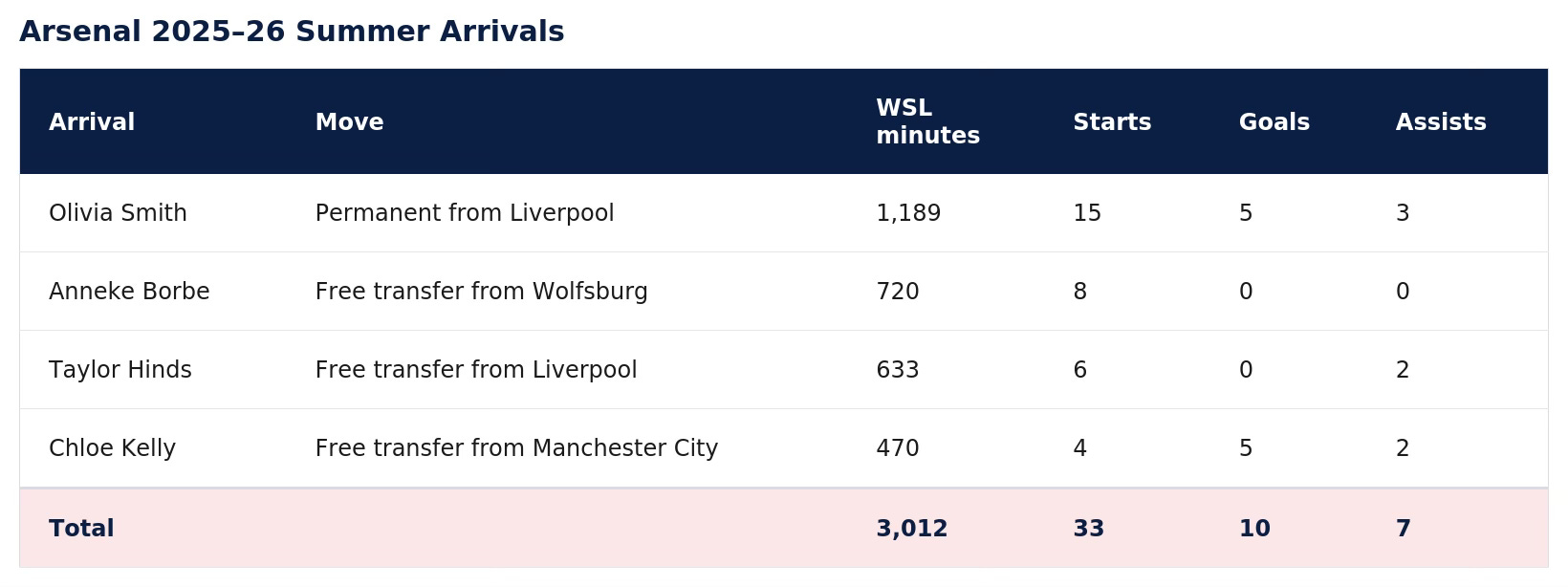
Our argument then was that Arsenal had exchanged fringe players for proven contributors. Olivia Smith, the first £1 million signing in women’s football, and Chloe Kelly, whose loan move from Manchester City had been made permanent, were expected to raise the attacking level. Taylor Hinds, who joined from Liverpool, added experienced full-back cover, while Anneke Borbe strengthened the goalkeeping group. The outgoing players, however talented, had contributed only a small fraction of Arsenal’s previous league minutes.
One season later, that verdict held.
The four arrivals produced 3,012 WSL minutes, 33 starts, 10 goals and seven assists. Smith established herself as a first-choice player. Kelly endured a stop-start, injury-disrupted season but delivered whenever available, scoring five goals in only 470 minutes. Hinds provided experienced full-back rotation, making six starts and 10 substitute appearances. Borbe, who was initially expected to simply strengthen Arsenal’s goalkeeping options, assumed a much greater role as Daphne van Domselaar struggled with injuries. She started eight league matches, kept six clean sheets and performed outstandingly when Arsenal needed her.
Arsenal did strengthen. But fell short again.
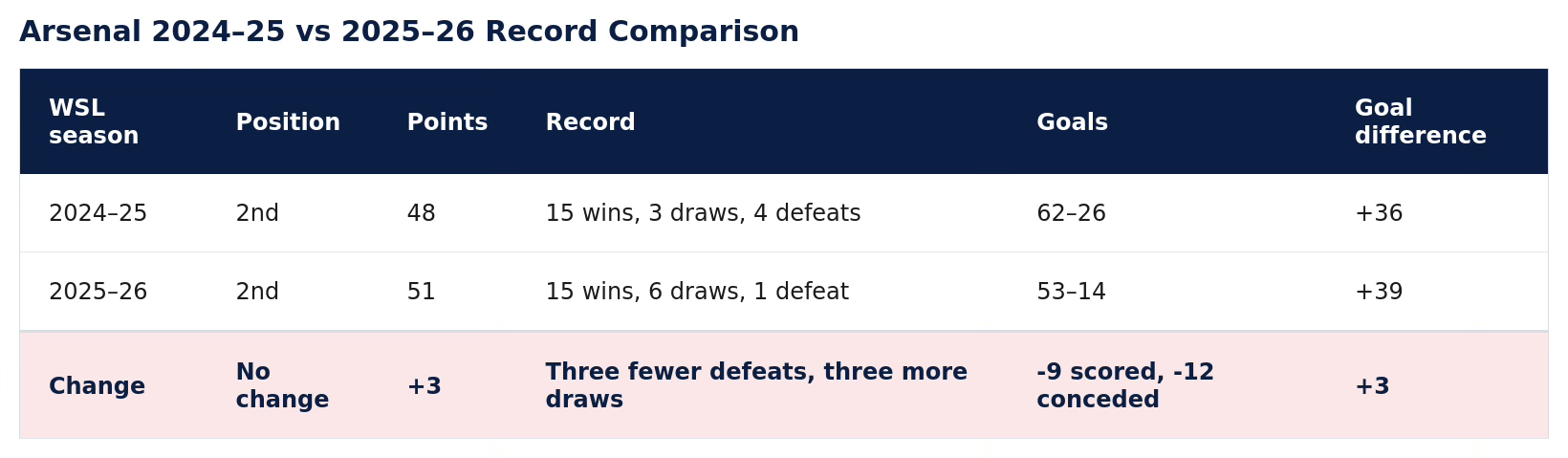
A transfer window can improve a squad without solving every reason a team falls short. Arsenal collected three more points, lost only once and conceded 12 fewer goals than in the previous season. They became the league’s strongest defensive side, conceding the fewest goals, while also finishing as its second-highest scorers behind Manchester City. Ultimately, they still finished four points behind City.
Our final verdict:
Arsenal’s 2025–26 summer recruitment worked: it raised the level of the first team and strengthened the rotation, but the deeper squad still did not convert enough league matches into victories.
Brighton — the defence worked, but the attacking replacement did not
Our original verdict: A gamble — weakened short-term, with genuine long-term upside
Retrospective grade: Mostly confirmed
Window score: 3.5/5
Our argument at the time was that Brighton had replaced more than 8,900 minutes of established WSL experience with a younger group composed largely of overseas arrivals and two Arsenal loanees. Nikita Parris, Poppy Pattinson and Guro Bergsvand were among the big-name departures, while much of the incoming talent had no previous WSL experience. The squad offered greater long-term value, but its immediate competitiveness depended on the new players adapting quickly and the attack replacing Parris’s seven goals and five assists. Given the demands of the WSL, we were not convinced that the young overseas arrivals could adjust immediately or shoulder such a significant responsibility.
One year later, the direction of that verdict held, but not for the reason we expected.
Brighton’s eight arrivals produced 6,701 WSL minutes, 75 starts, eight goals and five assists. Chiamaka Nnadozie and Moeka Minami became immediate first-choice players and were central to a defence that conceded 13 fewer goals. Manuela Vanegas provided another regular defensive option, while Rosa Kafaji contributed two goals and three assists. As we had anticipated, however, the loss of Parris was clearly reflected in the attacking returns: the eight new arrivals combined for only one more goal than Parris had scored single-handedly the previous season. Michelle Agyemang began promisingly before suffering a season-ending ACL injury, an unfortunate setback beyond Brighton’s control, and the story might have been different had she remained fit. Carla Camacho, Maëlys Mpomé and Fuka Tsunoda, meanwhile, remained developing players rather than dependable replacements for Parris. Brighton’s recruitment therefore produced genuine value, but the goals lost during the summer were never fully recovered.
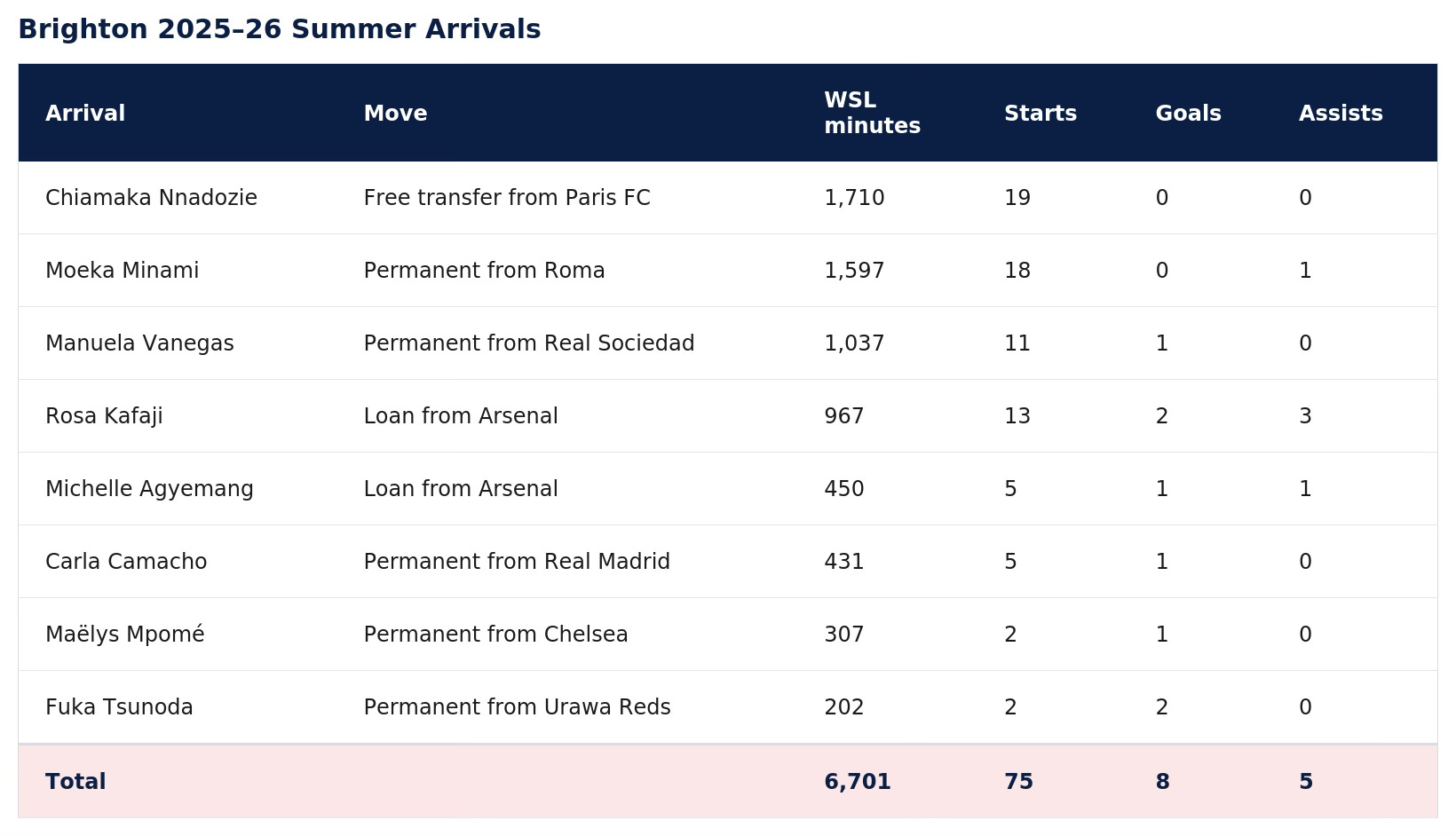
Brighton improved defensively, but lost their attacking edge
Brighton fell from fifth to seventh and collected two fewer points, but this was not a straightforward decline. Their defensive record improved substantially: goals conceded fell from 41 to 28, and their goal difference improved from minus six to minus one. The problem was at the opposite end. Brighton scored eight fewer goals, and the stronger defence could not compensate for the loss of attacking production. They won only one fewer league match and reached the Women’s FA Cup final, but the absence of a reliable replacement for Parris ultimately limited what the rebuild could achieve.
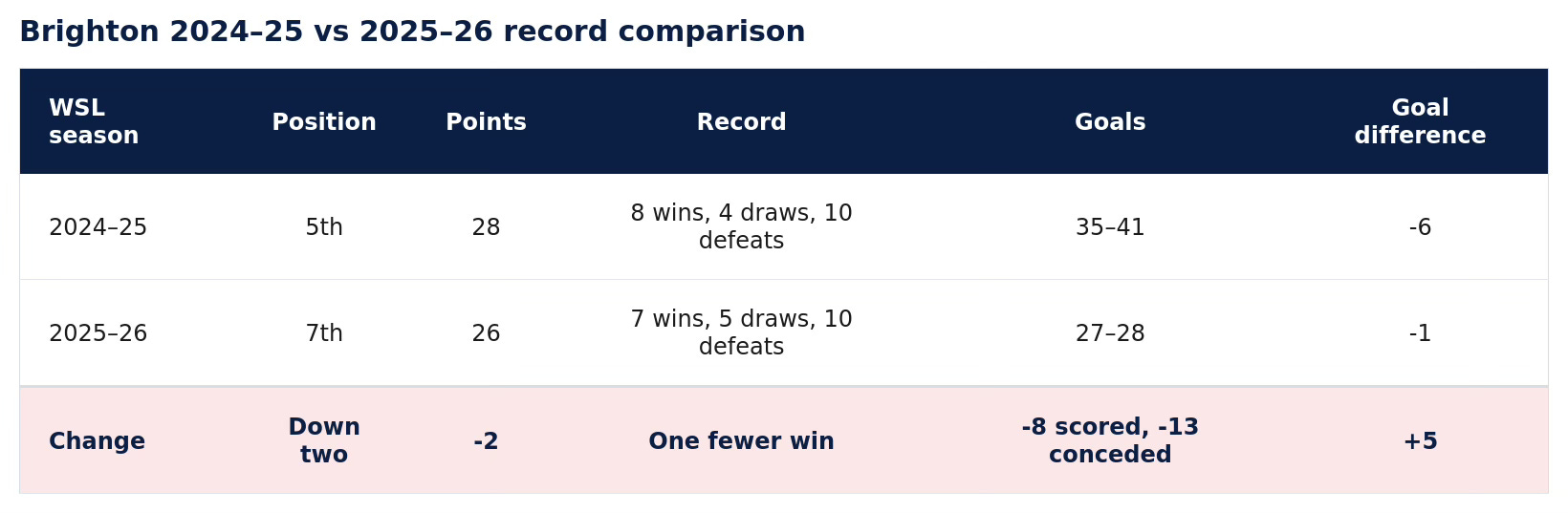
Our final verdict:
Brighton’s summer recruitment produced a younger squad and a significantly better defence, but it did not replace the attacking reliability that departed with Parris. The gamble worked to an extent, with several of the new arrivals adapting far better than we had originally anticipated.
Aston Villa — the transition was real, but so were the successes
Our original verdict: Transitioning
Retrospective grade: Confirmed, with some qualification
Window score: 3.3/5
Our argument at the time was that Villa had exchanged established WSL experience and leadership for a younger group of players assembled mainly from Germany, France, Spain, Japan and the Championship. Jordan Nobbs, Danielle Turner, Maz Pacheco and Rachel Corsie were among the significant departures. The squad in our view had long-term potential, but we were concerned that its immediate competitiveness could decline while the new arrivals assumed responsibilities left by the veteran departures. Our original analysis also omitted Maya Hijikata, despite Villa announcing her three days before publication.
One season later, the transition was real, but several of the new players succeeded immediately.
Villa’s six arrivals produced 6,087 WSL minutes, 69 starts, two goals and eight assists. Lynn Wilms was the outstanding signing, starting 17 matches and finishing joint-top of the league’s assist chart with seven. Lucia Kendall moved directly from the Championship into Villa’s starting midfield and earned a Rising Star nomination, while Océane Deslandes made 16 starts in defence. Hijikata also started ten matches, and Ellie Roebuck provided competition rather than becoming the undisputed first-choice goalkeeper. Jill Baijings, whose loan spell from Bayern Munich the previous season had been converted into a permanent move, ruptured her ACL after starting the opening three league matches. Villa therefore replaced the departing minutes, but the new group produced limited attacking output and could not immediately restore the stability and leadership that had been lost.
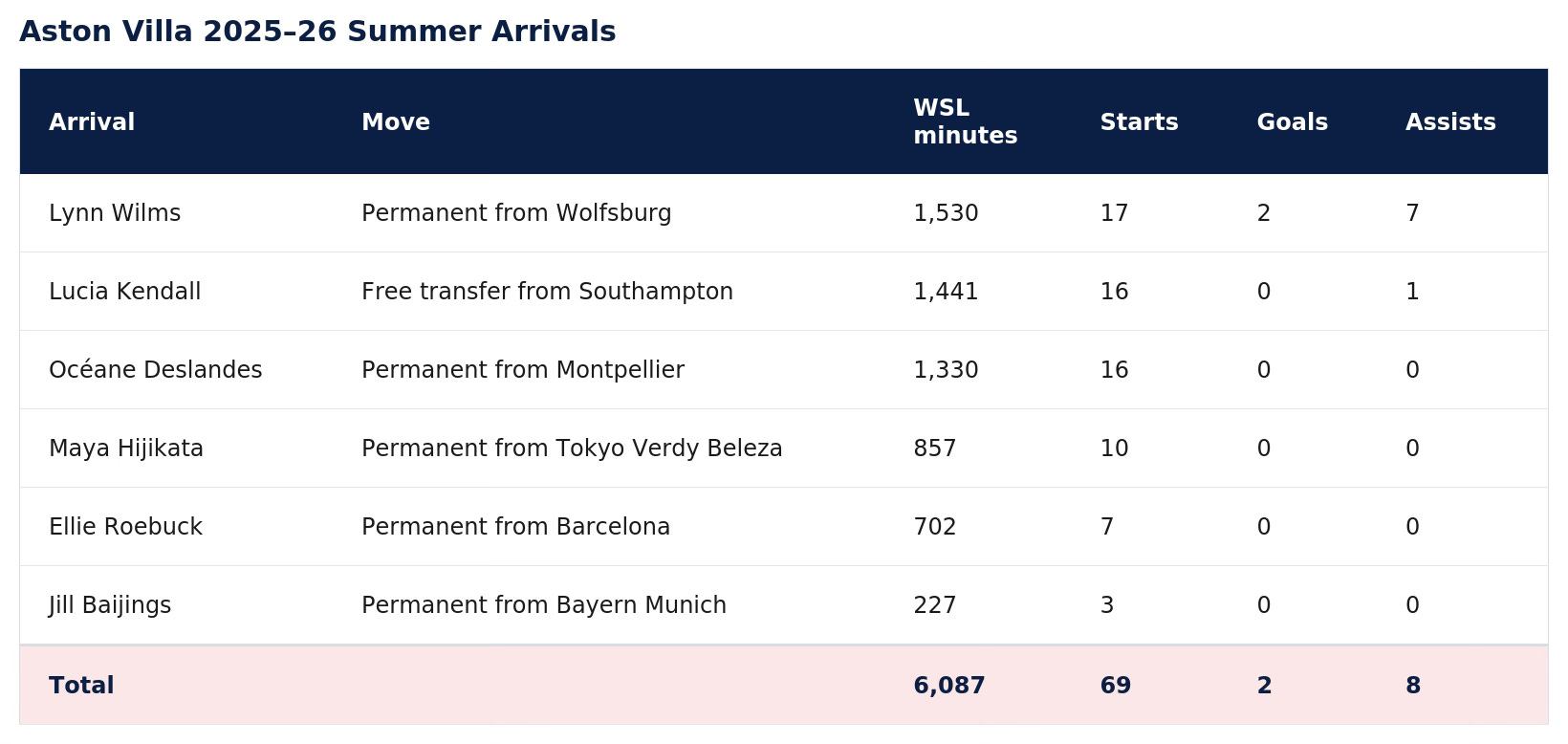
Villa found building blocks, but the team went backwards
Villa fell from sixth to ninth, collected five fewer points, scored four fewer goals and conceded four more. Wilms, Kendall and Deslandes established themselves, but their individual success did not produce a balanced team. The six arrivals scored only two league goals, both through Wilms, while Kirsty Hanson supplied 12 of Villa’s 28 goals by herself. Baijings’ injury removed an important source of midfield continuity, the goalkeeper position remained shared and the defence continued to concede heavily. Villa finished with several promising long-term pieces, but the first season of the rebuild left them weaker at both ends of the pitch.
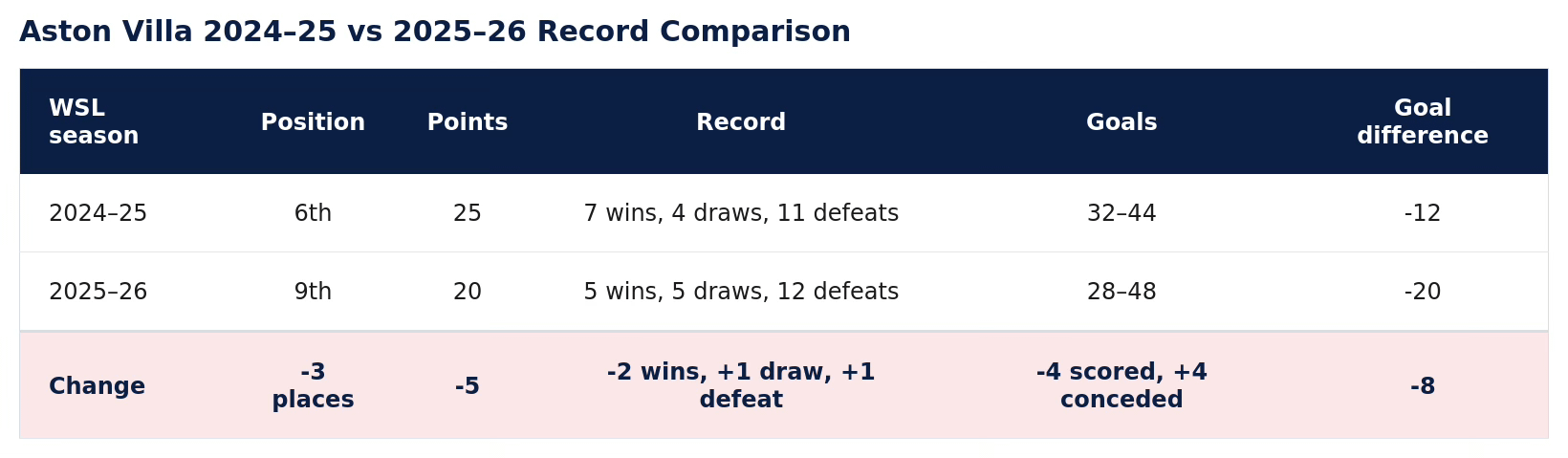
Our final verdict:
Villa’s transition produced genuine individual successes, particularly Wilms and Kendall, but the younger squad did not replace the balance, leadership or attacking support that departed. Our warning about a short-term decline was correct, even though several arrivals adapted better than the original analysis anticipated.
Leicester City — not only weakened, but relegated
Our original verdict: Weakened
Retrospective grade: Confirmed decisively
Window score: 2.0/5
Our argument at the time was that Leicester had lost too much established WSL quality, creativity and depth without adequately replacing it. Heather Payne added experience, but she could not offset the wider departures alone. The original assessment was incomplete, though. After publication, Leicester signed Emily van Egmond, Olivia McLoughlin, Rosella Ayane and Cecily Wellesley-Smith, while Ruby Mace subsequently left in a club-record sale. Those late changes improved the midfield, but they did not correct the overall imbalance of the squad.
One year later, our warning was confirmed more decisively than expected.
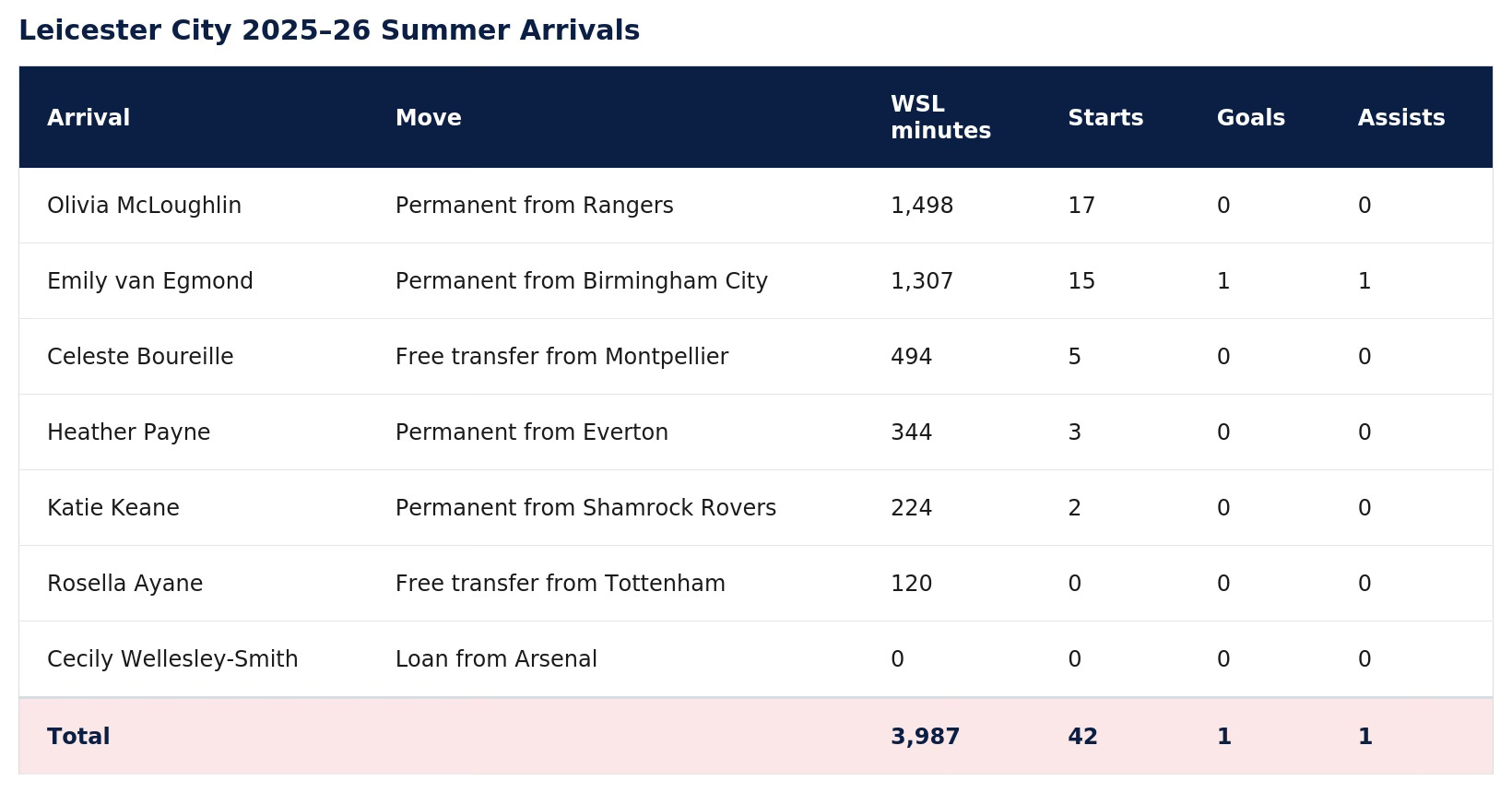
Leicester’s seven arrivals produced 3,987 WSL minutes, 42 starts, one goal and one assist. McLoughlin and Van Egmond were the two meaningful successes, accounting for 70% of the group’s minutes and 32 of its 42 starts. They became credible first-choice midfielders, with Van Egmond supplying the arrivals’ only goal and assist. The remaining additions offered little impact. Payne made only three starts, while Ayane, Keane and Wellesley-Smith barely featured. Celeste Boureille had begun to establish herself before suffering an unforeseeable ACL injury in December.
Leicester lost every margin they previously gained
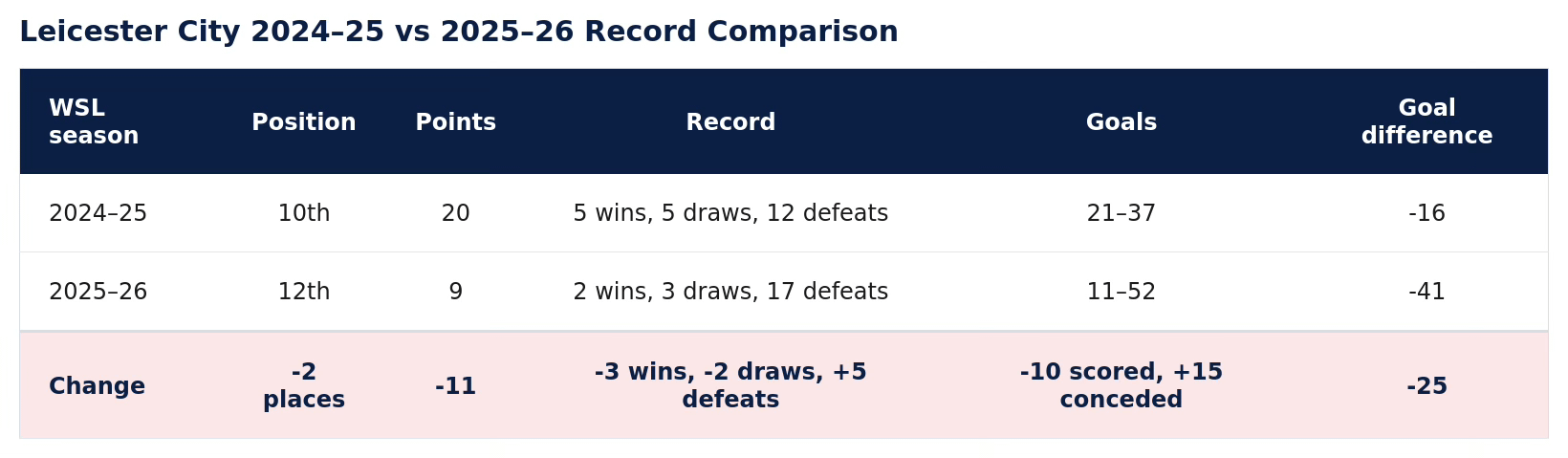
Leicester fell from a club-record 20 points to nine, scored ten fewer goals and conceded 15 more. Their goal difference deteriorated by 25, while the summer arrivals contributed only two direct goal involvements. A managerial change before the season added further instability, but the underlying squad problems were unmistakable. Leicester lost their final 11 league matches, scoring four goals and conceding 32 during that sequence, before losing to Charlton on penalties in the relegation play-off. The play-off delivered the final blow; the shortage of attacking threat, defensive resilience and first-team depth had developed across the entire season.
Our final verdict:
Leicester’s late midfield additions provided useful minutes, but the completed window did not replace the creativity, attacking output or established depth that departed. Our “weakened” verdict was decisively confirmed: the squad lost too much quality and entered the season without enough margin to survive.
The overall verdict on Part 1
We were right on the broad direction of all four clubs.
Arsenal strengthened. Brighton accepted a genuine short-term gamble. Aston Villa entered a transition that reduced their immediate competitiveness. Leicester were weakened, and the consequences were even more severe than we anticipated.
But this review also shows where our original framework was too blunt.
It overvalued previous WSL minutes, undervalued experience from other elite leagues and did not distinguish clearly enough between first-choice signings, rotation options, development players and goalkeepers.
Our next transfer analysis will still make direct judgments. But this time we will make them using more and better evidence.
That is the purpose of returning to the original work: not to rewrite what we said, but to understand why each verdict succeeded, failed or reached the right conclusion.
Coming in Part 2
Part 2 will revisit four more of our original transfer verdicts:
Chelsea: Did their re-tooling preserve the quality required to remain title contenders?
Manchester United: Did a squad that looked stronger on paper deliver meaningful improvement?
Tottenham Hotspur: Was our warning that the squad had become weaker justified?
West Ham United: Did their younger and less WSL-proven recruitment produce enough immediate quality?
If you enjoyed this retrospective and want more independent, data-led analysis of WSL transfers and squad building, consider subscribing to WSLAnalytics.
And if you know another supporter who would enjoy the series, please share this article with them. Every subscription and share helps this work reach more readers.