

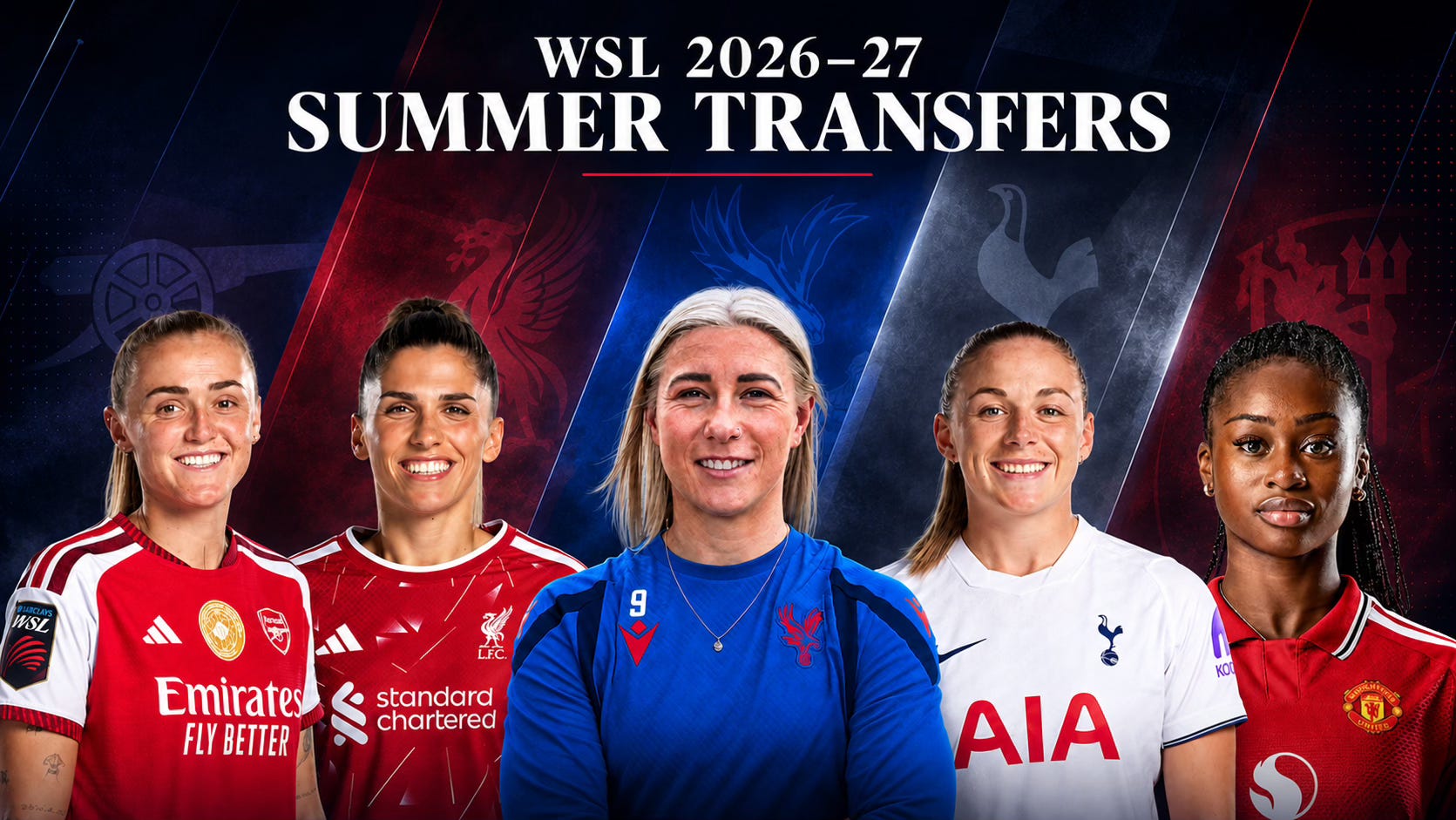
This is the second edition of our WSL summer transfer analysis, a series that began last season and later returned for a full retrospective. That retrospective allowed us the chance to test our original judgments against what actually happened, showing where the reasoning held up and where the evidence needed to be stronger.
This year’s analysis is built on some of the lessons we learnt from that exercise. A long transfer list does not automatically mean a stronger squad, and a departure does not automatically create a meaningful on-pitch loss.
So we start by looking at each club’s previous-season performance, establishing a baseline; then the contribution that left; then the problems the summer business had to solve; and finally whether the arrivals addressed them. The result is two clear judgments: a window verdict on the quality of the business, and a squad impact verdict on whether the team is now stronger, weaker or broadly unchanged. This first part covers Arsenal, Liverpool, Crystal Palace, Tottenham Hotspur and Manchester United. The remaining clubs follow across two further parts.
🔴 Arsenal
The Baseline
Arsenal did not enter the summer needing to be rebuilt. They had lost only once in the league, conceded a division-low 14 goals and finished second on 51 points. But Manchester City finished on 55. The difference was not collapse; it was six draws, and the fine margin between being elite and being champions.
That is the baseline for Arsenal’s transfer window. They needed more than replacements for departing names. They needed to preserve the defensive level, replace the creativity and width leaving with Katie McCabe, Beth Mead and Victoria Pelova, and add enough attacking variety to convert more close matches into wins.
What Arsenal lost before they could improve
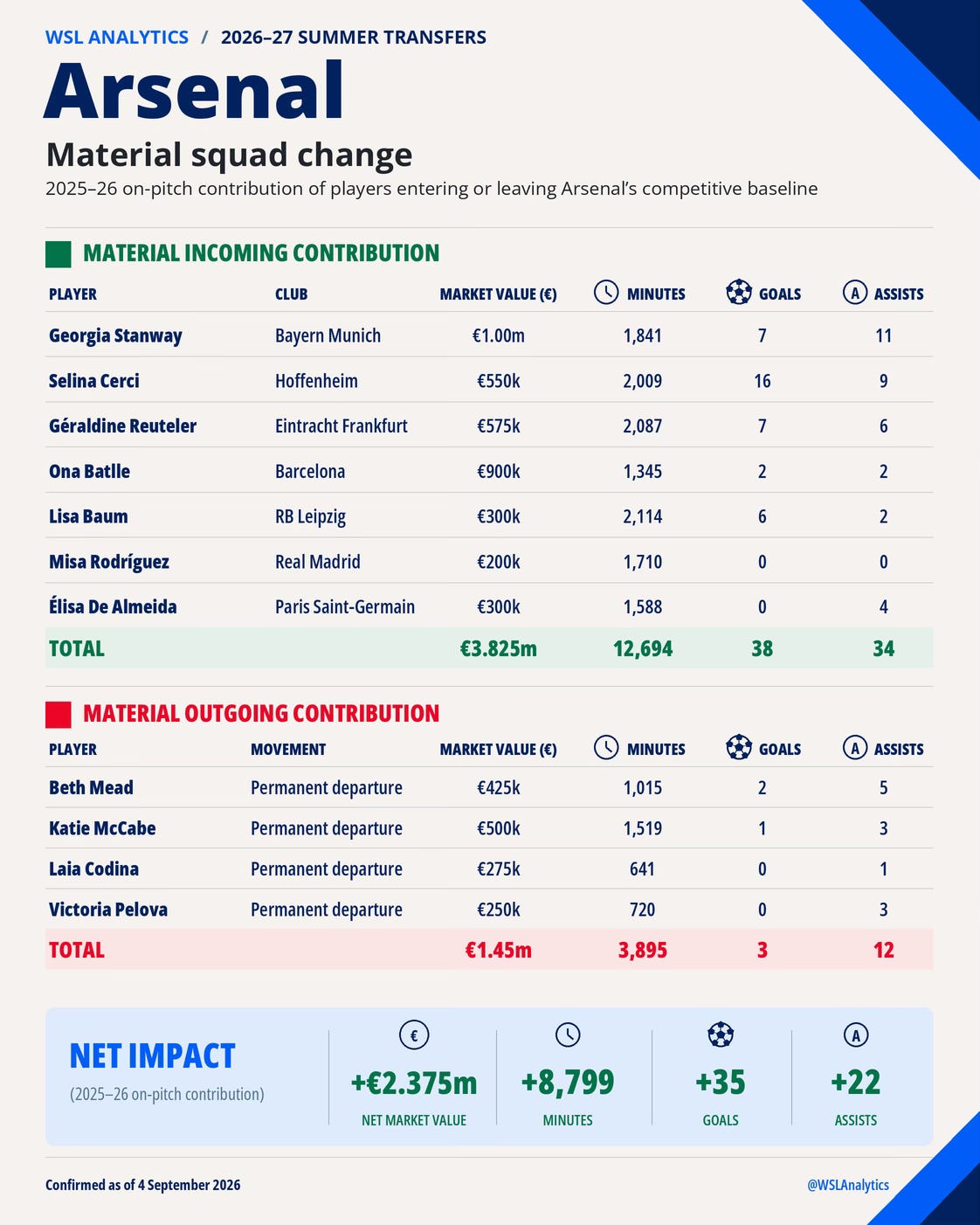
Arsenal’s permanent-departure list is long, but the replacement task is narrower. Beth Mead, Katie McCabe, Victoria Pelova and Laia Codina are the four players who contributed to Arsenal’s 2025–26 league baseline. Together, they supplied 3,895 league minutes, three goals and 12 assists.
McCabe is the biggest functional loss: 1,519 minutes, one goal, three assists and a dependable left-sided two-way presence. Mead added two goals and five assists in 1,015 minutes, alongside WSL experience and attacking relationships the numbers cannot fully measure. Pelova brought three assists as a midfield connector, while Codina supplied 641 minutes of centre-back depth.
The scoring loss is modest; the creative loss is not. Arsenal are losing 12 assists from players who helped turn possession into chances. Zinsberger’s zero-minute exit, plus the permanent sales of Kafaji and Nighswonger after loan seasons elsewhere, count in the business record but not as Arsenal performance losses. The requirement was therefore clear: replace McCabe’s function, recover Mead and Pelova’s creativity, and add more attacking variety to turn draws into wins.
Did Arsenal solve the problem?
The midfield and forward additions answer the need for more ways to win close matches. Georgia Stanway and Géraldine Reuteler bring 3,928 recent league minutes, 14 goals and 17 assists between them: workload, ball progression and the ability to create or finish from midfield. Selina Cerci and Lisa Baum add another 22 goals and 11 assists from wide and forward areas. Cerci is the clearest new scoring route after 16 goals for Hoffenheim, while Baum gives Arsenal another direct wide attacker rather than a like-for-like replacement for any one departure.
Ona Batlle is the most direct response to McCabe’s loss. Her two goals and two assists for Barcelona understate the case: Arsenal are buying a high-level full-back capable of carrying, creating and defending from the same side of the pitch. Misa Rodríguez and Élisa De Almeida then strengthen the goalkeeper and defensive groups. Neither is a repair for a broken defence — Arsenal already had the league’s best record — but both reduce the risk that departures and injuries weaken it.
The incoming group brings €3.825m in current market value, 12,694 recent league minutes, 38 goals and 34 assists—a +€2.375m squad-value differential against the material outgoings. That does not guarantee WSL translation, but it reinforces the role logic: Arsenal have added quality, workload and creative variety across midfield, wide attack, full-back, goalkeeping and defensive depth rather than replacing departures one for one.
Verdict
➡️ Window verdict: Strongly positive
Squad impact: Strengthened
Arsenal have turned a four-point title miss into a stronger squad. Batlle is a credible functional successor to McCabe; Stanway, Reuteler, Cerci and Baum spread the lost creativity across more midfield and wide-attacking options; while Misa and De Almeida protect the league’s best defensive base. Mead and McCabe’s leadership and WSL familiarity cannot be replicated automatically, and the new group must translate its output quickly. But this was precise recruitment against identifiable needs, adding more workload, variety and depth to a side already close to champions.
🔴 Liverpool
The baseline
Liverpool entered the summer from a very difficult position. They finished 11th out of 12 on 17 points, only narrowly avoiding the relegation play-off, while scoring just 21 league goals and conceding 34. This was a team close to the wrong end of the table, not one looking for marginal improvement.
The priority was clear: Liverpool needed a more dangerous attack, more control and threat through midfield, and enough defensive stability to avoid another season being defined by survival. The window had to improve the level of the team, not simply replace departing players.
What Liverpool lost before they could improve
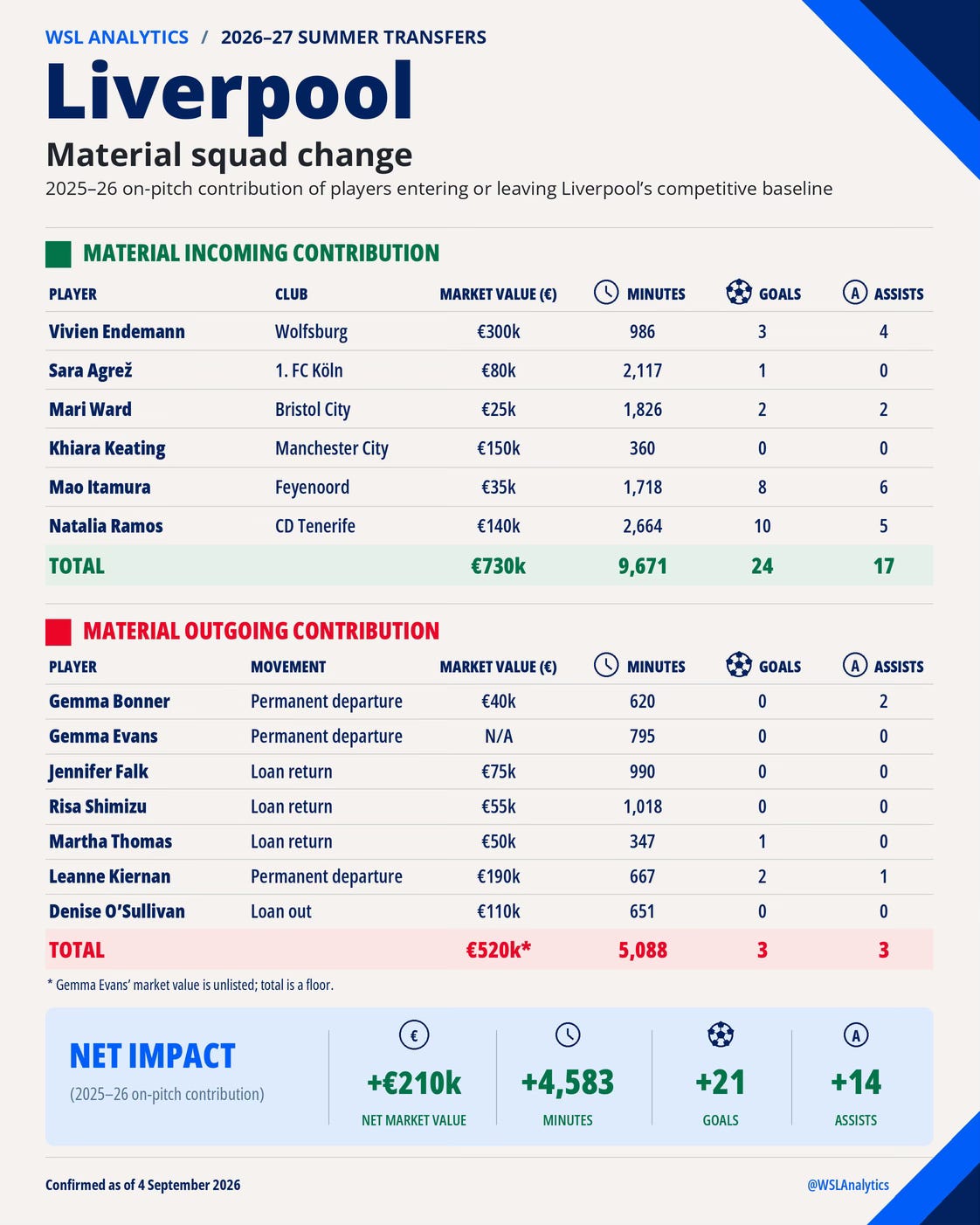
Liverpool’s outgoing group supplied 5,088 league minutes, but only three goals and three assists. That makes the task more complicated than simply replacing attacking output. The goals came from Martha Thomas and Leanne Kiernan, while Denise O’Sullivan added 651 minutes after arriving in January. Their departures reduce options around the attack and midfield, but they do not explain Liverpool’s 21-goal season on their own.
The larger loss is stability and experience. Gemma Bonner, Gemma Evans, Jennifer Falk and Risa Shimizu account for 3,423 of those minutes between the back line and goal. Bonner’s 620 minutes understate her leadership; Falk had become a regular after arriving in January; Shimizu brought senior international experience; and Evans supplied useful centre-back depth.
So Liverpool’s arrivals had to solve two problems at once. They needed to raise an attack that had scored only 21 league goals, while replacing a substantial amount of defensive and goalkeeping experience without making an 11th-place side even less stable.
Did Liverpool solve the problem?
Liverpool have attacked the scoring problem directly. Natalia Ramos, Mao Itamura and Vivien Endemann combined for 21 league goals and 15 assists in 2025–26 — the same number of league goals Liverpool scored as a whole last season. Ramos is the strongest immediate case after 2,664 minutes, 10 goals and five assists for Tenerife; Itamura adds eight goals and six assists at 19; while Endemann brings senior wide experience from Wolfsburg.
The defensive response is broader than one replacement. Sara Agrež arrives after 2,117 league minutes for Köln, Mari Ward after 1,826 minutes for Bristol City, and Khiara Keating provides a goalkeeper with WSL pedigree, even if her recent sample was only 360 league minutes. Alongside retained Grace Fisk and Jenna Clark, the arrivals give Liverpool new options in goal, at centre-back and at full-back rather than asking one player to replace every departure.
The incoming group brings €730k in current market value, alongside 9,671 recent league minutes, 24 goals and 17 assists. Those totals are not a promise that cross-league production will transfer directly to the WSL. But Liverpool have added attacking production, midfield threat and defensive cover; the remaining question is whether a group recruited from several leagues can become an immediate WSL improvement.
Verdict
➡️ Window verdict: Positive — high upside, high translation risk
Squad impact: Likely strengthened — high adaptation risk
Liverpool have addressed the scale of their problem rather than disguising it. Ramos, Itamura and Endemann give an 11th-place attack far more production and variety, while Agrež, Ward and Keating rebuild options behind them. But most of the evidence comes from outside the WSL, and the departures remove significant defensive experience from a side that cannot afford a slow transition. The upside is real; so is the adaptation risk.
🔵Crystal Palace
The baseline
Crystal Palace enter the WSL with a different test from the other clubs in this article: survival. Promotion gives them momentum, but it does not answer whether the squad that succeeded in WSL2 can withstand a higher level of attacking quality, physicality and week-to-week pressure.
Their retained attacking core offers a platform. Ashleigh Weerden, Abbie Larkin, Annabel Blanchard and Molly-Mae Sharpe combined for 44 goal involvements in the promotion campaign. But that production must now translate, and survival cannot rest on it alone. Palace needed more proven top-flight goals, greater midfield control and a defence capable of coping with the step up.
What Crystal Palace lost before they could improve
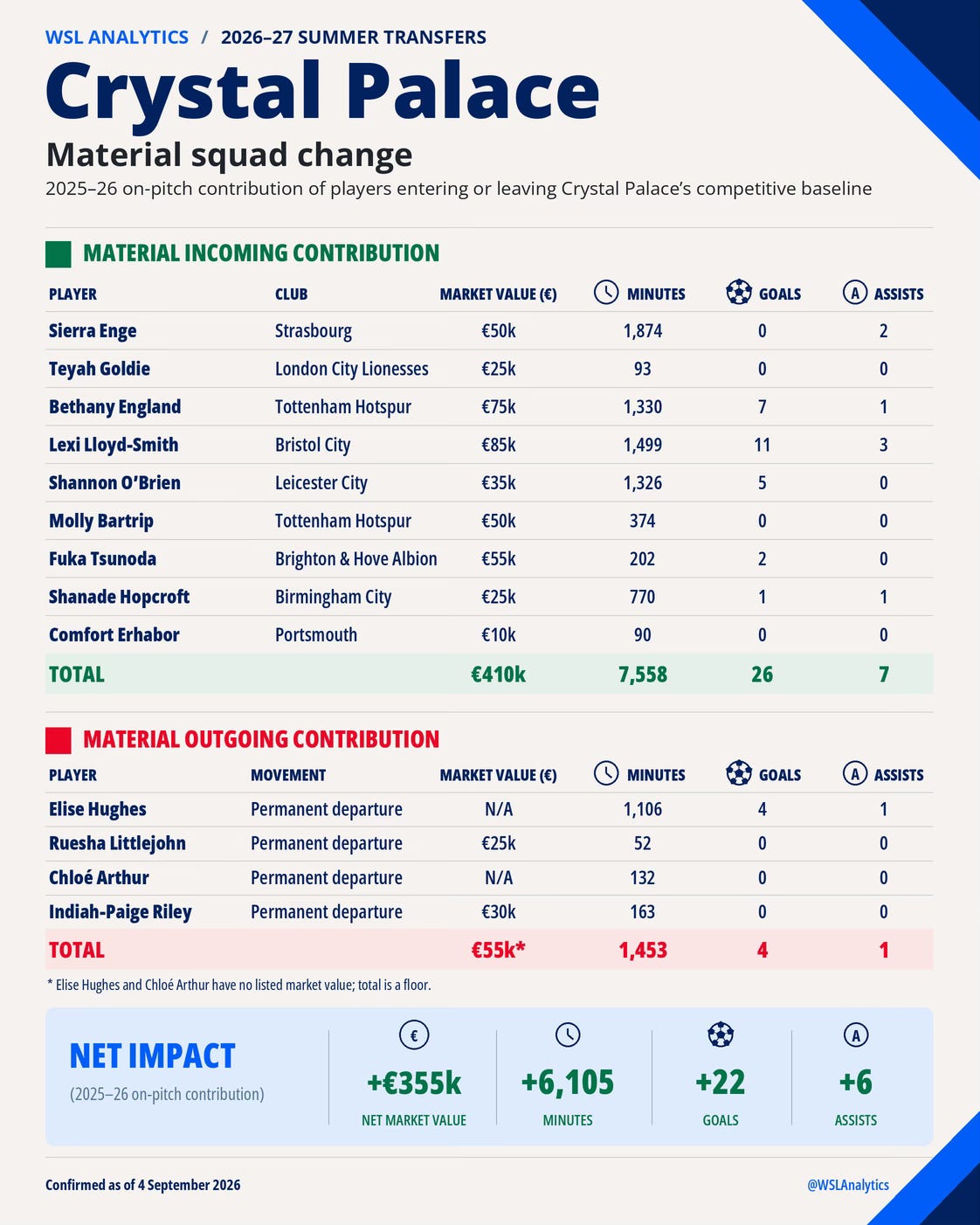
Crystal Palace’s outgoing group supplied 1,453 prior-season league minutes, four goals and one assist. Almost all of that loss belongs to Elise Hughes: 1,106 minutes, four goals and one assist. For a promoted side, losing its most productive departing forward creates a clear replacement requirement before the season even begins.
The other departures are smaller in recent workload. Ruesha Littlejohn played 52 league minutes, Chloë Arthur 132 and Indiah-Paige Riley 163; together they produced no goals or assists. Their exits still reduce options, but they do not carry the same on-pitch replacement burden as Hughes.
Palace therefore needed to replace Hughes’s contribution, add goals that could survive the move into the WSL, and build more protection around a squad facing a much tougher level of opposition.
Did Crystal Palace solve the problem?
Palace have replaced Hughes’s output with far more attacking evidence than they lost. Bethany England brings seven WSL goals, Lexi Lloyd-Smith arrives after 11 goals for Bristol City, and Shannon O’Brien adds five from Leicester City. Together, they supply 23 prior-season league goals against the four leaving with Hughes. England gives Palace proven WSL finishing; Lloyd-Smith supplies the promotion-level scoring upside; and O’Brien offers another current top-flight option.
Sierra Enge strengthens the midfield argument with 1,874 league minutes for Strasbourg, 88 tackles and 30 interceptions, while Shanade Hopcroft adds creativity after 770 minutes, one goal and one assist for Birmingham. The less settled part of the rebuild is defence: Molly Bartrip brings WSL experience but only 374 recent league minutes; Teyah Goldie and Fuka Tsunoda add options after limited recent workload; and Pauline Peyraud-Magnin increases competition in goal.
Across the incoming group, Palace have added €480k in current market value, 7,556 recent league minutes, 26 goals and seven assists—a substantial increase on the departing group’s 1,453 minutes, four goals and one assist. Palace have clearly improved their attack and midfield; whether the defensive additions become a reliable WSL unit remains the unanswered question.
Verdict
➡️ Window verdict: Positive for survival
Squad impact: Strengthened in attack and midfield; defence unresolved
Palace have given themselves a much stronger chance of surviving. They kept the core that won promotion, replaced Hughes’s output several times over and added England’s proven WSL goals, Lloyd-Smith’s WSL2 Golden Boot production, O’Brien’s top-flight scoring and Enge’s midfield workload. The defence still needs its new options to establish rhythm quickly, but Palace have addressed the most urgent survival questions with real quality and production.
⚪ Tottenham Hotspur
The baseline
Tottenham finished fifth on 36 points in 2025–26, four points behind fourth place. That was a credible season, but not yet the step into the league’s leading group. They scored 35 goals, showing a capable attack, but conceded 38 — too many for a side trying to turn top-half competitiveness into a sustained top-four challenge.
Their summer requirement was therefore not a wholesale rescue. Spurs needed to preserve their attacking threat, improve defensive reliability and add enough quality to close the gap above them. The complication was that they had to do it while losing a captain, experienced defenders and several long-serving figures who had helped define the group.
What Tottenham lost before they could improve
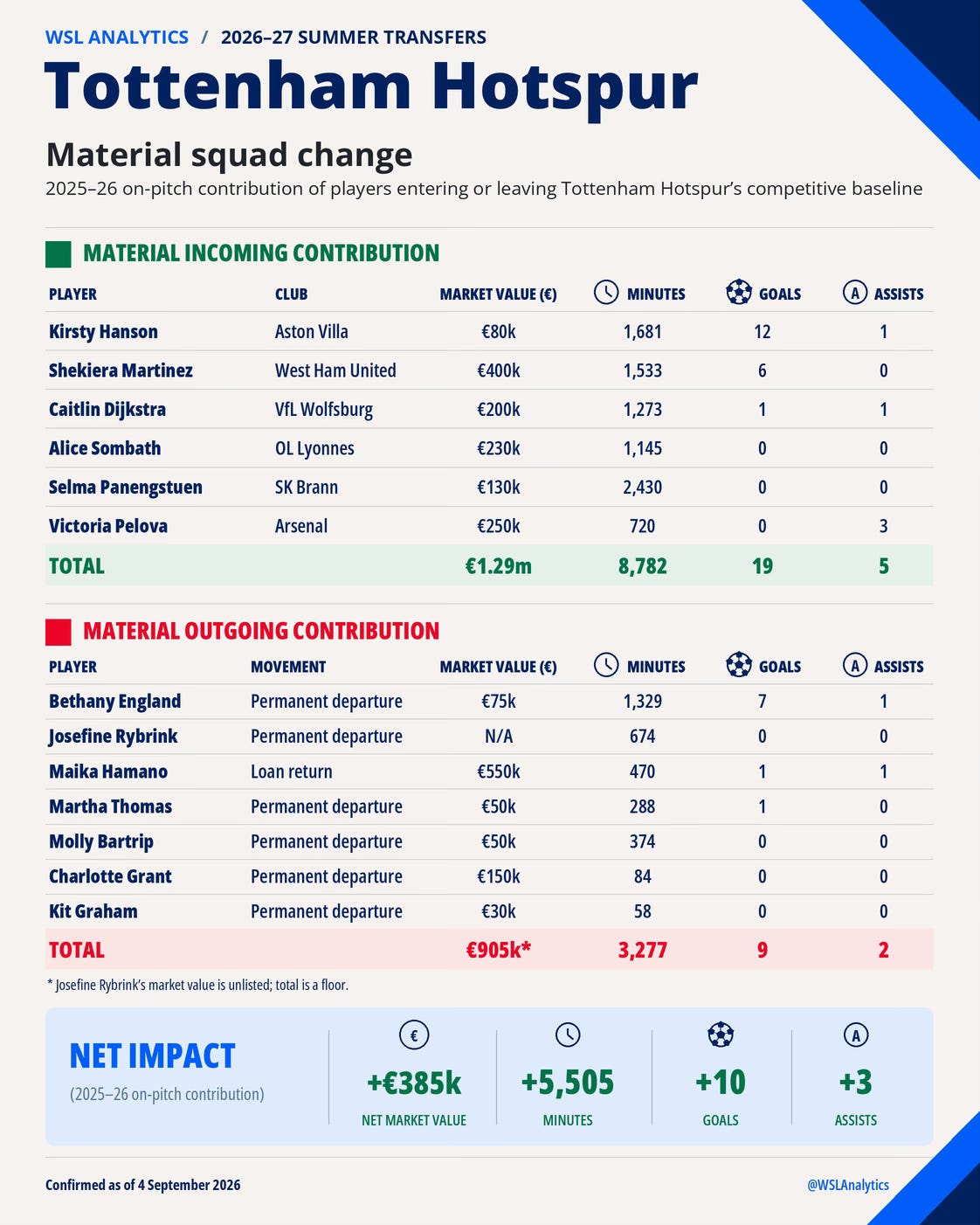
Tottenham’s departure list is long, but the material on-pitch loss is concentrated. The outgoing group supplied 3,277 league minutes, nine goals and two assists. Bethany England alone accounts for 1,329 minutes, seven goals and one assist — making her both the clearest attacking loss and the hardest leadership role to replace.
Maika Hamano returned to Chelsea after 470 minutes, one goal and one assist, while Martha Thomas added 288 minutes and one goal before her permanent move. Behind them, Josefine Rybrink, Molly Bartrip and Charlotte Grant remove 1,132 minutes of defensive depth. Those are usable minutes, but not an irreplaceable settled back line.
The numbers still understate the challenge. England was captain and Tottenham’s all-time leading WSL scorer; Bartrip and Amy James-Turner were important senior voices; and Kit Graham represented a long connection to the club’s rise. Spurs therefore needed to replace England’s production, improve their defensive workload and establish a new leadership group at the same time.
Did Tottenham solve the problem?
Spurs have replaced England’s scoring collectively, rather than asking one player to become a new captain and a new number nine at once. Kirsty Hanson and Shekiera Martinez scored 18 WSL goals between them in 2025–26, double the nine Tottenham lost through England, Hamano and Thomas. Martinez is the cleaner direct successor after six goals for West Ham, while Hanson’s 12-goal Aston Villa season adds pace, flexibility and a far larger attacking ceiling.
The defensive exchange is equally persuasive on recent workload. Dijkstra and Sombath bring 2,418 league minutes between them, more than twice the 1,132 minutes lost through Rybrink, Bartrip and Grant. Victoria Pelova then restores creative connection from midfield with 720 Arsenal minutes and three assists, while Selma Panengstuen adds strong recent goalkeeper workload behind the ever-present Lize Kop.
Across the incoming group, Tottenham add €1.29m in current market value, 8,784 recent league minutes, 19 goals and five assists. Hanson’s 12 goals came from 6.70 expected goals, meaning she finished around five goals above what the quality of her chances would normally predict; that may not repeat. Dijkstra and Sombath also need to show that their Bundesliga and French-league workload can translate to the WSL. Even so, the recruitment clearly answers Tottenham’s needs: more scoring, more defensive availability and more quality through the spine.
Verdict
➡️ Window verdict: Positive
Squad impact: Strengthened in playing quality; leadership weakened
Tottenham have converted a major exit list into a stronger footballing squad. Martinez replaces England at striker, Hanson adds goals from wide areas, Pelova raises creativity, and Dijkstra plus Sombath increase defensive workload. But England’s captaincy and the senior voices leaving with her make this a positive window rather than an unequivocally strong one.
🔴 Manchester United
The baseline
Manchester United finished fourth on 40 points in 2025–26. Their defence gave them a credible platform, conceding only 22 league goals, but 38 scored was not enough to close the gap to the teams above them or secure a Champions League place.
The summer task was clear: add more reliable attacking output without weakening a strong defensive base. United also needed enough depth through midfield and the back line to ensure that a fourth-place team did not become more fragile after its departures.
What Manchester United lost before they could improve
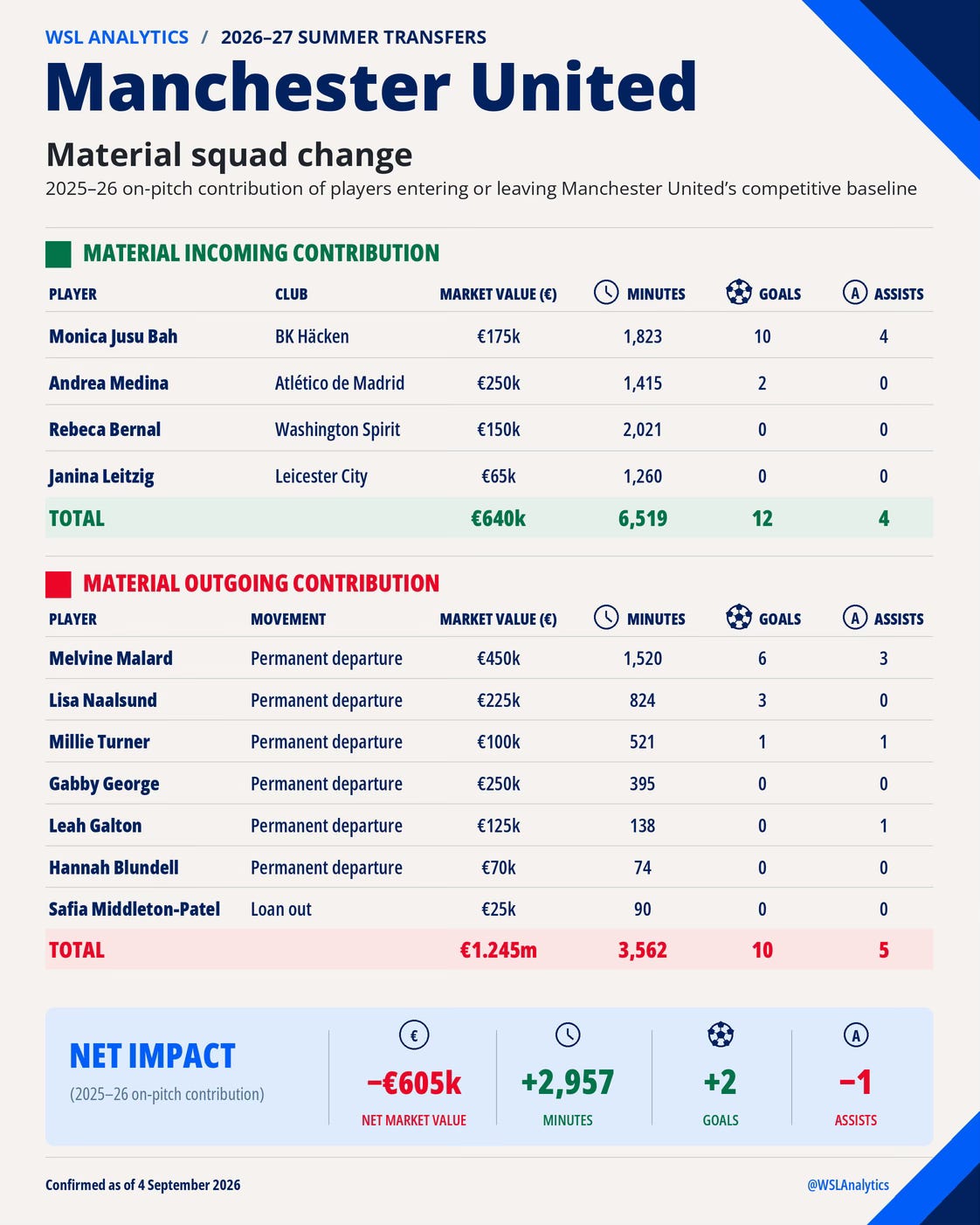
United’s material outgoing group supplied 3,563 league minutes, 10 goals and five assists. Melvine Malard is the defining loss: 1,520 minutes, six goals and three assists. Her combination of availability and attacking output was too substantial to be covered simply by expecting more from the players already in the squad.
Lisa Naalsund is the other major concern. Her 824 minutes and three goals came from midfield, where United needed more than another defensive body. Millie Turner, Gabby George and Hannah Blundell then remove 990 minutes of defensive depth, while Leah Galton’s injury-affected season still included 138 minutes and one assist.
United therefore needed to replace Malard’s attacking contribution, protect the defensive platform that had delivered fourth place, and stop Naalsund’s midfield departure from leaving the squad thinner in the area that connects both tasks.
Did Manchester United solve the problem?
Monica Jusu Bah gives United a credible answer to Malard’s departure, but not a confirmed replacement. Malard left 1,520 WSL minutes, six goals and three assists; Jusu Bah arrives with 1,823 minutes, 10 goals and four assists for BK Häcken. But Jusu Bah’s current €175k valuation remains well below Malard’s €450k, reflecting the difference between proven WSL standing and potential that still has to translate from Sweden.
The other additions improve the range of options without clearly resolving every loss. Andrea Medina has 1,415 Liga F minutes and the versatility to cover several left-sided defensive roles, while Rebeca Bernal brings 2,021 minutes of senior experience from Washington Spirit. Janina Leitzig adds competition in goal, but joins a position already occupied by an established first choice. Each signing is credible; none automatically turns United’s departures into a clear upgrade.
Across the whole exchange, United have added more recent league minutes and goals, but the incoming group carries €640k in market value against €1.245m leaving. That does not mean the window has failed; it explains why it feels more like a transition than a clear upgrade.
Verdict
➡️ Window verdict: Qualified positive
Squad impact: No clear net change — credible cover added, midfield thinner
Jusu Bah prevents Malard’s exit from defining United’s window, while Medina and Bernal add useful cover. But Naalsund’s midfield contribution is not directly replaced, Leitzig improves competition rather than the first XI, and the major arrivals must translate quickly. United have avoided a clear weakening.
Data sources
Transfers were reconciled from club announcements, destination-club confirmations and reputable football reporting. Previous-season league minutes, goals and assists were compiled from provider and competition records; league tables and team baselines come from completed 2025–26 match results. For players arriving from calendar-year competitions, such as the NWSL, we use the full 2025 league season rather than an incomplete 2026 sample. Market values are Soccerdonna estimates captured on 4 September.
📅 What’s Next
We turn to West Ham United, Aston Villa, Everton, Birmingham City and Charlton Athletic—five clubs facing very different summer tests. We will use the same framework—baseline, departures and arrivals framework, to assess which teams have genuinely improved their position and where the biggest questions remain.
See you in Part 2.