


Welcome to Part 2 of our 2026–27 WSL summer transfer analysis. In Part 1, we examined Arsenal’s title push, Liverpool’s rebuild, Crystal Palace’s survival bid, Tottenham’s playing-quality upgrade and Manchester United’s unsettled transition. This instalment turns to West Ham United, Aston Villa, Everton, Birmingham City and Charlton Athletic — five clubs with very different starting points, from established WSL sides seeking progress to promoted teams preparing for the step up.
The framework is unchanged. We begin with each club’s 2025–26 baseline, assess what departures have removed from it, then examine whether the arrivals have addressed the resulting needs. The result is two judgments: a window verdict on the quality of the summer business, and a squad impact verdict on whether the team is now stronger, weaker or broadly unchanged.
🟤 West Ham United
The Baseline
West Ham finished 10th on 19 points in 2025–26, scoring 20 league goals and conceding 45. They stayed clear of the relegation play-off, but not by enough to call the season comfortable: this was a side that needed a more reliable route to goals and far greater defensive security.
The summer task was therefore broader than replacing individual departures. West Ham needed to protect the competitive edge built under Rita Guarino, improve a defence that conceded more than two goals per game, and find enough attacking depth to avoid placing the scoring burden on one forward.
What West Ham lost before they could improve
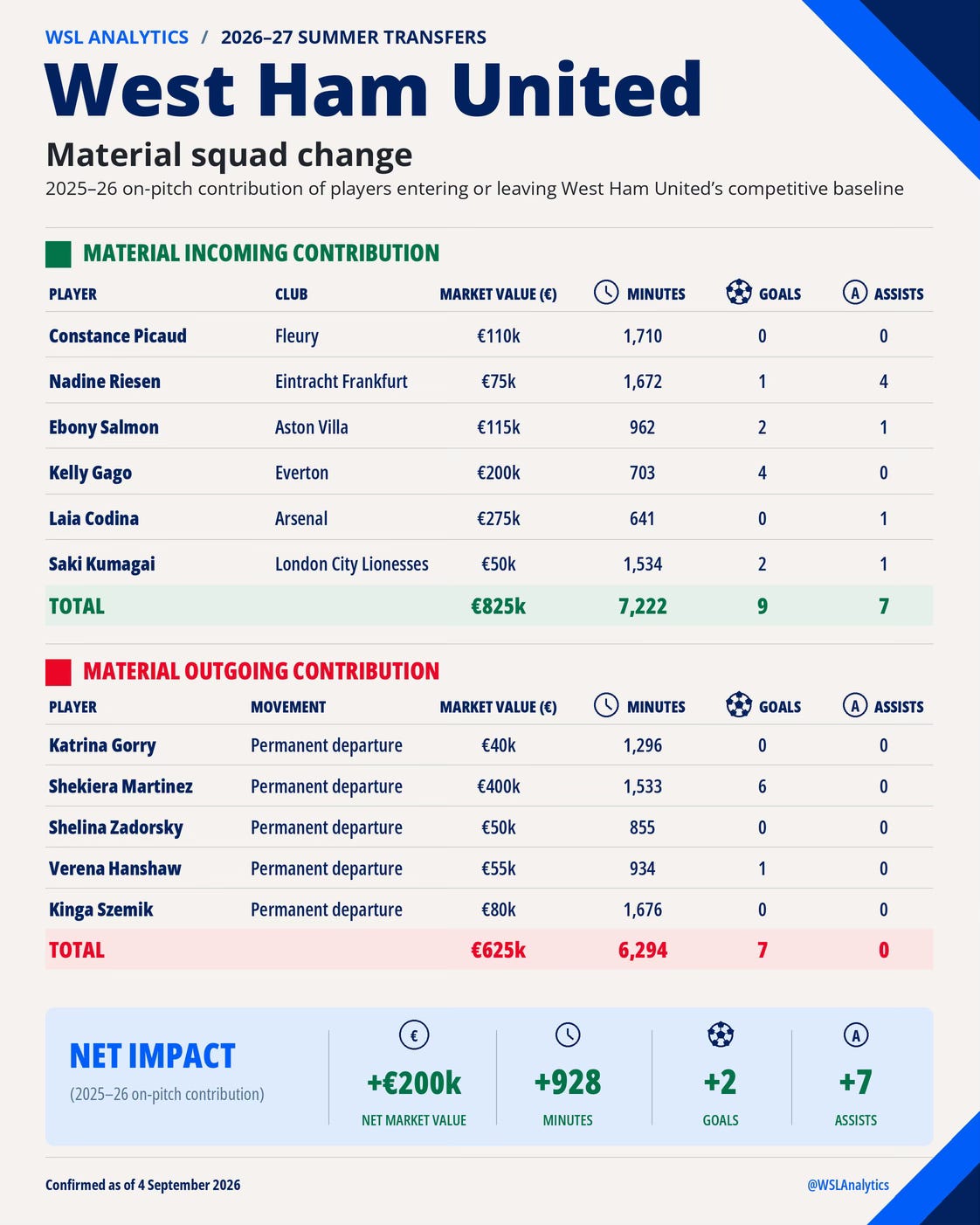
West Ham’s most important losses were concentrated in the spine of the team. Shekiera Martinez, Katrina Gorry, Shelina Zadorsky and Verena Hanshaw combined for the goals, midfield intensity, defensive experience and leadership that carried much of the side’s competitive weight. Martinez was the clearest statistical departure: six league goals in 1,533 minutes, from 19 starts, made her West Ham’s leading scorer.
Gorry’s 1,296 minutes do not need goals or assists to explain their value. She was captain, the side’s main midfield organiser and a source of defensive intensity. Zadorsky added roughly 855 league minutes as vice-captain and left-sided centre-back cover, while Hanshaw brought about 934 minutes, a league goal and two-way work from full-back or wing-back. Kinga Szemik’s departure then removes a goalkeeper who started 19 of 22 league matches.
That leaves a clear replacement brief: replace Martinez’s goals collectively, rebuild the left side of the defence, find a more secure goalkeeping answer and make sure the exits of a captain and vice-captain do not leave a thinner, less coherent team.
Did West Ham solve the problem?
West Ham have replaced Martinez’s goals collectively rather than asking one arrival to become an automatic first-choice striker. Kelly Gago scored four times in 703 Everton minutes, while Ebony Salmon added two goals and an assist in 962 minutes for Aston Villa. Together, they match Martinez’s six-goal output and give Guarino different profiles in the forward line — though neither arrives with Martinez’s 19-start role already secured.
The defensive response is more substantial. Constance Picaud arrives after playing every league minute for Fleury, keeping nine clean sheets with a 74.7% save rate; she gives West Ham genuine competition after Szemik’s 19-start season. Laia Codina and Nadine Riesen bring high-level defensive experience and 2,313 recent league minutes between them, while deadline-day arrival Saki Kumagai adds another senior option with the authority and international pedigree that the departures had removed.
The six new senior arrivals — Picaud, Codina, Riesen, Gago, Salmon and Kumagai — bring 7,222 recent league minutes, nine goals and seven assists. Katie Zelem and Estelle Cascarino’s permanent deals matter differently: both preserve contributions already present during their 2025–26 loans. West Ham have addressed the right areas and added real depth; the remaining uncertainty is whether the new forward collective can replace Martinez’s dependable starting role, and whether anyone can immediately replace Gorry and Zadorsky’s leadership.
Verdict
➡️ Window verdict: Positive
Squad impact: Strengthened in depth and balance; leadership thinner
West Ham have rebuilt intelligently around their most obvious weaknesses. Picaud, Codina and Riesen add more security and quality to a defence that needed it, while Gago and Salmon give the attack more routes to goals after Martinez’s exit. Keeping Zelem and Cascarino prevents another reset, and Kumagai adds important experience. But the captain, vice-captain and leading scorer have all left; until the new group settles and a leadership core emerges, this is a positive, better-balanced squad rather than a complete transformation.
🟣 Aston Villa
The baseline
Aston Villa finished ninth on 20 points in 2025–26. They scored 28 league goals, but conceded 48 — the second-highest total in the division. The season was not a relegation fight, yet it never developed into a push towards the teams above them either.
Villa’s summer task was therefore to make the squad more reliable at both ends: find a way to replace the goals of their leading scorer, reduce the fragility around the back line and establish a clearer goalkeeping solution. This was a reset around a useful core, not a simple like-for-like rebuild.
What Aston Villa lost before they could improve
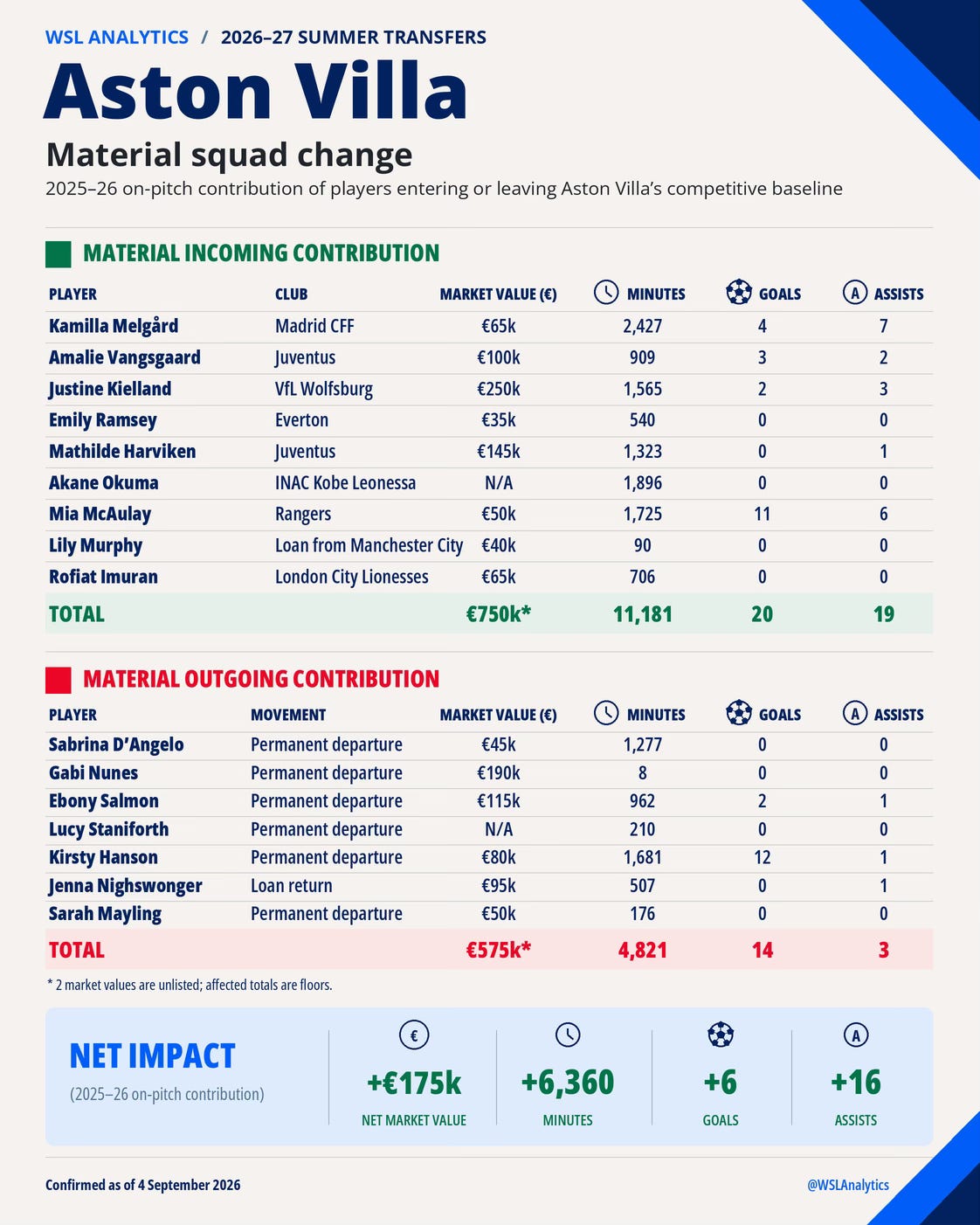
Villa’s outgoing group supplied 4,821 league minutes, 14 goals and three assists. The loss is heavily concentrated in Kirsty Hanson, who played 1,681 minutes and scored 12 of Villa’s 28 league goals. That was 43% of the team’s scoring — not simply a departing wide player, but Villa’s clearest route to turning pressure into goals.
Sabrina D’Angelo is the other major workload loss after 1,277 league minutes and 15 starts in goal. Ebony Salmon then removes 962 minutes of forward rotation, while Jenna Nighswonger’s loan return takes away 507 Villa minutes and one assist from the left side. Those exits leave fewer established options in goal, attack and defence before Villa can claim to have improved any of them.
Staniforth and Nunes combined for only 218 league minutes, while Sarah Mayling contributed another 176 Villa minutes before her January loan to Leicester became permanent. Their departures reduce experience and depth, but the summer requirement was clear: find new sources of goals to replace Hanson’s output, rebuild the goalkeeper group, and add enough defensive stability that Villa are not again defined by conceding too freely.
Did Aston Villa solve the problem?
Villa have recruited several ways to share the attacking responsibility. Mia McAulay brings 11 goals and six assists from 1,725 league minutes for Rangers, adding a substantial source of recent scoring, although that production must translate from the Scottish league to the WSL. Kamilla Melgård arrives after 2,427 Liga F minutes, four goals and seven assists for Madrid CFF, bringing availability and creativity. Amalie Vangsgaard adds a different centre-forward profile after three goals and two assists for Juventus, while Lily Murphy’s loan from Manchester City offers another wide option following a limited 90-minute league season.
The defensive and midfield additions also address clear needs. Justine Kielland brings 1,565 Bundesliga minutes, two goals and three assists from midfield, while Mathilde Harviken adds 1,323 Serie A minutes and Champions League experience at centre-back. Rofiat Imuran strengthens the left-back options after 706 WSL minutes and nine starts for London City Lionesses, adding cover following Nighswonger’s loan return and Mayling’s departure. In goal, Akane Okuma and Emily Ramsey create competition alongside the retained Ellie Roebuck, but the evidence does not yet establish a clear successor to D’Angelo.
Across the nine incoming players, Villa have added 11,181 recent league minutes, 20 goals and 19 assists. That exceeds the departing contribution by 6,360 minutes, six goals and 16 assists, although the comparison spans different leagues. The recruitment gives Villa greater depth and a broader attacking response to Hanson’s departure than a reliance on Melgård and Vangsgaard alone. The remaining question is whether those options can produce consistently in the WSL while the defensive additions and goalkeeper competition help reduce the goals conceded.
Verdict
➡️ Window verdict: Qualified positive
Squad impact: Deeper and better balanced; attacking options strengthened
Villa have broadened their options across the squad. McAulay adds meaningful recent scoring alongside Melgård’s creativity and Vangsgaard’s centre-forward experience, while Murphy provides further attacking depth. Kielland, Harviken and Imuran reinforce midfield and defence, and the goalkeeper group offers competition. The recruitment addresses the right areas, but production from other leagues must translate and the new defensive and goalkeeping arrangements still have to prove themselves.
🔵 Everton
The baseline
Everton finished eighth on 23 points in 2025–26. They were clear of the relegation places, but 25 goals scored and 37 conceded left them with a negative goal difference and little margin for error. It was a season of stability rather than real upward momentum.
The summer task was to add more attacking threat without weakening the defensive base that kept Everton in the division’s middle ground. Above all, they needed a credible plan for replacing Martina Fernández, whose minutes and reliability had made her the foundation of the back line.
What Everton lost before they could improve
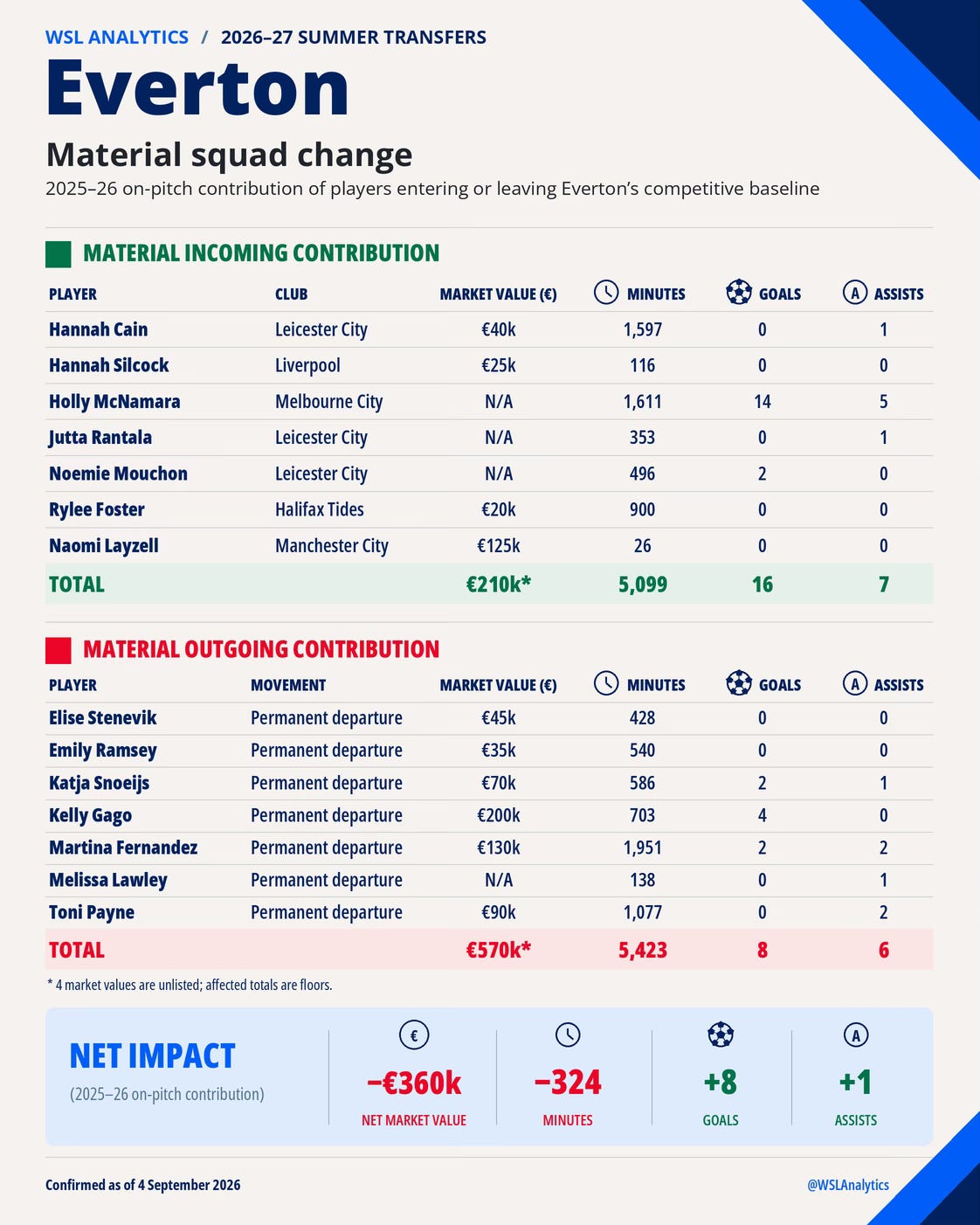
Everton’s outgoing group supplied 5,423 league minutes, eight goals and six assists. Martina Fernández is the defining loss: 1,951 minutes, two goals and two assists, with starts in all 22 league matches before Barcelona activated their buy-back. Replacing that level of availability at centre-back is the window’s clearest unresolved task.
The attacking loss is spread across Kelly Gago, Katja Snoeijs and Toni Payne. Gago leaves after four goals in 703 minutes; Snoeijs contributed two goals and an assist; Payne added 1,077 minutes and two assists from wide areas. Emily Ramsey’s 540 minutes in goal, plus Elise Stenevik’s 428 minutes of defensive cover, remove further depth from a side that could not afford to become thinner.
Everton therefore needed more than fresh attacking names. They needed to replace Gago’s goals, maintain their goalkeeping depth and find a credible successor to Fernández’s ever-present defensive role.
Did Everton solve the problem?
Everton’s clearest answer is Holly McNamara, who arrives with 14 goals and five assists in 1,611 A-League minutes for Melbourne City. She gives Everton the scoring profile they lacked too often last season. Hannah Cain adds 1,597 recent WSL minutes, while Noémie Mouchon and Jutta Rantala offer further forward options after disrupted seasons at Leicester.
The defensive response is less certain. Naomi Layzell arrives on loan with only 26 recent WSL minutes, while Hannah Silcock brings potential and useful depth but not evidence equivalent to Fernández’s 22-start role. Rylee Foster gives the goalkeeper group competition behind Courtney Brosnan, but she is a depth solution rather than a direct answer to Everton’s central-defensive loss.
Across the incoming group, Everton add at least €210k in listed market value, 5,099 recent league minutes, 16 goals and seven assists — twice the goal output of the departing group. The recorded net swing is −324 minutes and −€360k in listed value, but +8 goals and +1 assist: an incoming group with slightly fewer recent minutes and a lower listed-value floor, but meaningfully more attacking end product concentrated heavily in one signing.
Verdict
➡️ Window verdict: Qualified positive
Squad impact: Attack strengthened; centre-back succession unresolved
McNamara gives Everton a signing with genuine game-changing upside, while Cain, Mouchon and Rantala make the forward line deeper and less dependent on one source of goals. But Fernández was Everton’s highest-minute player and no arrival yet matches her experience or workload at centre-back. Everton have raised their attacking ceiling; whether they have protected their floor depends on how quickly the new defensive group settles.
🔵 Birmingham City
The baseline
Birmingham City return to the WSL as WSL2 champions, promoted after winning the decisive final-day match at Charlton. They finished on 44 points, level with Crystal Palace but ahead on goal difference, having scored 46 and conceded 24 across 22 matches. That is a promotion-winning record — but also a reminder that their summer starts from a different question: can the team that mastered WSL2 become competitive quickly at the higher level?
The task was not to abandon the attack that won promotion. Wilma Leidhammar, Martha Harris and the retained forward group have earned the chance to test themselves in the WSL. Birmingham instead needed to add top-flight experience through the spine, replace the leadership and goalkeeping security that left, and give a newly promoted side enough resilience to ensure promotion is not followed by an immediate survival fight.
What Birmingham City lost before they could improve
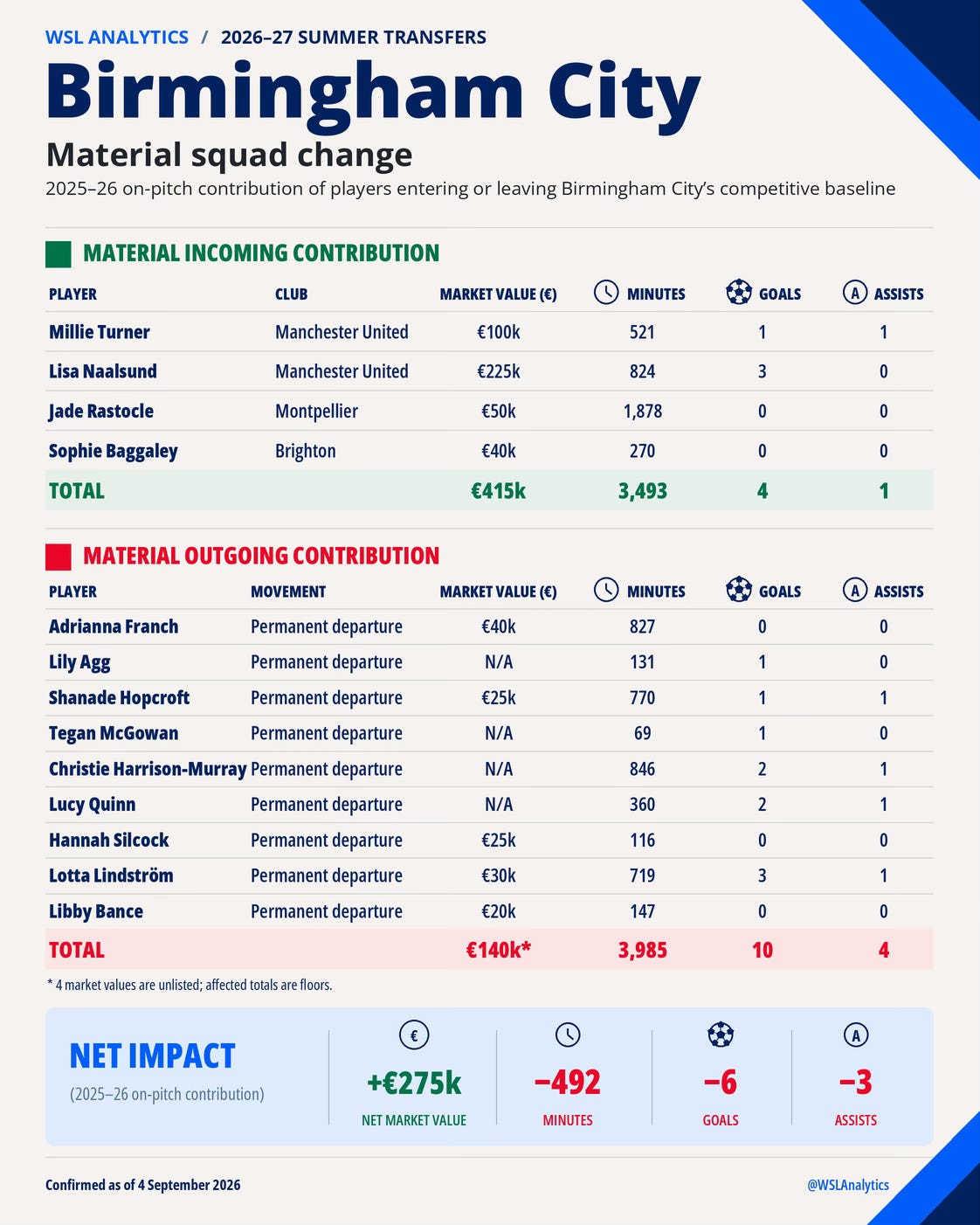
Birmingham’s outgoing group is not defined by a mass loss of current WSL2 production. The clearest departures are experience, leadership and goalkeeping continuity. Adrianna Franch played 827 league minutes last season, while captain Christie Harrison-Murray supplied 846 minutes at the heart of the defence. Together, they leave a newly promoted side without two of the figures who helped turn a strong Championship squad into champions.
The most visible attacking departure is Lotta Lindström, whose three goals and one assist in 719 league minutes made her a useful part of Birmingham’s promotion attack. The remaining exits carried far lighter recent workloads: some were fringe contributors, some had spent time away from the club, and others had not established themselves in the promotion-winning side. That matters because Birmingham are not trying to rebuild an entire XI.
But the losses still sharpen the summer brief. Birmingham needed a goalkeeper solution after Franch, a way to replace Harrison-Murray’s leadership and centre-back reliability, and enough proven top-flight experience that their retained WSL2 attack would not be asked to make the step up without support.
Did Birmingham City solve the problem?
Birmingham have used the window to strengthen the spine rather than replace their attack from scratch. Lisa Naalsund arrives with 824 WSL minutes and three goals from Manchester United, bringing top-flight midfield experience to a promoted team. Millie Turner adds 521 WSL minutes, a goal and an assist, plus the leadership of a player who has competed at the league’s highest level. Jade Rastocle complements them with 1,878 recent league minutes for Montpellier: a younger centre-back addition with the workload to compete for a role quickly.
The goalkeeper response is deliberately collective. Sophie Baggaley brings 270 recent WSL minutes, while Katie Startup provides another senior option after a season without top-flight league action. Neither arrives as a proven like-for-like successor to Franch, but together they create a genuine competition rather than leaving Birmingham dependent on one new starter. The defence has also gained more experience around Harrison-Murray’s exit, even if replacing a title-winning captain is not a numbers exercise.
Across Turner, Naalsund and Rastocle, Birmingham add 3,223 recent top-flight league minutes, four goals and one assist. Crucially, they have retained the promotion attack rather than trying to replace Lindström externally: Crosthwaite, Sarri and Leidhammar combined for 22 WSL2 goals last season. Birmingham have added the WSL experience and defensive structure they lacked, while trusting the players who won the division to provide the goals.
Verdict
➡️ Window verdict: Qualified positive
Squad impact: Stronger through the spine; attack untested at WSL level
Birmingham have avoided an indiscriminate promotion rebuild. Naalsund, Turner and Rastocle add the top-flight experience, leadership and defensive depth a newly promoted side needs, while the retained forward group preserves the attack that won WSL2. The unanswered questions are in goal and in transition: the new goalkeeper competition must settle quickly, and Birmingham’s 22-goal retained attacking core must show that its promotion form can travel.
🔴 Charlton Athletic
The baseline
Charlton entered the summer as a promoted side, but not an uncomplicated one. They finished third in WSL2 on 42 points, having led the division by nine points earlier in the campaign before Birmingham and Crystal Palace overtook them on the final day. Promotion still came through a goalless play-off against Leicester, won on penalties — proof of resilience, but also of how fine the margins had become.
Their underlying platform was defence. Charlton conceded a division-low 21 league goals, kept eight clean sheets and were comfortable succeeding without dominating possession. The task for the summer was to make that structure survive against stronger WSL attacks, while adding enough attacking threat so that they don’t spend every week defending their way to safety.
What Charlton Athletic lost before they could improve
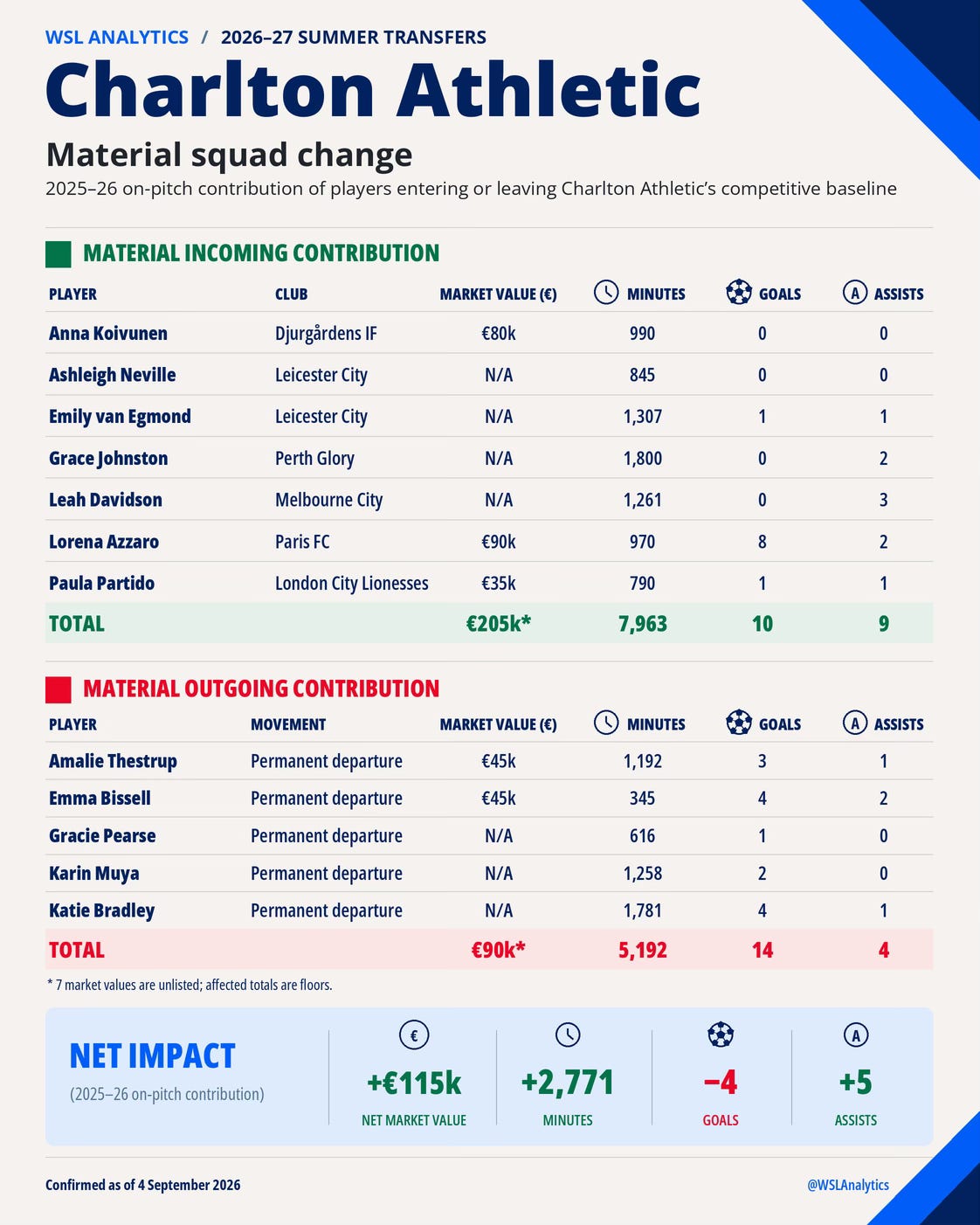
Charlton’s departures remove 5,192 recorded league minutes and 18 goal involvements, but the replacement task is concentrated in four players. Katie Bradley is the defining loss: 1,781 minutes, four goals and one assist from a player who was central to the team’s set pieces and familiarity with the system. Karin Muya adds a further 1,258 minutes of regular midfield workload.
Amalie Thestrup’s exit removes the side’s most regular centre-forward reference: 1,192 minutes, three goals and one assist. Emma Bissell is the more unusual loss. Her workload was only 345 minutes, but she produced four goals and two assists — the kind of bench efficiency that is difficult to plan for, particularly after promotion.
Charlton therefore needed to replace Bradley’s influence across midfield and set pieces, find enough forward production to cover Thestrup and Bissell, and make sure the departures did not loosen the defensive organisation that had carried the promotion campaign.
Did Charlton Athletic solve the problem?
Charlton have brought in more attacking evidence than they lost. Lorena Azzaro is the clearest new scoring arrival after eight goals and two assists in 970 Première Ligue minutes for Paris FC. Emily van Egmond adds 1,307 recent WSL minutes, one goal and one assist from midfield, while Paula Partido offers another attacking option after a season split between Liga F and London City. None is a simple Bradley or Thestrup replacement, but together they broaden a group that needed more than one route to goal.
The defensive additions are designed to protect Charlton’s identity rather than reinvent it. Ashleigh Neville brings recent WSL experience and athleticism at full-back; Grace Johnston arrives after playing every minute of Perth Glory’s league season; and Leah Davidson adds 1,261 A-League minutes and three assists from midfield. Anna Koivunen gives Sophie Whitehouse real goalkeeping competition, but Whitehouse’s 1,980 promotion-season minutes and eight clean sheets mean this is depth, not an automatic change of number one.
Across the seven new arrivals, Charlton have added 7,963 recent league minutes and 19 goal involvements. Keira Flannery’s permanent move matters differently: it secures the 1,891 Charlton minutes she had already supplied on loan, preserving rather than adding to the promotion baseline. Charlton have invested in experience, scoring and defensive availability; the question is whether a group assembled from several leagues can preserve their defensive discipline while producing enough at WSL level.
Verdict
➡️ Window verdict: Qualified positive for survival
Squad impact: Strengthened in experience and depth; attack must translate
Charlton have recruited with a clear understanding of what promotion requires. Azzaro offers the most credible new source of goals, while Neville, Johnston, Davidson and van Egmond add experience and workload around a defensive base that already worked. Keeping Flannery preserves an important part of that base. But Bradley’s influence, Bissell’s efficiency and the need for goals from several new leagues mean Charlton’s survival case still depends on quick adaptation rather than recruitment alone.
Data sources
Transfers were reconciled from club announcements, destination-club confirmations and reputable football reporting. Previous-season league minutes, goals and assists were compiled from provider and competition records; league tables and team baselines come from completed 2025–26 match results. For players arriving from calendar-year competitions, such as the NWSL, we use the full 2025 league season rather than an incomplete 2026 sample. Where a player had already changed clubs before this transfer window, we credit only their production at the club they are actually arriving from, even if that spell is shorter than a full season, rather than reaching back to an earlier, non-contiguous club. Market values are Soccerdonna estimates captured on 4 September.
📅 What’s Next
Part 3 closes the series with Brighton, Chelsea, London City Lionesses and Manchester City — four clubs whose windows range from targeted reinforcement to major squad reconstruction.
See you in Part 3.
I'm enjoying your break down of the transfer market for this season. You have missed 3 of Villa's signings.