

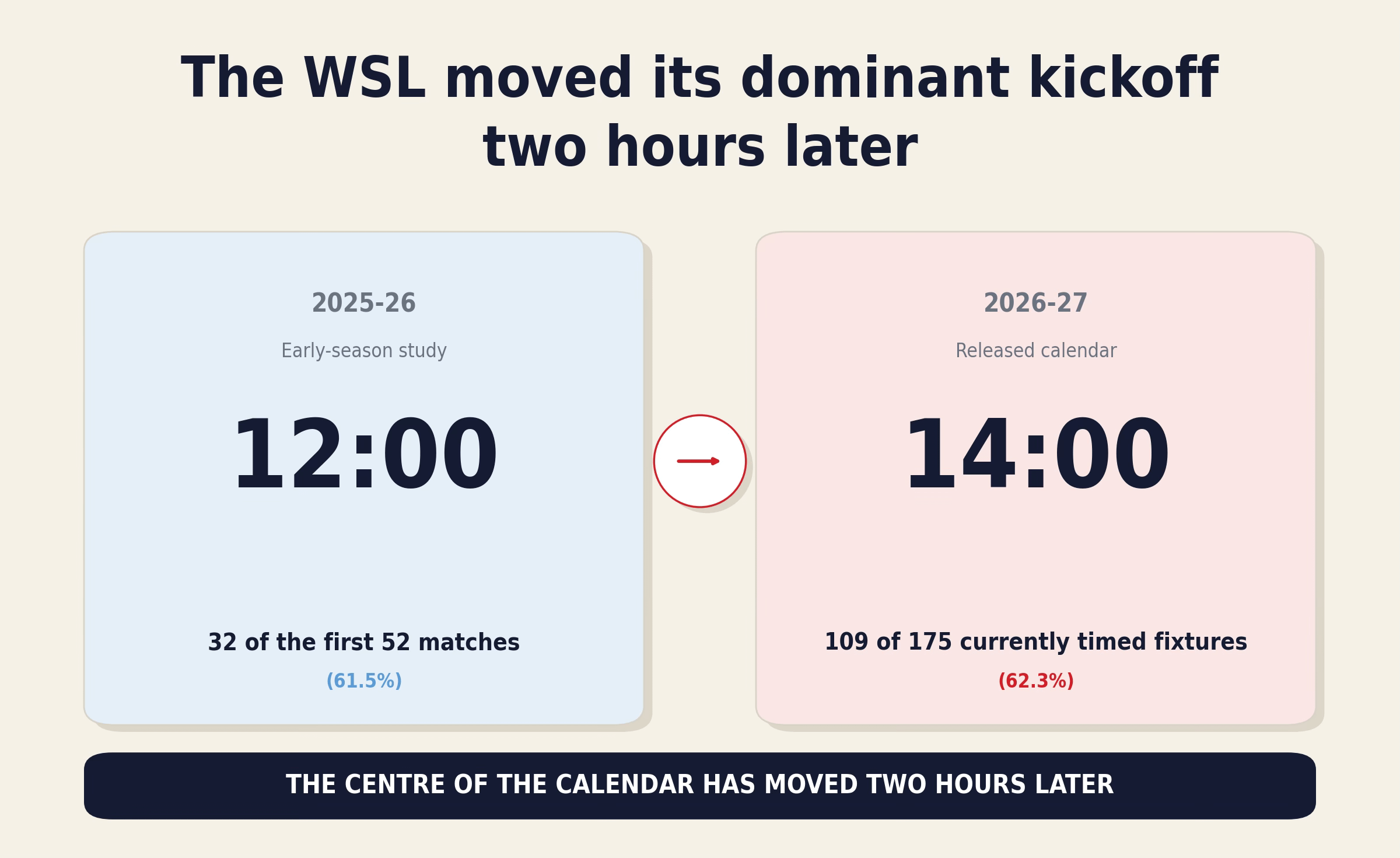
The 2026–27 fixture release was the first clear indication of how WSL Football responded to last season’s attendance and broadcast experiment.
The response is visible immediately. Sunday still remains the league’s dominant day, but that awkward noon kickoff no longer controls the calendar. The new schedule is now built around 14:00. The use of larger stadiums is also becoming standard. Six clubs have all 13 home fixtures at a main stadium, another six use a hybrid model and 92 of the league’s 182 matches are currently assigned to a main or larger ground.
That is a meaningful change in strategy. It gives clubs better conditions in which to attract supporters. It does not guarantee that they will.
The clearest change is the clock
Last season, the WSL deliberately concentrated matches around Sunday midday. The stated objective was to create a recognisable appointment-to-view and give every matchweek a consistent shape.
The outcome of that was mixed. Our early-season attendance study found that 32 of the first 52 league matches—61.5%—started at 12:00. Another five began at either 11:55 or 12:15. In total, 37 of the 52 fixtures were scheduled within 15 minutes of noon.
It is true that kickoff time was not the only cause of weak crowds. Things like club demand, fixture quality and venue mattered even more. But timing amplified those conditions. A major match could overcome an inconvenient time slot; a less prominent one often could not.
The new calendar changes that centre of gravity. Of the 175 fixtures with a published time, 109—62.3%—are scheduled for 14:00. Only seven are currently at 12:00, with none at 11:55 or 12:15. Sunday still accounts for 136 of the 175 timed fixtures, so the league has not abandoned its principal matchday. It simply moved it later.
For supporters, 14:00 is a more usable time. It allows more time for travel, reduces the pressure on families and creates a larger pre-match hospitality window. Later broadcast selections could still alter the schedule, but the league has corrected the most obvious weakness in last season’s calendar.
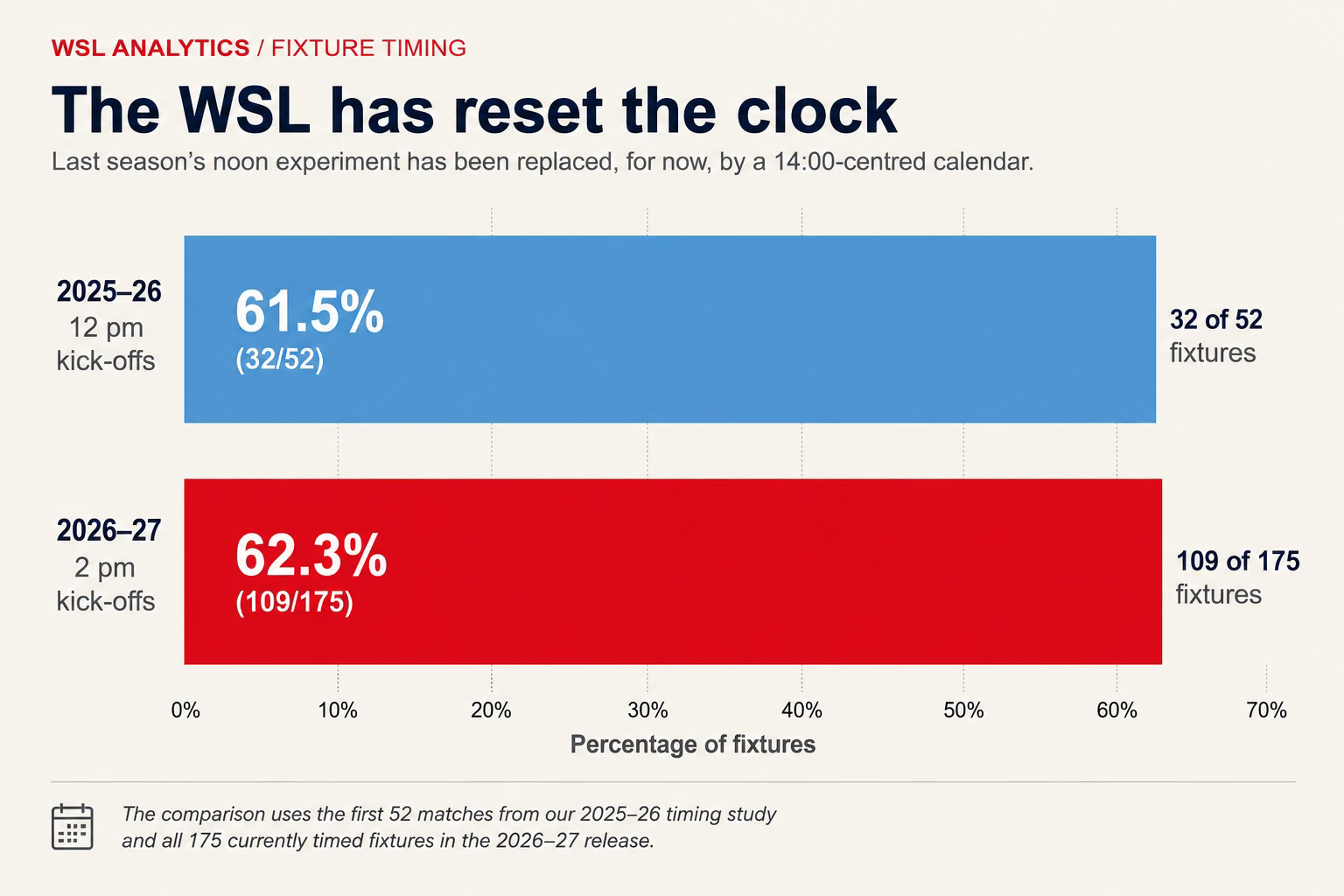
The comparison uses the first 52 matches from our 2025–26 timing study and all 175 currently timed fixtures in the 2026–27 release.
Big-stadium football is becoming the operating model
The second change is even larger.
Arsenal, Aston Villa, Birmingham City, Charlton Athletic, Chelsea and Everton currently have all 13 home league fixtures at a main stadium. Brighton, Liverpool, Tottenham Hotspur, Manchester City, Crystal Palace and Manchester United use a hybrid model that places selected matches at a larger venue.
Across the league, 92 of 182 fixtures—50.5%—are assigned to a main or larger stadium. The big grounds are no longer being treated only as a showcase. They are becoming the operating model.
Arsenal demonstrated the opportunity last season. Their 11 Emirates league matches generated 371,886 spectators, 41.2% of the league’s total attendance. Everton’s use of Goodison Park created another permanent step up. Chelsea are taking the same bet by scheduling all 13 home matches at Stamford Bridge.
It is important to note that capacity is not demand. A club that opens a major stadium every week must create repeat behaviour through season tickets, local partnerships, group sales, transport planning and a recognisable matchday identity. The test is no longer whether a club can stage one large event. It is whether it can sustain a large home crowd across an entire season.
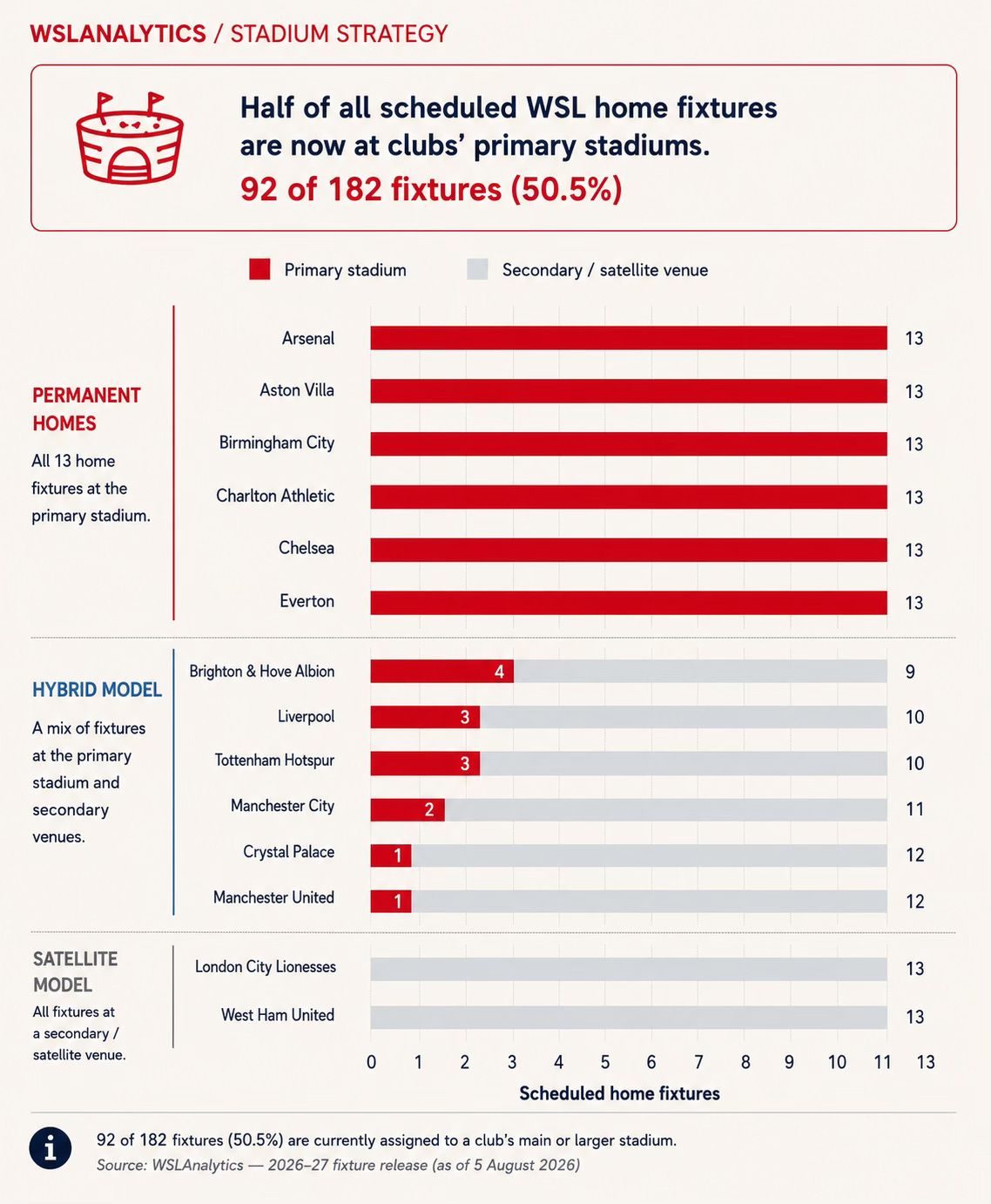
“Main or larger stadium” is a venue classification, not an attendance forecast. London City Lionesses and West Ham remain at their established home grounds in the current release.
One million spectators is now a weak benchmark
Another important feature of the expanded league is that it changes our headline benchmark. The WSL drew 902,981 spectators across 132 matches in 2025–26, an average of 6,841 and a median of 3,236. With 182 matches this season, one million spectators would require an average of only 5,495—19.7% below last year’s figure. If the previous average were simply maintained, total attendance would reach about 1.245 million.
One million would be marketable. It would not, on its own, prove growth. Average attendance, median attendance, stadium utilisation and improvement beyond Arsenal will tell us far more.
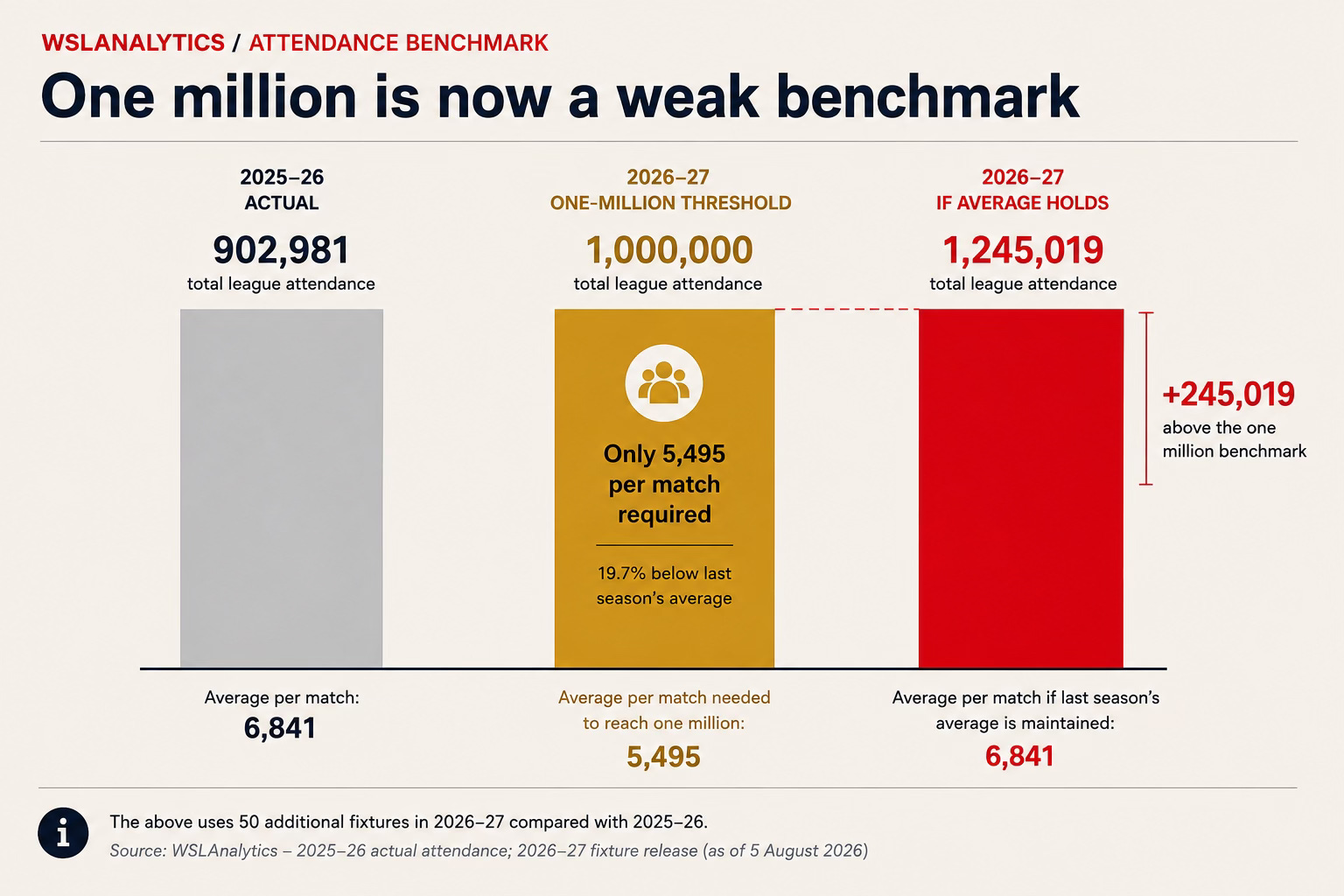
The “if average holds” figure is a mechanical scenario, not a forecast.
The broadcast structure is clearer. The reach question remains.
The new fixture plan improves when matches are played, but it does not yet expand who can watch them without a Sky subscription. That is the unresolved part of the WSL’s audience strategy.
The opening four matchweeks contain 28 fixtures. Sky will show 25 of them, while three will appear on the BBC. Within Sky’s allocation, 14 matches are on Sky Sports+ and 11 receive a dedicated Sky Sports slot. This gives existing supporters comprehensive access and creates clearer television windows. However, it leaves free-to-air exposure largely unchanged.
This is important because last season demonstrated the difference between availability and discovery. Domestic coverage increased by 76% to 697 hours, yet measured reach fell by 10% to 11.06 million and total viewing hours slipped by 1%. Also all of the ten largest live audiences came on the BBC last season. So while Sky showed more football, the BBC delivered the season’s largest individual audiences.
This is not an argument against Sky’s position as the WSL’s principal broadcast partner. Sky provides the volume, production and consistent destination required by the five-year agreement. The issue is how the smaller BBC allocation is used. Those matches are the league’s strongest opportunity to reach people who do not already follow the competition.
Most of the season remains unassigned, so this is not a final verdict. The remaining 154 fixtures could still produce a stronger BBC schedule. For now, the WSL has improved the structure of its coverage; whether it has improved its reach remains unanswered.
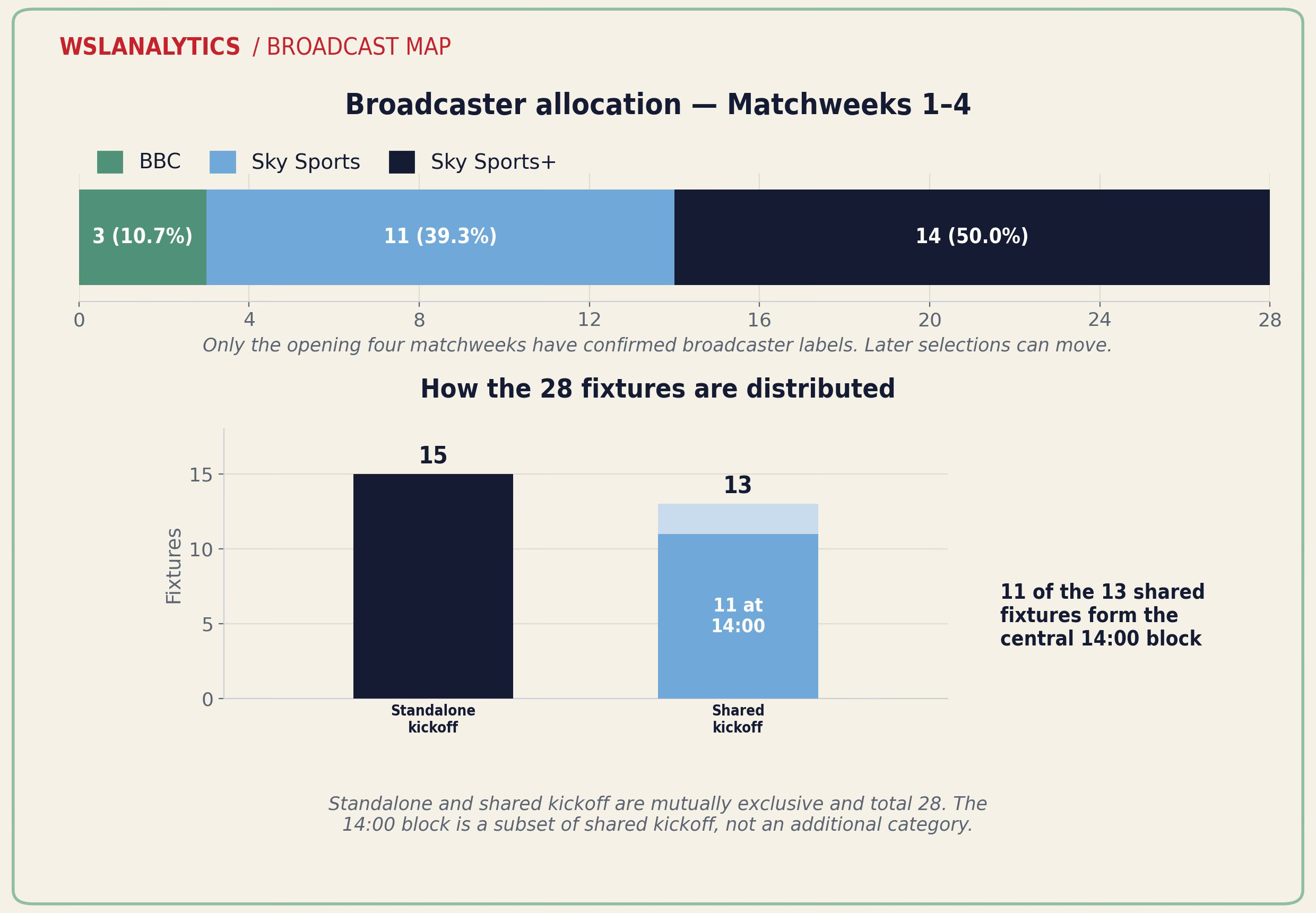
The chart covers Matchweeks 1–4 only. It does not assume the later unassigned fixtures will remain in their current slots.
What success now looks like
The WSL has improved the conditions around attendance in three clear ways: the dominant kickoff has moved from noon to 14:00, clubs have committed far more inventory to major stadiums and premium matches can be separated from the central Sunday block.
The risks are equally clear. Larger grounds can expose empty seats. Growth can remain too dependent on Arsenal. A crowded 14:00 block can reproduce the same fragmentation as noon. And a schedule concentrated on paid platforms can serve existing supporters without widening the audience.
The league should therefore be judged against four tests: whether average and median attendance rise; whether growth extends across more clubs; whether larger stadiums achieve credible utilisation; and whether later broadcast selections preserve the better timing in the released calendar.
Verdict: a better plan, not problem solved
The WSL has corrected two clear weaknesses from last season. It has moved the centre of the calendar from noon to 14:00 and committed half of its fixtures to main or larger stadiums. That gives supporters more convenient kickoff times and gives clubs substantially more room to grow their crowds.
But better conditions do not automatically create greater demand. Larger stadiums still have to be filled, attendance growth must extend beyond Arsenal and the league must reach people who are not already committed supporters. The opening broadcast allocation does not yet show a significant expansion of that reach.
So, has the WSL fixed its audience problem? No—not yet. It has removed some of the obstacles that made growth more difficult.
The 2026–27 fixture list provides a much stronger platform for attendance growth than last season’s calendar. Whether that platform produces a genuinely larger audience will now depend on club-level ticketing, promotion, stadium utilisation and the quality of the remaining broadcast selections.