

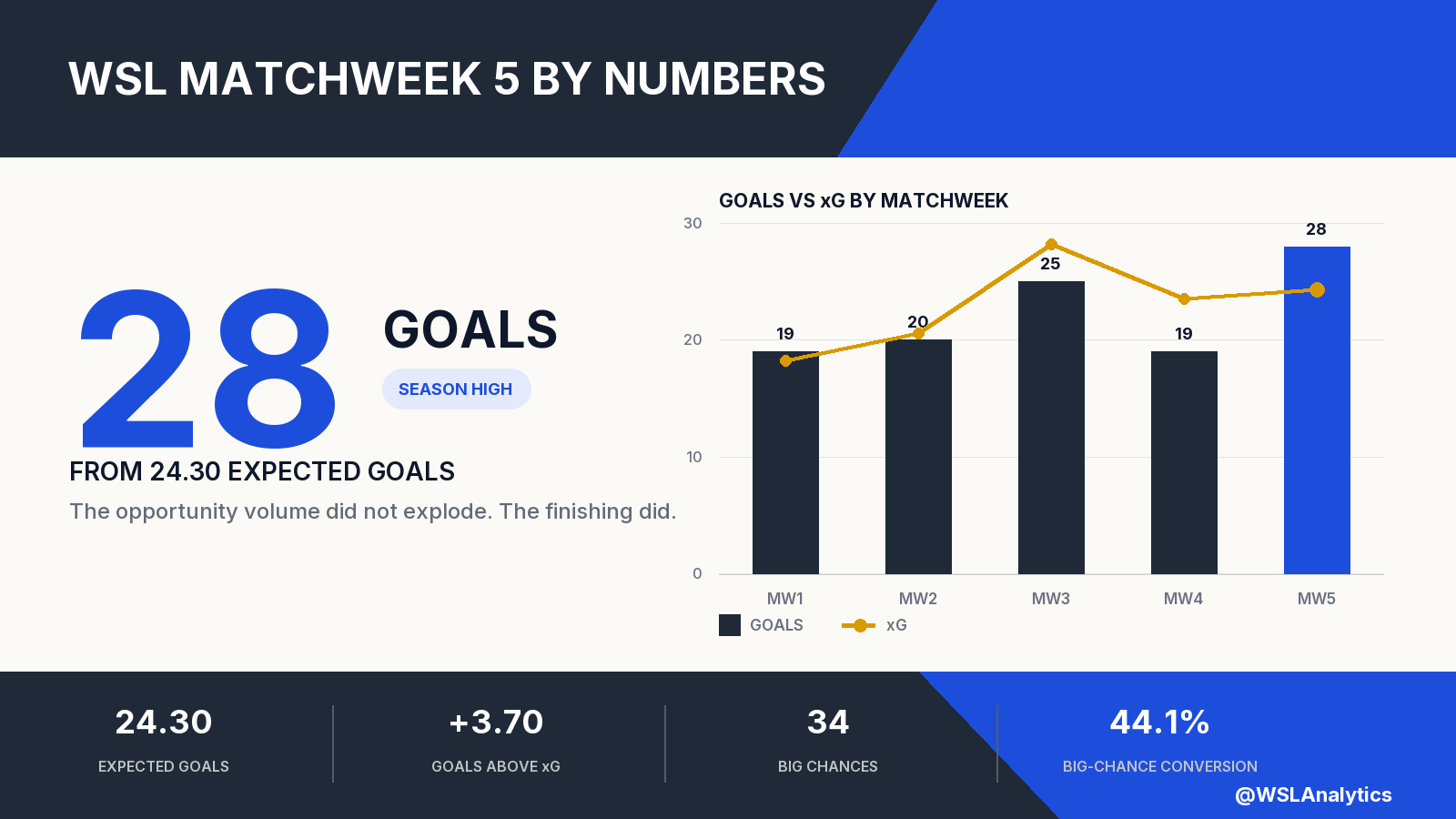
Matchweek 5 produced 28 goals—the most in any round this season—but this was not simply a weekend of overwhelming chance volume. The seven matches generated fewer shots and fewer big chances than Matchweek 4. What changed was how efficiently those opportunities were finished.
There were also several scorelines that need more explanation than the result alone provides: London City and Tottenham created a similar number of chances but very different chance quality; Manchester City were outshot and lost the overall xG contest against Arsenal but were more clinical with the chances they created; and Manchester United beat Liverpool largely because of the round’s outstanding goalkeeping performance.
Here are eight things that stood out in the numbers.
1. Matchweek 5 produced 28 goals from 24.30 xG
The league recorded its highest-scoring round of the season despite producing neither its most shots nor its most expected goals.
Across the seven matches, there were:
28 goals from 24.30 xG
192 shots
70 shots on target
34 big chances
15 big chances converted
That is a collective overperformance of 3.70 goals—the largest positive goals-minus-xG difference of the season so far.
The contrast with Matchweek 4 is sharp. It produced 19 goals from 23.52 xG, a shortfall of 4.52 goals. In Matchweek 5, overall shot conversion rose from 9.5% to 14.6%, while big-chance conversion jumped from 24.3% to 44.1%.
The volume did not suddenly explode. The finishing did.
2. London City produced 5.99 xG—the highest by any team this season
London City’s 6–1 victory over Tottenham generated several season highs.
They accumulated 5.99 xG and created 10 big chances, the highest single-match totals recorded by any WSL team through five rounds. The two teams combined for 8.40 xG, comfortably above the previous season high of 5.73 from Manchester City–Liverpool in Matchweek 3.
This was not a simple story of London City monopolising the ball or producing far more attacks. They had only 41% possession, while Tottenham created 13 chances to London’s 14 and attempted 18 shots to London’s 21.
The decisive difference was chance quality.
At half-time, both teams had attempted 10 shots and recorded 18 opposition-box touches. London City nevertheless led 3–0 because they had generated 3.07 xG to Tottenham’s 0.79 and put six shots on target to Tottenham’s one.
Tottenham still finished with 2.41 xG. London City did not merely create more; they created much better and executed far more cleanly.
3. Manchester City’s four goals came from only 1.01 xG—but the full story is more nuanced
Manchester City’s 4–2 win over Arsenal produced the largest single-team xG overperformance of the season: four goals from 1.01 xG, a difference of +2.99.
Arsenal had more shots, more shots on target and more overall xG:
Shots: Arsenal 16–9 City
Shots on target: Arsenal 9–5 City
xG: Arsenal 1.61–1.01 City
But Arsenal’s xG advantage was largely created by Lisa Baum’s 0.92-xG opportunity from a corner. In open play, City led the xG 0.92–0.56 and created three big chances to Arsenal’s one.
The goalkeeping numbers widened the difference further. Ayaka Yamashita made seven saves and prevented 0.68 goals for City. Anneke Borbe conceded four from 2.09 xG on target, leaving her with a goals-prevented figure of –1.91.
City trailed twice, but produced all three of their big chances after half-time and won the moments that decided the match.
4. Chelsea held West Ham to zero shots
West Ham became the first team this season to complete a WSL match without attempting a shot.
Chelsea won 3–0 while recording:
21 shots to West Ham’s zero
2.77 xG to zero
15 chances created to zero
Four big chances to zero
67% possession
47 opposition-box touches
This was the first time across the opening 35 matches that a team recorded neither a shot nor a chance created.
Chelsea put only three of their 21 attempts on target, but all three resulted in goals. At one end, they completely removed West Ham’s attacking threat. At the other, they made their limited on-target shooting count.
5. Phallon Tullis-Joyce turned Liverpool’s pressure into nothing
Liverpool outperformed Manchester United across most of the attacking measures at the Progress with Unity Stadium in Leigh:
Shots: Liverpool 15–9 United
Shots on target: Liverpool 8–3 United
xG: Liverpool 1.47–0.47 United
Chances created: Liverpool 9–4 United
United still won 1–0.
Julia Zigiotti Olme scored after six minutes from an attempt worth only 0.04 xG. Phallon Tullis-Joyce then saved all eight Liverpool shots on target and prevented 1.98 goals—the highest single-match goal-prevention figure recorded by any WSL goalkeeper this season.
United did not win the attacking process. They won because their early finish and their goalkeeper were decisive.
6. Brighton responded to an early setback with overwhelming control
Charlton took the lead after three minutes through an opportunity worth 0.82 xG. Almost everything after that belonged to Brighton.
Brighton finished with:
76% possession
25 shots
3.78 xG
51 opposition-box touches
16 chances created
Charlton managed three shots, three opposition-box touches and two chances created.
The final 5–1 scoreline does need one qualification: Brighton led 3–1 until two set-piece goals in the third and ninth minutes of stoppage time. Those late goals enlarged the margin, but they did not create the underlying dominance. Brighton had already controlled virtually every attacking measure.
7. Everton scored twice without creating a single big chance
Everton’s 2–1 victory over Birmingham was the lowest-xG match of the round at 1.68 combined, yet all three goals were scored.
Everton attempted 17 shots and put nine on target, but none was a big chance. They generated 0.99 xG in total.
Ruby Mace supplied both of them from four shots and only 0.36 xG. Birmingham’s Océane Hurtré also converted a 0.15-xG attempt.
The three goals had a combined shot value of only 0.42 xG. This was a match decided by the execution of relatively difficult opportunities rather than the creation of clear ones.
8. Aston Villa created four big chances and still could not beat Crystal Palace
Aston Villa generated 1.31 xG, created four big chances and missed three of them in the 1–1 draw with Crystal Palace.
Palace created only one big chance, but there was more balance to the match than those totals alone suggest. They edged the opposition-box touches 22–21, matched Villa’s eight second-half shots and generated 0.75 second-half xG to Villa’s 0.79.
Abbie Larkin’s equaliser came from an attempt worth only 0.05 xG. Villa created the clearer opportunities, but Palace maintained enough territorial presence to stay in the contest and found their finish from the least likely opening.
The Matchweek 5 crowd picture
The round drew 26,782 spectators, producing an average of 3,826 and a median crowd of 2,377.
Confirmed attendances, ranked (stadium occupancy in brackets)
Manchester City v Arsenal: 12,360 (20.1%)
Manchester United v Liverpool: 3,416 (28.5%)
Brighton v Charlton: 2,465 (7.6%)
Tottenham Hotspur v London City Lionesses: 2,377 (25.6%)
West Ham United v Chelsea: 2,185 (35.9%)
Everton v Birmingham City: 2,026 (5.1%)
Aston Villa v Crystal Palace: 1,953 (5.3%)
Manchester City’s 12,360 at the Etihad Stadium was comfortably the largest crowd and accounted for 46.2% of the Matchweek 5 total.
But the largest crowd did not produce the highest occupancy. That belonged to West Ham, whose 2,185 spectators filled 35.9% of Victoria Road Stadium. Manchester United followed at 28.5%, with Tottenham at 25.6%.
Across the season, 34 of the 35 completed matches have drawn 175,534 spectators—17.6% of the Road to 1 Million target. The average crowd is 5,163, below the 5,495 required to reach one million.
The round in one sentence
Matchweek 4 was defined by opportunities going unused; Matchweek 5 was defined by teams and players extracting far more from the opportunities they had.