

This is the final instalment of our three-part retrospective on the 2025 summer transfer window. Across the series, we have returned to the judgments we made before the season and tested them against what actually followed.
In Part 1, we revisited Arsenal, Brighton, Aston Villa and Leicester City. Part 2 examined Chelsea, Manchester United, Tottenham Hotspur and West Ham United. In this final part, the focus shifts to Everton, Liverpool, London City Lionesses and Manchester City.
The same questions remain: did the arrivals strengthen the first team, replace what departed and address the club’s most important needs?
The results reinforce the distinction at the heart of this series. Useful recruitment does not automatically produce a better season, while a strong retained core, a new coach or a different competitive environment can transform a team beyond the contribution of its summer arrivals. Equally, an ambitious window can give a promoted club the quality to compete immediately.
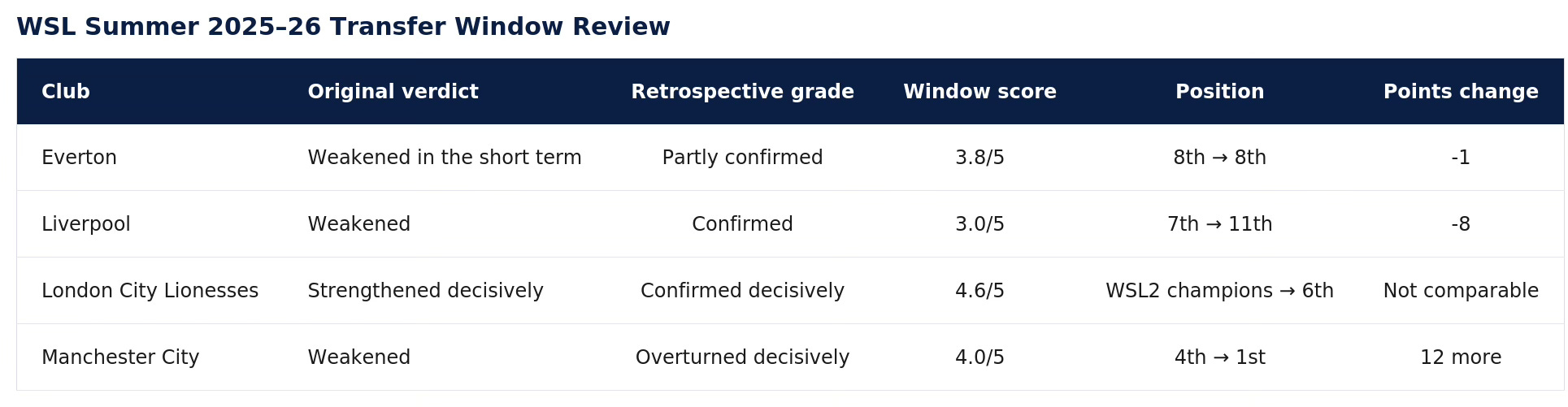
Part 3 at a glance
Everton — useful recruitment, unchanged season
Our original verdict: Weakened in the short term
Retrospective grade: Partly confirmed
Window score: 3.8/5
Our argument at the time was that Everton had lost considerable WSL experience and leadership without replacing it with enough proven league production. Yuka Momiki represented the clearest immediate contributor, while the wider group carried significant adaptation risk. We felt the squad looked weaker in the short term, even if several arrivals possessed longer-term potential.
One season later, the recruitment worked better than the team did.
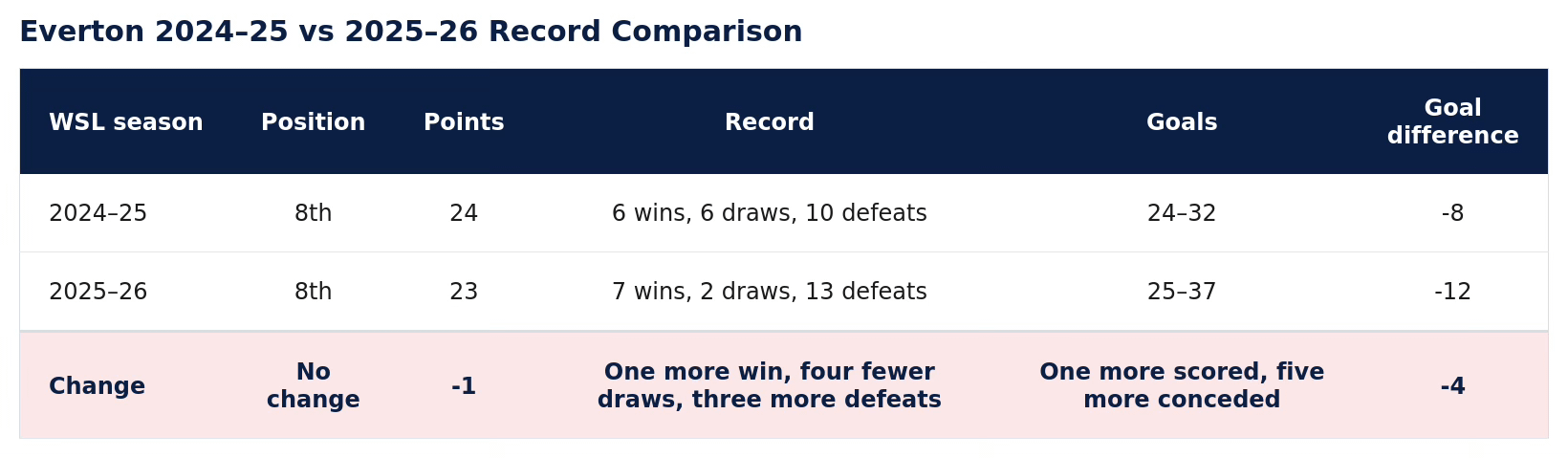
Everton finished eighth again, although they collected one fewer point and conceded five more goals. Brian Sørensen was also let go in February after three wins from 14 league matches. Overall, the campaign did not deliver the progress expected after the move to Goodison Park and an ambitious summer.
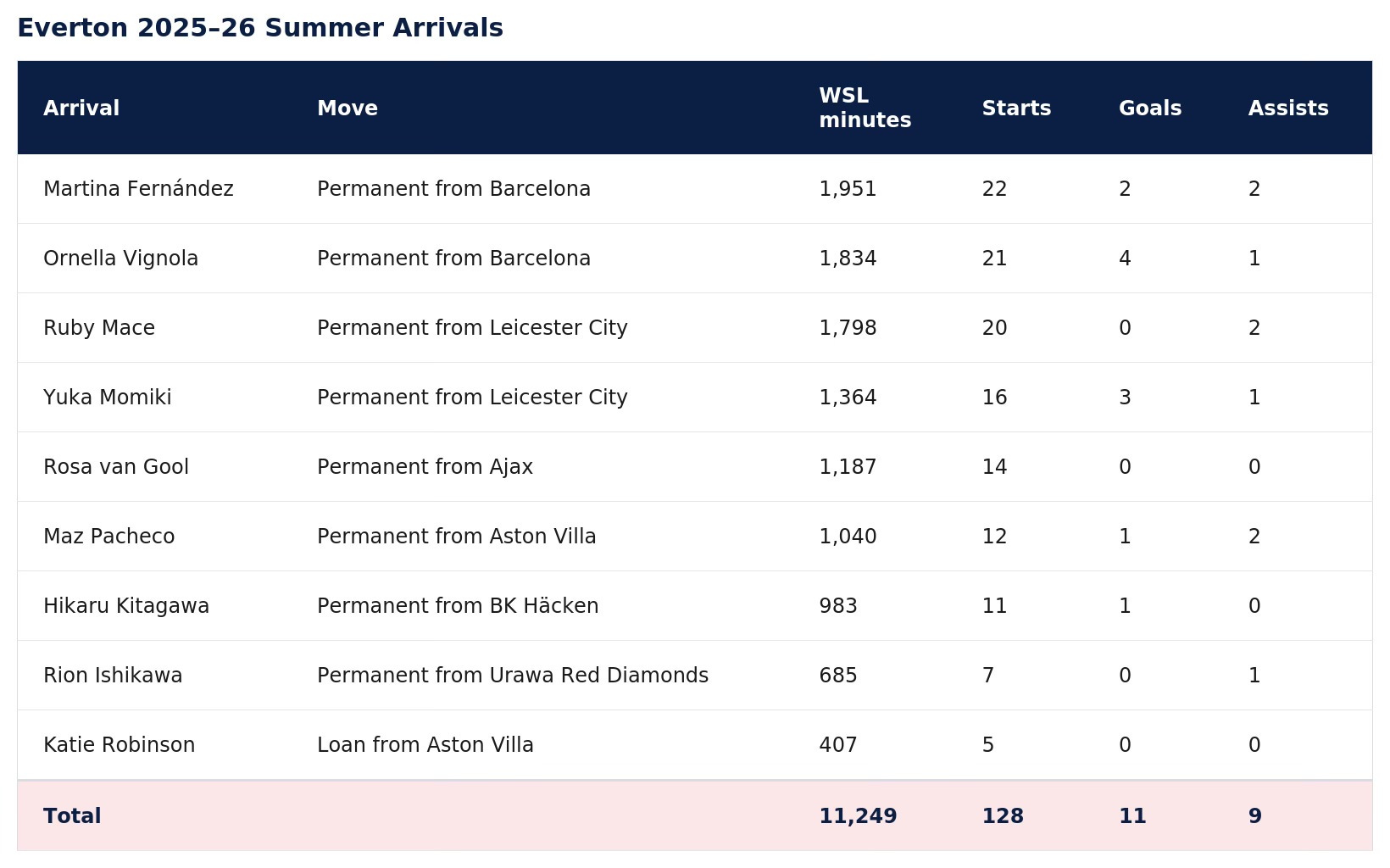
The arrivals, however, were not passengers. Martina Fernández and Ruby Mace became the central defensive pairing. Ornella Vignola started 21 matches and scored four goals, including a hat-trick on her WSL debut at Anfield, while Momiki contributed three goals and one assist. Altogether, the nine arrivals produced 11,249 minutes, 128 starts, 11 goals and nine assists.
Everton’s new core took responsibility—but did not raise the level
Our original verdict treated adaptation risk as the primary problem. In reality, several overseas arrivals adapted quickly enough to become regulars. But Everton had already removed much of the previous first-choice group, so those players had to assume responsibility immediately. Regular selection most likely reflected necessity rather than successful adaptation.
The final test was whether the new core could match or improve upon the players it replaced. It did not, because Everton collected one fewer point, scored only one additional goal and conceded five more. The attack still lacked a dominant scorer, while the managerial change further disrupted the campaign.
Our final verdict:
Everton’s summer arrivals formed a credible new first-team core, but they did not raise the team’s collective level. The short-term warning was justified, even if the individual players performed better than we expected.
Liverpool — one successful striker, weaker team
Our original verdict: Weakened
Retrospective grade: Confirmed
Window score: 3.0/5
Our argument at the time was that Liverpool had lost too much proven attacking quality and senior leadership. Olivia Smith, Taylor Hinds and several established players had departed. The squad looked younger, but also less authoritative especially in the areas that decide matches.
At the time of publication, Beata Olsson, Risa Shimizu, Alejandra Bernabé and Emilia Szymczak had not yet joined, so they were not included in our original analysis. Because this retrospective assesses the completed window and its overall impact, all four are included in the evaluation.
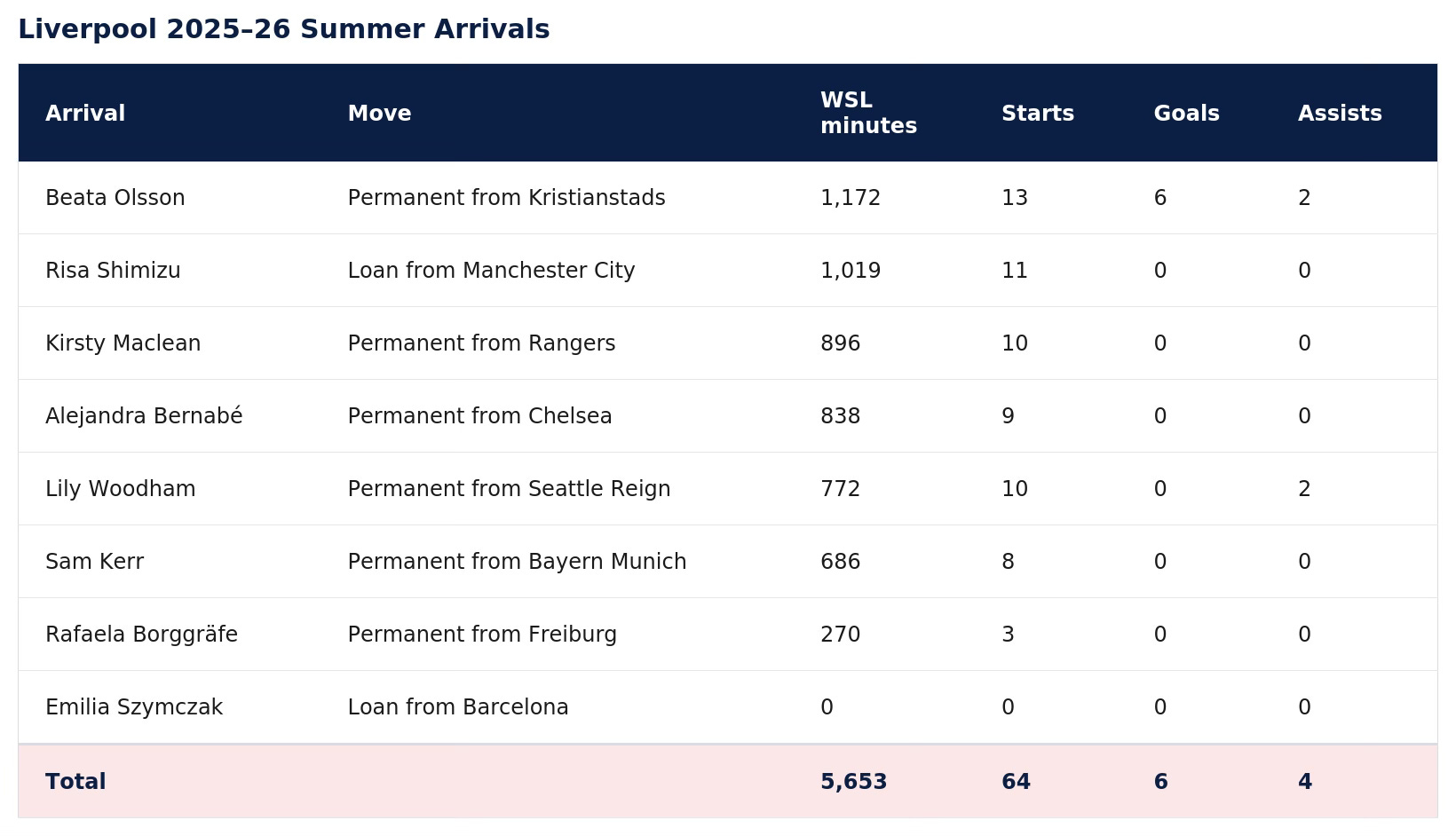
One season later, Liverpool were weaker despite finding a successful striker.
Olsson was the clear success. She scored six goals in 16 appearances, supplied two assists and accounted for almost 29% of Liverpool’s league goals. However, she was the only summer arrival to score in the WSL. Altogether, the eight arrivals produced 5,653 minutes, 64 starts, six goals and four assists.
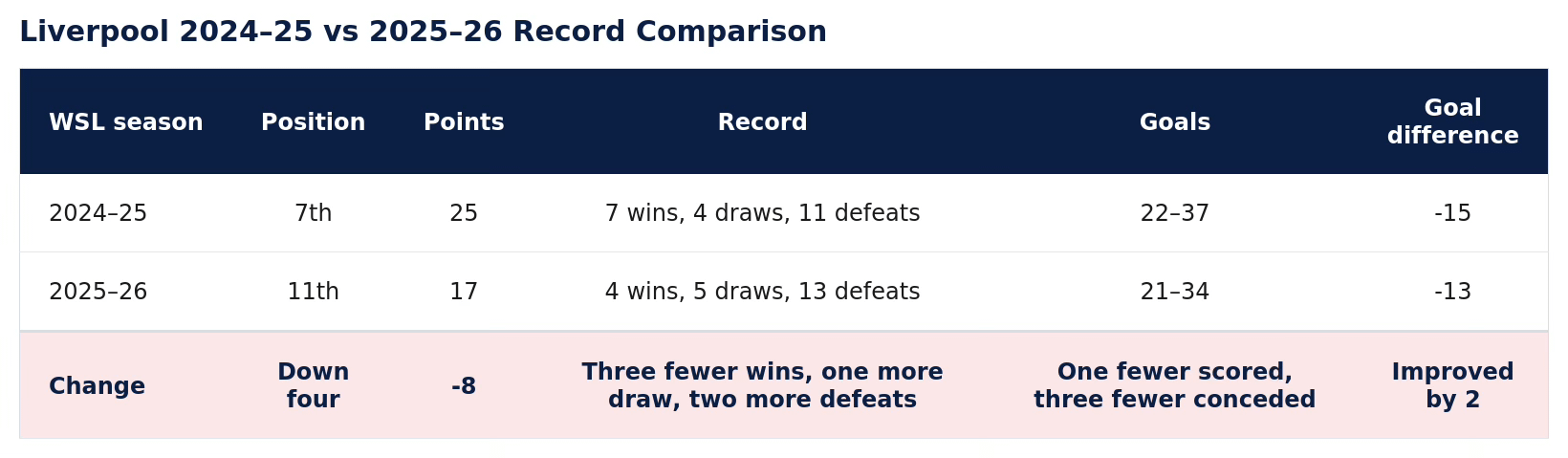
That was not enough to replace everything Liverpool had lost. They fell from seventh to 11th, collected eight fewer points and scored one fewer goal. The defence conceded three fewer, but the completed window did not restore the creativity, progression or leadership removed from the team.
Our final verdict:
Liverpool found a successful striker in Olsson, but the completed window did not replace enough of the creativity, progression and leadership that departed. Their fall from seventh to 11th confirmed our original warning.
London City Lionesses — ambitious recruitment, immediate impact
Our original verdict: Strengthened decisively
Retrospective grade: Confirmed decisively
Window score: 4.6/5
Our argument at the time was that London City had produced the clearest improvement of the summer. The promoted club added proven WSL production, Champions League experience, international leadership and younger players with significant upside, while losing little top-flight output.
The completed window eventually included 17 senior additions, giving London City genuine first-team options across every line.
One season later, the ambition translated immediately.
London City won eight matches, collected 27 points and finished sixth in their first WSL campaign, above six established top-flight clubs. Their summer recruitment formed the spine of the side.
Elene Lete played every league minute, Jana Fernández started 21 matches and Elena Linari started 15. Grace Geyoro started 16 times, but her overall influence and return of one goal and no assists fell short of the expectations surrounding such a high-profile signing. Nikita Parris contributed seven goal involvements, while Freya Godfrey produced six goals and four assists. The eight principal contributors shown below combined for 10,412 minutes, 119 starts, 15 goals and nine assists.
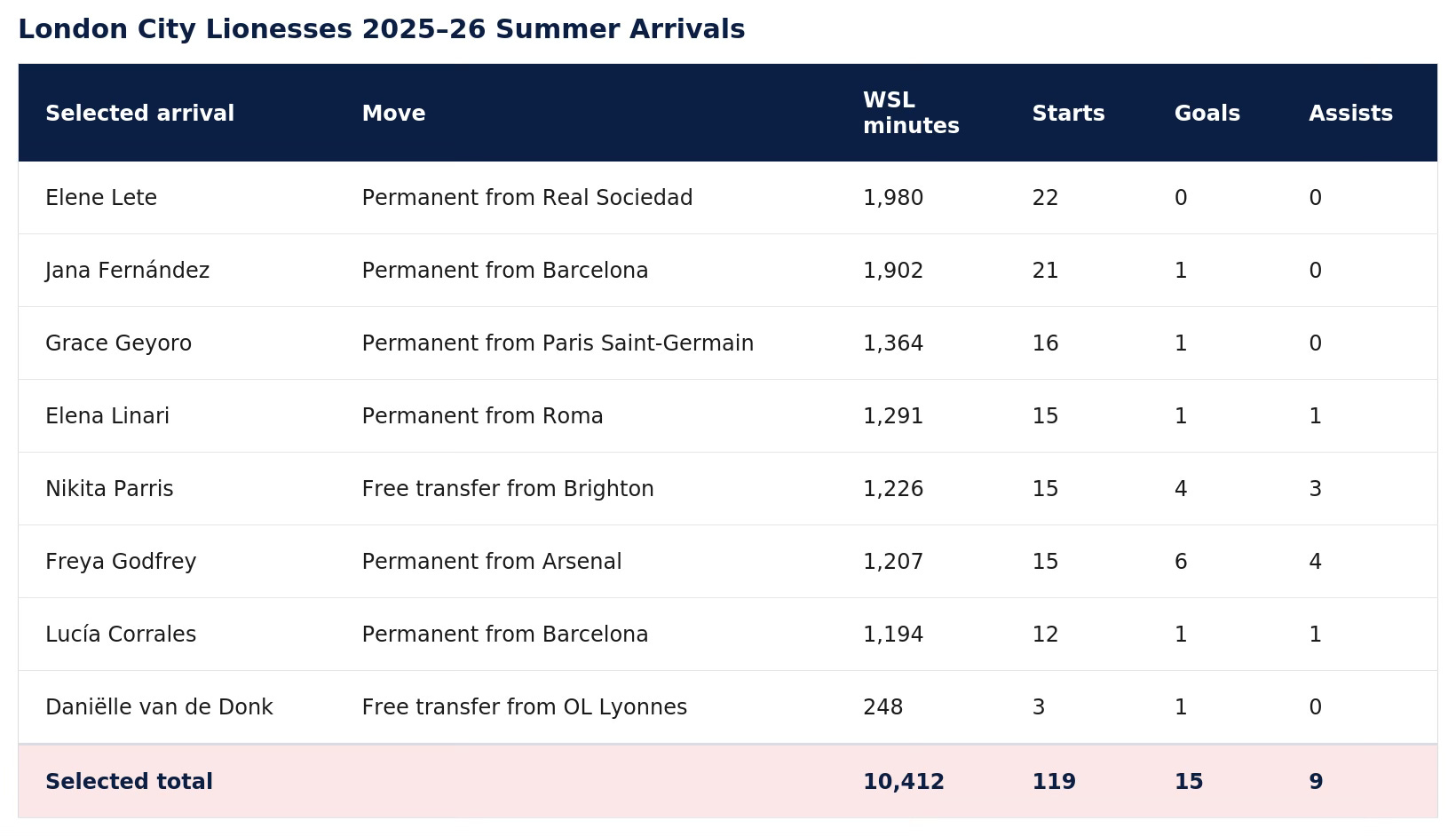
The summer window built the platform
Not every high-profile arrival met expectations, but the class collectively gave London City enough quality and depth to compete immediately in the WSL.
London City were already sixth when the coaching change was made, with little jeopardy surrounding their position. The change therefore cannot be credited with producing the top-half finish, and the subsequent results did not establish a clear immediate upgrade. It appeared to be a decision made with the club’s next stage in mind. The core of the team that finished sixth had already been assembled during the summer.

Our final verdict:
London City’s summer recruitment worked: it built the core of a promoted side that finished sixth in its first WSL season. Not every high-profile arrival met expectations, but the defensive foundation, depth and attacking output confirmed our verdict that the squad had been strengthened decisively.
Manchester City — limited transfer impact, title-winning season
Our original verdict: Weakened
Retrospective grade: Overturned decisively
Window score: 4.0/5
Our argument at the time was that Manchester City had exchanged proven, prime-age WSL performers for younger players with less certain immediate output. Chloe Kelly, Jill Roord and Laia Aleixandri had departed, leaving the squad with significant experience and production to replace.
At the time of publication, the deadline-day exchange involving Jess Park and Grace Clinton had not yet happened, so it was not included in our original analysis. Because this retrospective assesses the completed window, both moves are considered here.
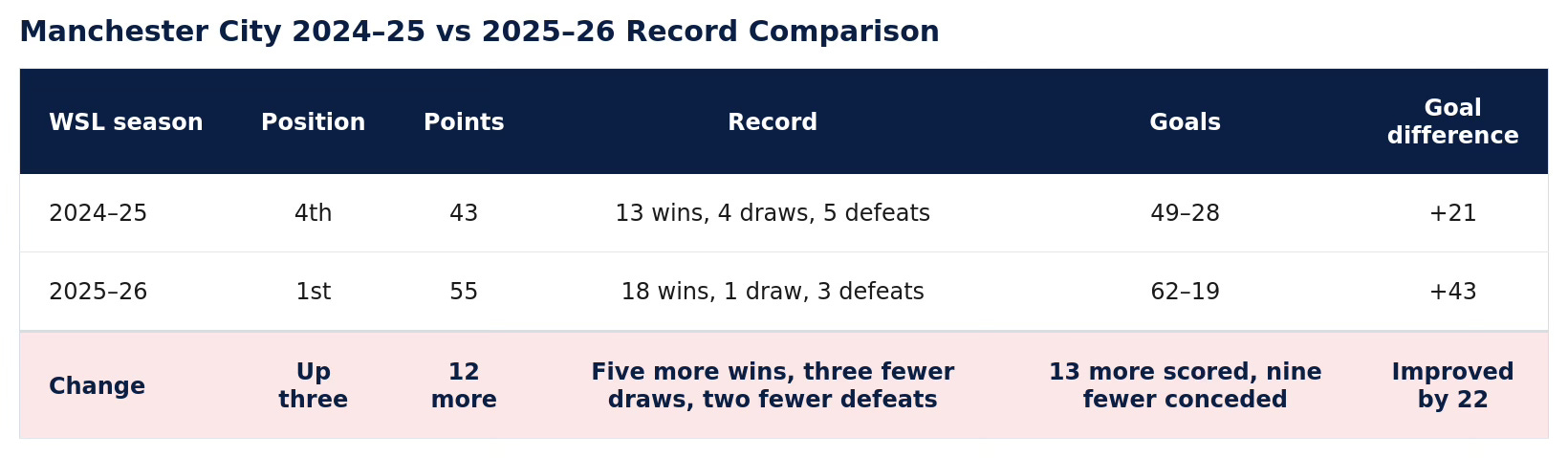
One season later, the team improved far more than the transfer class did.
City rose from fourth to first, collected 12 more points, scored 13 more goals and conceded nine fewer. They finished on 55 points, ended Chelsea’s six-year title run and equalled their highest WSL points total.
Jade Rose was the standout arrival, starting 19 matches and scoring once in a title-winning defence. Iman Beney contributed two goals and two assists from a rotation role, but the remaining four additions made only four league starts between them. Altogether, the six arrivals produced 2,868 minutes, 28 starts, four goals and four assists.
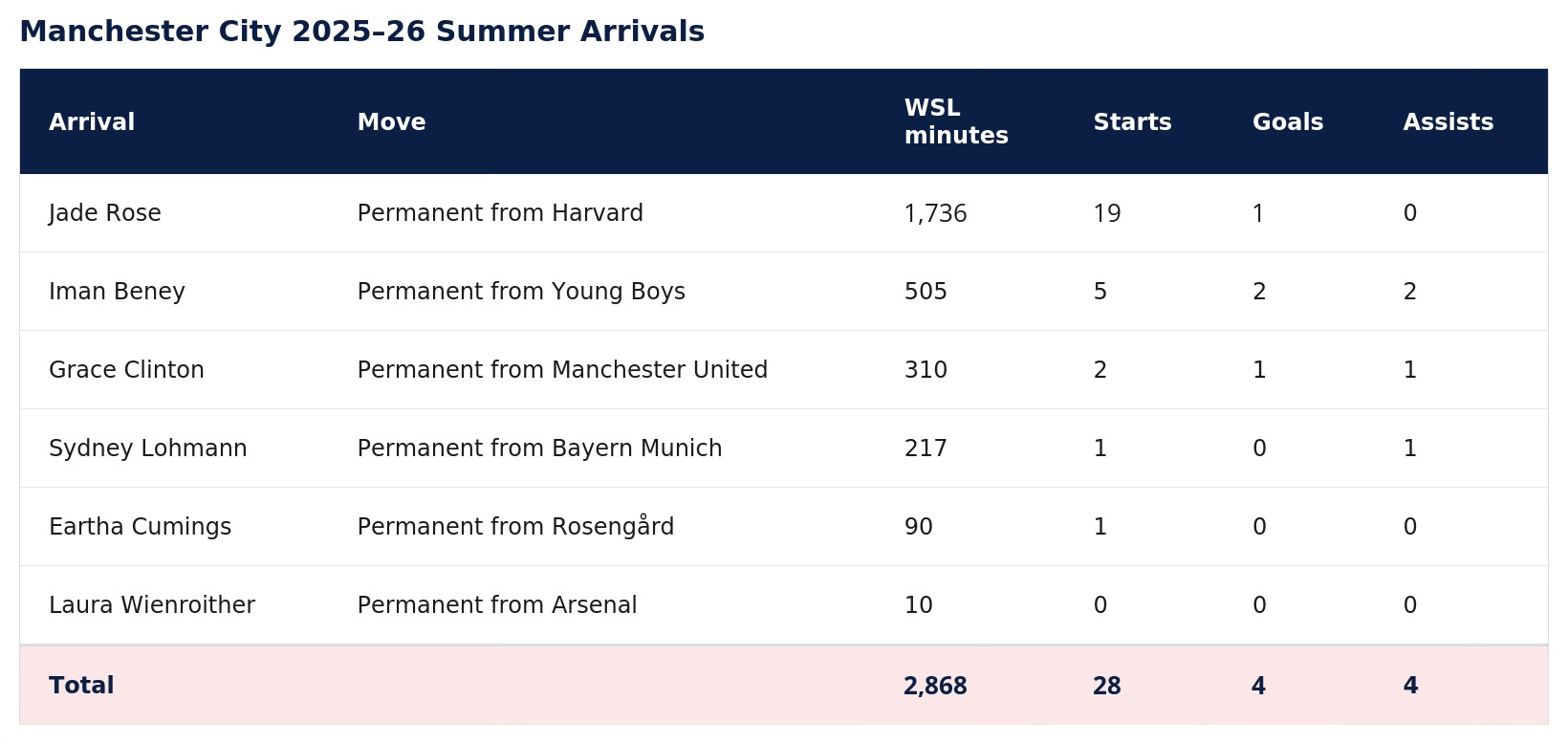
City’s improvement extended beyond the transfer window
Our original framework placed too much weight on the exchange of summer arrivals and departures without giving enough consideration to the quality that remained.
Andrée Jeglertz changed the team’s style and restored consistency. City also had no Champions League schedule, while Bunny Shaw and the retained core supplied most of the title-winning output. The team became less possession-heavy, more direct and considerably more efficient.
The title therefore overturns our judgment that City had become weaker, but it does not mean every concern about the window disappeared. The Park–Clinton exchange delivered far more immediate league output to Manchester United, while most of City’s other additions played limited roles.
Our final verdict:
Manchester City became champions, decisively overturning our verdict that the squad had weakened. Rose was an excellent first-team addition, but the largest improvement came from the coach, the retained core and a lighter schedule rather than widespread impact from the summer arrivals.
The overall verdict on Part 3
Two original judgments survived, one was only partly right and one was overturned.
Liverpool lost the attacking authority we feared they would miss. London City’s ambition translated into an immediate top-half finish. Everton stood still, but their arrivals were considerably better than our original warning implied. Manchester City became champions after we called their window weaker.
The lesson is not that transfer analysis is futile. It is that a window must be judged alongside the quality already in the squad, the role available to each signing, the coach and the schedule the team will face.
Our next transfer analysis will still make direct judgments. But it will distinguish more clearly between a club’s recruitment, the total strength of its squad and the conditions in which that squad must perform.
Catch up on the series
If you missed the earlier instalments:
Part 1 revisited our judgments that Arsenal had strengthened, Brighton had gambled, Aston Villa were transitioning and Leicester City had weakened.
Part 2 examined Chelsea’s re-tooling, Manchester United’s limited strengthening and our warnings that Tottenham Hotspur and West Ham United had weakened.
If you enjoyed this retrospective, please consider subscribing to WSL Analytics and sharing the series with other women’s football supporters.
From next week, we will begin publishing our 2026–27 season predictions. Once the transfer window closes, we will follow them with our new summer transfer analysis, using the lessons from this retrospective to make sharper, better-supported judgments about every club.