


Welcome to Part 3, the final instalment of our 2026–27 WSL summer transfer analysis. In Part 1, we examined Arsenal, Liverpool, Crystal Palace, Tottenham Hotspur and Manchester United. Part 2 turned to West Ham United, Aston Villa, Everton, Birmingham City and Charlton Athletic. We complete the series with Chelsea, Manchester City, Brighton & Hove Albion and London City Lionesses — four clubs with different ambitions: reclaiming the title, building on a domestic double, turning defensive progress into attacking improvement, and pushing higher after a promising first WSL season.
The framework is unchanged. We begin with each club’s 2025–26 baseline, assess what departures have removed from it, then examine whether the arrivals have addressed the resulting needs. The result is two judgments: a window verdict on the quality of the summer business, and a squad impact verdict on whether the team is now stronger, weaker or broadly unchanged.
🔵 Chelsea
The baseline
Chelsea entered the summer after a season that was successful by most standards but represented a clear step backwards by theirs. They finished third on 49 points, six behind champions Manchester City, after scoring 44 league goals and conceding 20. Champions League qualification and a successful League Cup defence confirmed that Chelsea remained an elite side, but their six-year WSL title run had ended.
Their summer task was therefore not to rebuild a failing team. They needed to restore the attacking reliability that had deserted them, close the gap to City and preserve one of the league’s strongest defensive foundations. For a club of Chelsea’s pedigree, remaining inside the top three was not enough; the window had to create a squad capable of returning to the title.
What Chelsea lost before they could improve
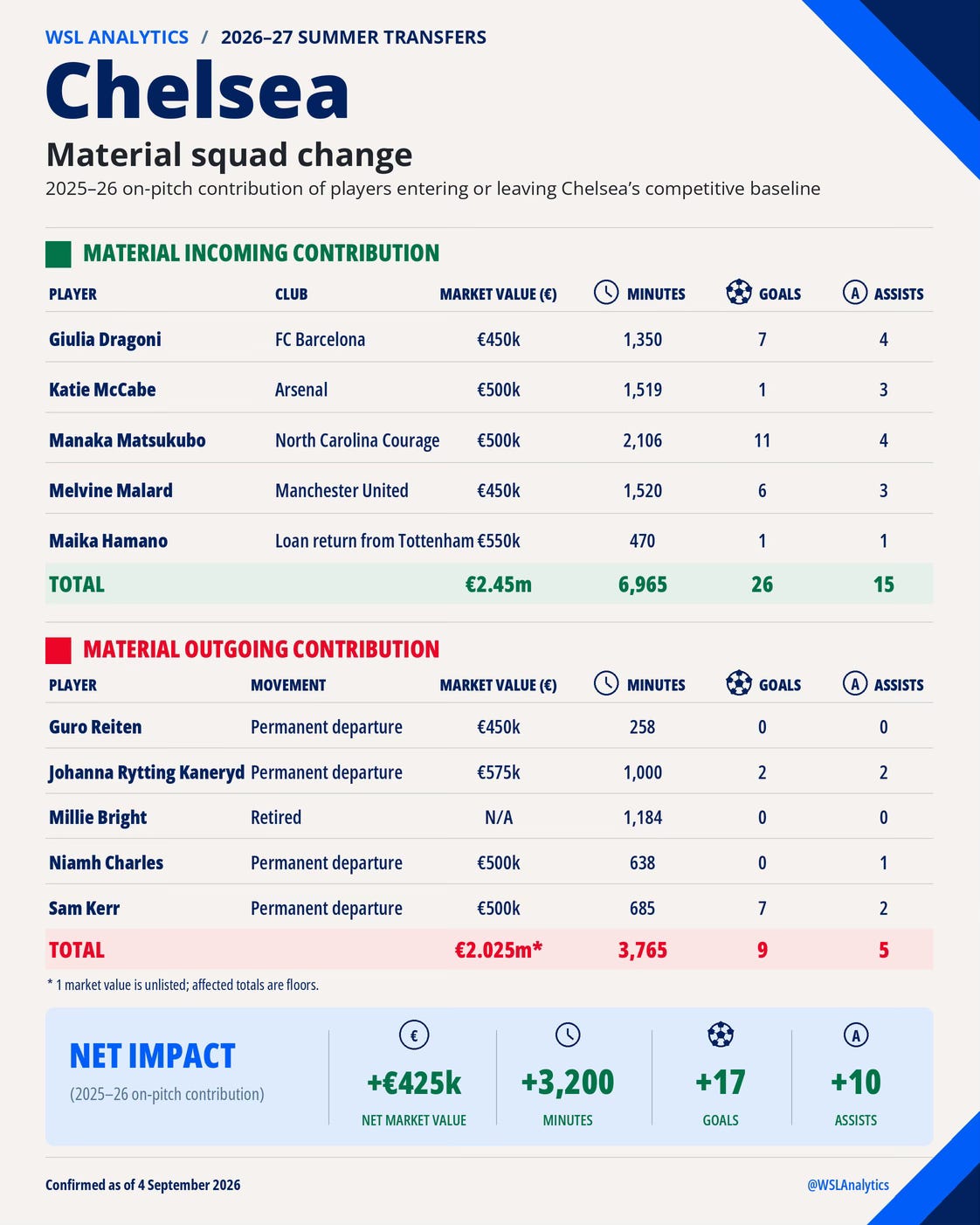
Chelsea’s material outgoing group accounted for 3,780 league minutes and 14 goal involvements. Sam Kerr was the defining loss: seven goals and two assists in only 695 minutes. Her 0.91 goals per 90 showed that, even after returning from a long injury absence, she remained Chelsea’s most efficient penalty-box finisher.
The departures also removed experience across the spine and wide areas. Millie Bright contributed 1,185 minutes and the captaincy, while Johanna Rytting Kaneryd supplied 1,001 minutes, two goals and two assists. Niamh Charles added 636 minutes of left-sided versatility, and Guro Reiten’s limited 263-minute season understates her longer-term importance.
Chelsea therefore had several different problems to solve. They needed to replace Kerr’s decisive finishing, replace Kaneryd’s wide attacking output, cover Charles at left-back and redistribute Bright’s defensive workload without weakening a back line that conceded only 20 goals. Just as importantly, they had to replace the leadership and big-match authority carried by Kerr, Bright and Reiten—qualities that cannot be captured by minutes alone.
Did Chelsea solve the problems?
Chelsea responded to their attacking decline with volume and variety. Manaka Matsukubo, Melvine Malard and Giulia Dragoni combined for 4,977 recent league minutes, 24 goals and 11 assists. Matsukubo arrives after 11 goals and four assists in the NWSL, while Dragoni contributed seven goals and four assists in Serie A. Malard provides the most direct centre-forward response with six WSL goals, but she does not automatically replace Kerr’s elite finishing.
Katie McCabe is the clearest positional solution. Her 1,522 Arsenal minutes give Chelsea an experienced, proven left-sided replacement for Niamh Charles. The centre-back question is less direct: Chelsea have not signed a successor to Millie Bright, instead trusting Naomi Girma, Nathalie Björn, Kadeisha Buchanan and Veerle Buurman to absorb the defensive workload. That may preserve the playing level, but Bright’s leadership remains harder to replace.
Across the incoming group, Chelsea have added €2.45m in current market value, 6,965 recent league minutes, 26 goals and 15 assists, including Maika Hamano’s return from her Tottenham loan. Combined with the attacking quality already retained, the window gives them more routes to create and score while protecting the left side of the defence. Chelsea have strengthened the squad and addressed several of last season’s weaknesses, but the two hardest questions remain unresolved: whether the new attack can replace Kerr’s scoring efficiency and whether the existing defensive group can replace the authority that left with Bright. The window gives them a route back to the title, rather than compelling evidence that the gap has been closed.
Verdict
➡️ Window verdict: Qualified Positive
Squad impact: Strengthened in attack; leadership weakened
Chelsea have added the attacking variety last season lacked. Matsukubo, Malard and Dragoni bring current production, while McCabe directly reinforces the left side. But Kerr’s finishing and Bright’s captaincy have not been replaced like for like, leaving important responsibility with the existing squad. The footballing options are stronger; whether that is enough to close the title gap will depend on finishing efficiency and how quickly a new leadership core emerges.
🔵 Manchester City
The baseline
Manchester City entered the summer as WSL champions and FA Cup winners after a very strong domestic season. They finished first on 55 points, four ahead of Arsenal, while scoring a league-high 62 goals and conceding only 19. This was not a squad requiring reconstruction; it was the standard every other contender was trying to reach.
City’s task was to protect that championship-winning core while preparing for the additional demands of Champions League football. With the league’s most productive attack and a defence that conceded only 19 goals, there was little need for major structural change. The priority was to preserve that balance while ensuring the squad had sufficient quality and depth to compete across multiple fronts.
What Manchester City lost before they could improve
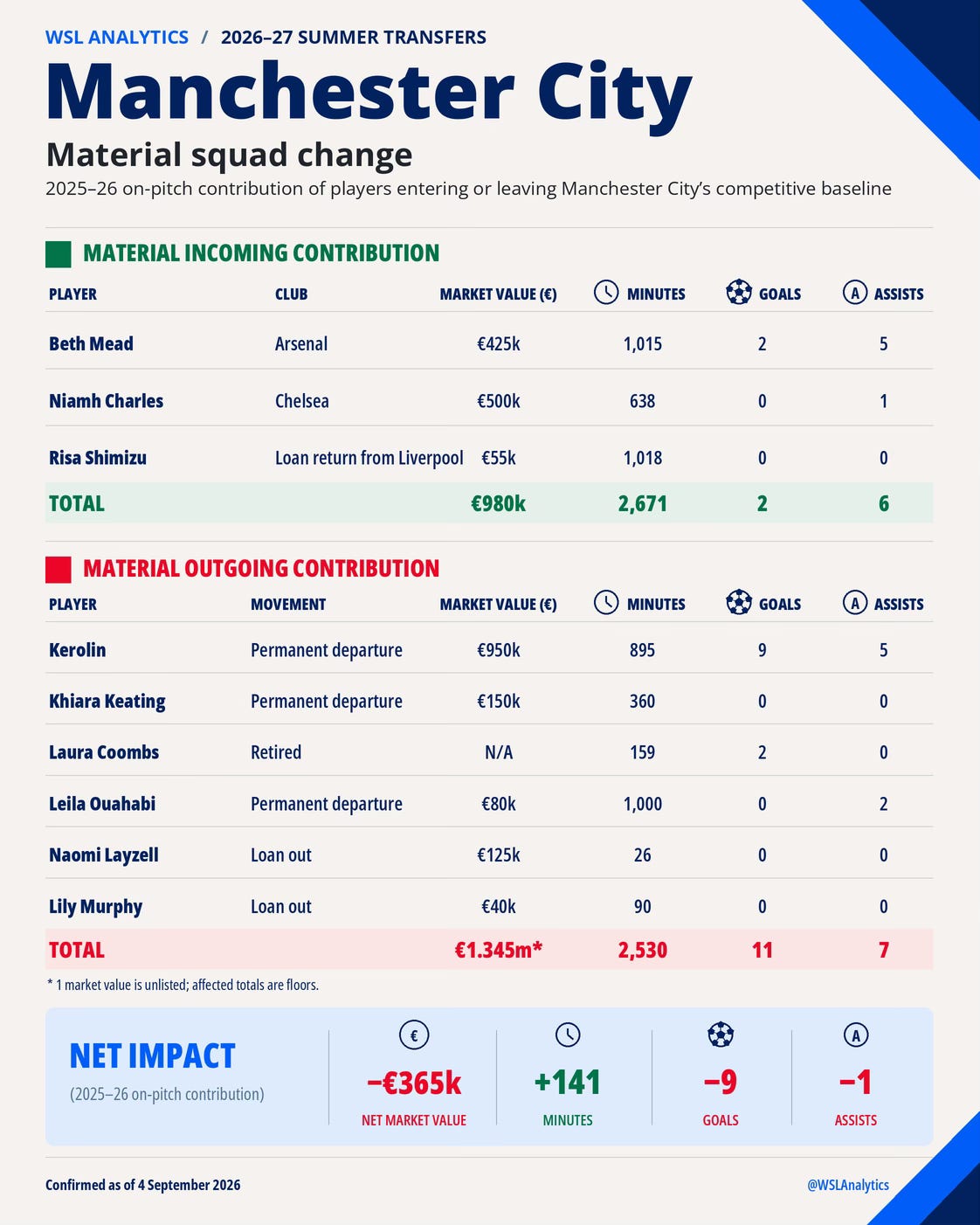
City’s outgoing group accounted for 2,530 league minutes, 11 goals and seven assists. Kerolin is the defining attacking loss: nine goals and five assists in just 895 minutes, equivalent to a goal involvement every 64 minutes. Her departure removes a wide forward whose speed, direct running and finishing gave City another way to decide matches.
The other departures affect cover and experience across the squad. Leila Ouahabi contributed 1,000 minutes and two assists at left-back, while Khiara Keating supplied 360 minutes in goal. Laura Coombs scored twice in 159 minutes, although her retirement also removes experience that her limited recent workload cannot capture. Naomi Layzell’s loan to Everton takes away a further 26 minutes of defensive contribution, while Lily Murphy’s loan to Aston Villa removes 90 minutes of attacking rotation.
City therefore needed to replace decisive wide production, restore depth at left-back and maintain sufficient goalkeeper and midfield cover for a heavier schedule.
Did Manchester City solve the problems?
Beth Mead adds WSL experience, creative delivery and intelligent movement to City’s wide options. She offers a different profile from Kerolin, whose speed and direct running gave the champions a particular attacking threat. Mead contributed two goals and five assists in 1,015 league minutes, compared with Kerolin’s 14 goal involvements. Her arrival gives City another way to supply Shaw and combine with Miedema, but Kerolin’s individual threat and recent production have not been fully replaced. For Mead to close that gap herself, she would need to produce at a level she has not reached in recent seasons.
Niamh Charles addresses the vacancy left by Ouahabi, bringing 638 recent league minutes, while Risa Shimizu’s return from Liverpool adds another 1,018 minutes of recent defensive workload and strengthens the full-back options. Together they improve City’s capacity to cover both flanks. The goalkeeper and midfield questions remain with the existing squad, which must absorb Keating’s workload and the experience lost through Coombs’s retirement.
Across the incoming group, City have added 2,671 league minutes, two goals and six assists. That leaves them 141 minutes up, but nine goals and one assist down on the departing contribution. City have addressed the full-back positions and added an experienced attacking option, but their business does not resolve every problem raised by the departures. With the title-winning core still in place, they have the quality to absorb some of those losses internally; the uncertainty is whether enough of Kerolin’s production and direct threat can be replaced while carrying the additional demands of Champions League football.
Verdict
➡️ Window verdict: Neutral
Squad impact: Largely unchanged; attacking threat slightly weakened
City protected the core of their championship-winning squad and strengthened their full-back options, but the window does not clearly leave them stronger. Mead adds experience and creativity, yet Kerolin’s direct threat and recent production have not been fully replaced. The champions remain formidable, but they appear to have fallen short of the window’s wider task: strengthening a title-winning squad for the additional demands of Champions League football.
🔵 Brighton & Hove Albion
The baseline
Brighton entered the summer after a season of mixed progress. They finished seventh on 26 points, two places and two points below the previous campaign, but reached their first Women’s FA Cup final. Their defensive improvement was substantial: league goals conceded fell from 41 to 28, helped by Chiamaka Nnadozie and Moeka Minami. But their goals scored dropped from 35 to 27.
The summer task was to build on that defensive progress while restoring creativity and spreading the scoring responsibility. Kiko Seike’s eight league goals gave Brighton a reliable attacking reference, but they needed more support around her and greater consistency in supplying chances. The priority was therefore to preserve Brighton’s improved defensive platform while building an attack capable of making it count at the other end.
What Brighton lost before they could improve
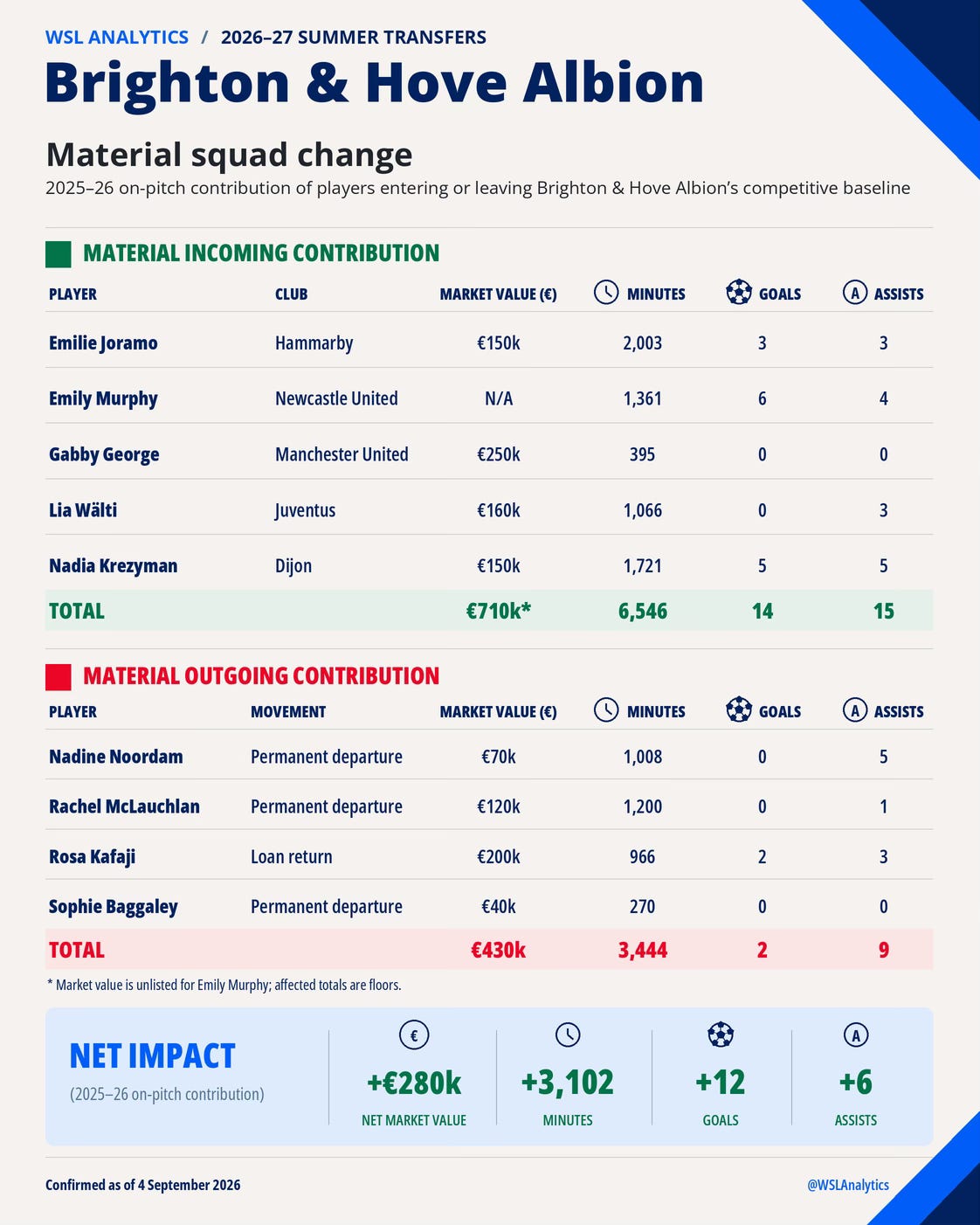
Brighton’s outgoing group accounted for 3,444 league minutes, two goals and nine assists. The central loss is creativity: Nadine Noordam contributed five assists in 1,008 minutes, while Rosa Kafaji’s loan spell produced two goals and three assists in 966 minutes. For a team that scored only 27 league goals, losing those ten combined goal involvements creates an immediate challenge.
Rachel McLauchlan’s departure removes 1,200 minutes and one assist, along with the versatility to cover both defensive flanks. Her workload matters to a side seeking to preserve its defensive improvement. Sophie Baggaley contributed another 270 minutes in goal; her exit changes the cover behind Nnadozie.
Brighton therefore had two connected tasks: rebuild the creative contribution lost through Noordam and Kafaji, and replace dependable defensive cover without weakening their foundation. The attacking requirement was especially demanding. Matching the departing production would only restore what Brighton already had; moving beyond seventh required the new group to offer more.
Did Brighton solve the problems?
Lia Wälti and Emilie Joramo give Brighton a different midfield balance. Wälti brings experience, composure and the ability to organise possession, while Joramo adds ball-winning and carrying. Their combined 3,069 recent league minutes and six assists provide evidence of regular involvement. Neither could be treated as a direct replacement for Noordam’s five assists; the stronger case is that they can improve how Brighton recover the ball, progress it and sustain attacks.
Nadia Krezyman and Emily Murphy address the need for more attacking support around Seike. Krezyman supplied five goals and five assists for Dijon, while Murphy contributed six goals and four assists for Newcastle. Those 20 goal involvements offer a credible route to replacing Kafaji’s contribution and spreading responsibility, but both must translate that output into the WSL. At the back, Gabby George adds experience and positional flexibility, although her 395 league minutes at Manchester United leave a substantial recent workload gap against McLauchlan’s 1,200.
Across the five incoming outfield players, Brighton have added 6,546 recent league minutes, 14 goals and 15 assists. The recruitment addresses the right areas: midfield control, attacking variety and defensive cover. It also brings substantially more recent attacking production than the departing group, although that comparison spans different leagues and season structures. Brighton have therefore done more than simply replace what they lost and have given themselves a credible route to improvement. The remaining question is whether the new attackers can translate their production into the WSL.
Verdict
➡️ Window verdict: Positive
Squad impact: Strengthened in midfield and attacking options; defensive depth less certain
Brighton have recruited with a clear purpose. Wälti and Joramo offer greater midfield control and variety, while Krezyman and Murphy give Seike more attacking support. George brings defensive experience. The window provides a credible route beyond last season’s limitations; the next step depends on translating production from other leagues into consistent WSL contributions and George providing the dependable defensive workload lost with McLauchlan.
🔵 London City Lionesses
The baseline
London City Lionesses entered the summer after finishing sixth on 27 points in their first WSL campaign. Eight wins established them in the top half, with their ambitious recruitment supplying the experience and quality needed to compete immediately. But 28 goals scored and 35 conceded also showed the distance still to travel: London City had established themselves at this level without yet matching the league’s leading sides.
The summer task was to turn that promising foundation into a team capable of challenging higher up the table. They needed greater attacking consistency and a stronger defensive platform, with enough additional quality across the squad to narrow the gap to the teams above them. The challenge was no longer simply to establish London City in the WSL, but to build on sixth place and make further progress.
What London City lost before they could improve
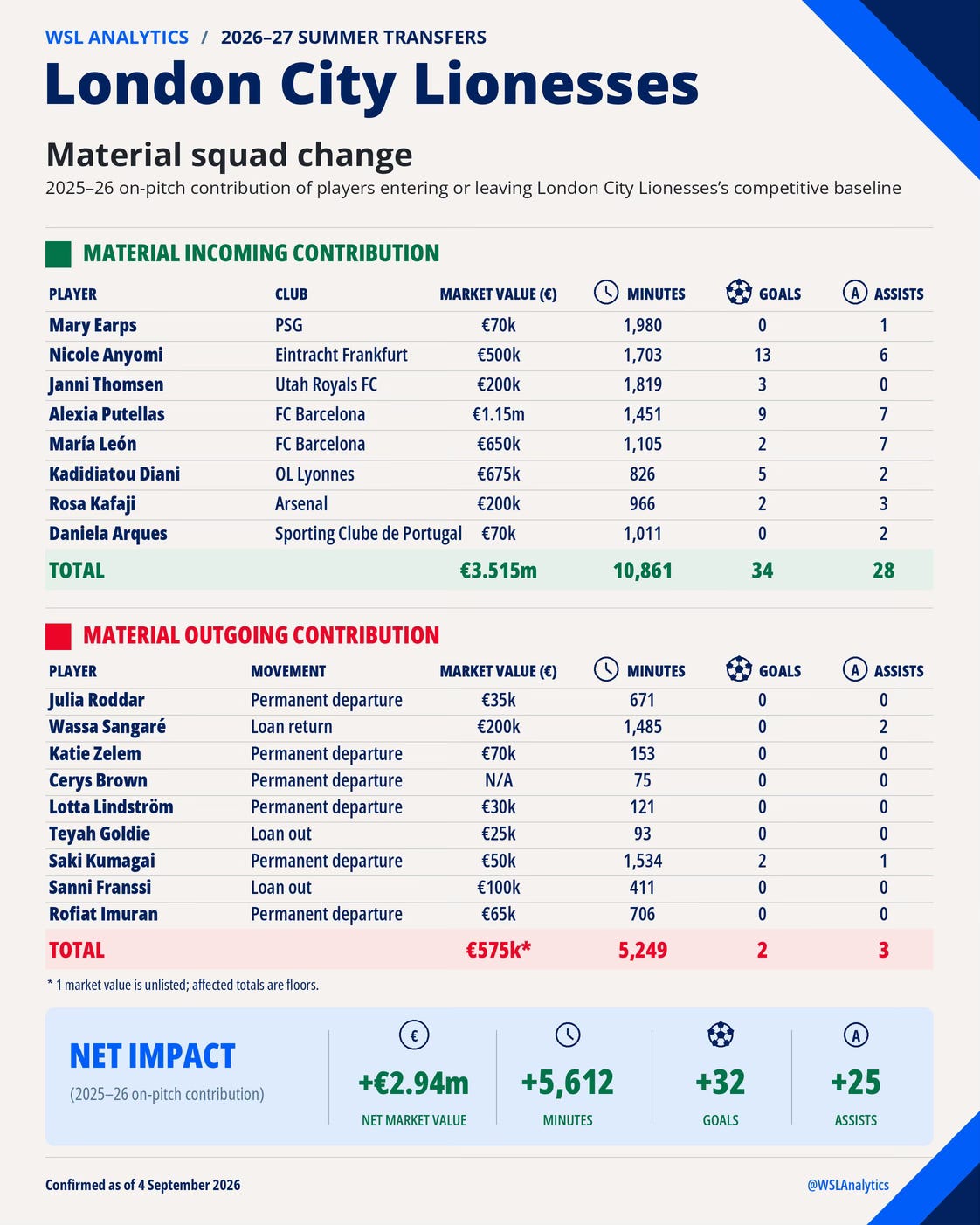
London City’s outgoing group accounted for 5,249 league minutes, two goals and three assists. The largest losses were concentrated in defence. Saki Kumagai contributed 1,534 minutes, 18 starts, two goals and one assist before joining West Ham, while Wassa Sangaré supplied 1,485 minutes, 17 starts and two assists before returning to OL Lyonnes at the end of her loan. Rofiat Imuran’s move to Aston Villa removed another 706 minutes and nine starts at left-back.
Julia Roddar contributed 671 minutes of midfield cover, while Katie Zelem’s London City contribution was limited to 153 minutes before her January loan to West Ham became permanent. Sanni Franssi’s Sunderland loan removed another 411 minutes of attacking rotation. Cerys Brown, Lotta Lindström and Teyah Goldie supplied 289 minutes between them. Those exits reduced options across the squad, although the principal attacking contributors remained.
The summer task was therefore to replace significant defensive workload and maintain reliable cover while building beyond the existing attacking level.
Did London City solve the problems?
Alexia Putellas, Nicole Anyomi and Kadidiatou Diani substantially expand London City’s attacking options. They bring 27 goals and 15 assists from their recent league campaigns, with Anyomi alone contributing 13 goals and six assists for Eintracht Frankfurt. Rosa Kafaji adds another two goals and three assists from her Brighton loan. That is considerable production entering a squad whose outgoing group contributed only two league goals, although the challenge is to combine their different strengths with Godfrey, Goodwin and the retained creators in a coherent attack.
María León addresses the central defensive need and offers a route to improving how London City build from defence. Janni Thomsen adds experience and workload at full-back, while Daniela Arques provides another midfield option. Those additions help replenish the defensive and midfield depth lost over the summer, although Imuran’s departure also leaves left-back workload to be absorbed by the retained options. Mary Earps strengthens the goalkeeping group, joining a position where Elene Lete already played every league minute last season. Her arrival adds competition and depth rather than filling a hole left by an outgoing starter.
Across the incoming group, London City have added 10,861 recent league minutes, 34 goals and 28 assists. Against the departing contribution, that represents a net increase of 5,612 minutes, 32 goals and 25 assists. The recruitment supports a substantial improvement in quality and options, even allowing for differences between leagues. London City have recruited far beyond the attacking production that departed and added quality across the defensive and midfield areas. The remaining test is whether the new arrivals and established performers can form a coherent, balanced side.
Verdict
➡️ Window verdict: Strongly Positive
Squad impact: Strengthened substantially; balance and integration remain the test
London City have added substantial quality while retaining their principal attacking contributors. Putellas, Anyomi, Diani and Kafaji raise the attacking possibilities, while León strengthens their central defensive options. The scale and quality of the recruitment provide a credible platform to challenge beyond last season’s sixth place. The task now is to turn those individual upgrades into a balanced side, with clear roles and enough continuity for the collective improvement to translate into progress up the table.
Data sources
Transfers were reconciled from club announcements, destination-club confirmations and reputable football reporting. Previous-season league minutes, goals and assists were compiled from provider and competition records; league tables and team baselines come from completed 2025–26 match results. For players arriving from calendar-year competitions, such as the NWSL, we use the full 2025 league season rather than an incomplete 2026 sample. Where a player had already changed clubs before this transfer window, we credit only their production at the club they are actually arriving from, even if that spell is shorter than a full season, rather than reaching back to an earlier, non-contiguous club. Market values are Soccerdonna estimates captured on 4 September.
📅 What’s Next
This completes our 2026–27 WSL summer transfer analysis, covering all 14 clubs across three parts. At the end of the season, we’ll return to these verdicts in our transfer retrospective series, just as we did for last season’s window.
We’ll examine which signings delivered, whether the problems identified here were solved, and where our judgments held up or missed the mark.